How to Use the Plant Spacing Calculator
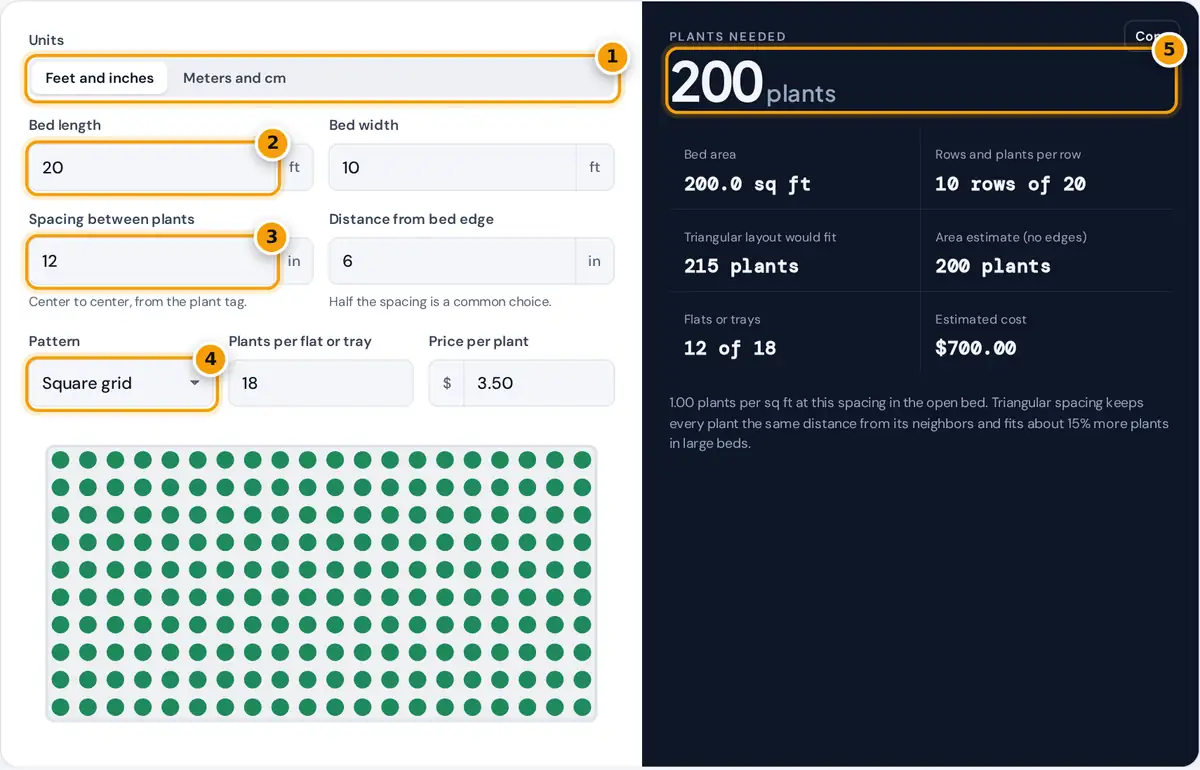
- Choose feet and inches or meters and centimeters.
- Enter the bed length and width.
- Enter the plant spacing and edge distance.
- Pick a square grid or triangular offset rows.
- Read the plant count, layout, flats and cost.
Choose feet and inches or meters and centimeters. Enter the length and width of the bed, then the spacing between plants from the plant tag or nursery listing. Spacing is measured from the center of one plant to the center of the next. Groundcovers may be spaced 6 to 12 in apart, perennials often 12 to 24 in and shrubs several feet.
Set the distance from the bed edge to the first row. Half the spacing is common, because each plant then has the same room on the edge side as between plants. Pick a square grid or a triangular pattern with offset rows, enter how many plants come in a flat or tray and the price per plant. The preview shows exactly where each plant goes.
Plant Spacing Formula
triangular: row spacing = s × √3 ÷ 2 = 0.866 × s, alternate rows shifted by s ÷ 2
open-area density: square = 1 ÷ s², triangular = 1.155 ÷ s²
L′ = length − 2 × edge distance, W′ = width − 2 × edge distance
In a triangular pattern every plant sits at the same distance from six neighbors, like the corners of equilateral triangles. The rows are only 0.866 times the spacing apart, so the same area holds about 15.5% more plants than a square grid. In narrow beds the shifted rows lose a plant at the end, so the exact count can be closer.
Worked Example: A Perennial Border
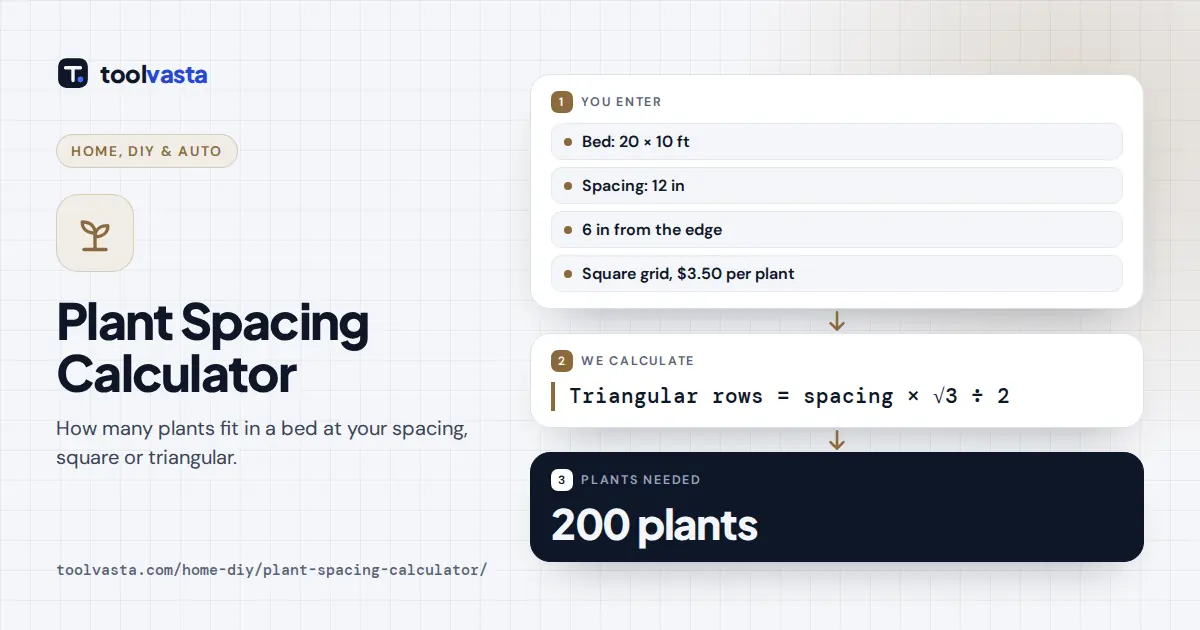
A border is 20 ft long and 10 ft wide, planted at 12 in spacing with the first plants 6 in from the edges. The planting area is 228 by 108 in between the outer plant centers. A square grid fits 228 ÷ 12 + 1 = 20 plants per row and 108 ÷ 12 + 1 = 10 rows, so 200 plants.
A triangular pattern uses rows 10.39 in apart, which fits 11 rows. Six rows hold 20 plants and the five offset rows hold 19, for 215 plants, or 7.5% more on this bed. At $3.50 per plant the square layout costs $700, and with 18 plants per flat you would buy 12 flats.
Plants per 100 Square Feet
| Spacing | Metric | Square grid | Triangular |
|---|---|---|---|
| 6 in | 15 cm | 400 | 462 |
| 8 in | 20 cm | 225 | 260 |
| 12 in | 30 cm | 100 | 115 |
| 18 in | 45 cm | 44 | 51 |
| 24 in | 60 cm | 25 | 29 |
| 36 in | 90 cm | 11 | 13 |
These are open-area densities with no edge effects, so they suit large plantings and groundcover. For a single bed the exact layout count from the calculator is more accurate.
For mixed plantings, work out each plant type separately using its own spacing and the part of the bed it will fill, then add the counts. Larger shrubs placed first set the frame, and smaller perennials and groundcovers fill the spaces between them.
Tips for Planting
- Use the mature spread of the plant, not its size in the pot, when choosing spacing.
- Closer spacing fills in faster but costs more and can crowd plants later. Wider spacing needs mulch to hold back weeds in the meantime.
- Mark the rows with string and a spacing stick cut to the plant distance before you dig.
- For a natural look, use the triangular pattern and vary the edge distance slightly.
Assumptions and Limits
The calculator assumes a rectangular bed and a single plant type at one spacing. Curved or irregular beds can be split into rectangles, or estimated with the area-based figure. Paths, stepping stones and existing trees reduce the count. Recommended spacing depends on the species, climate and soil, so follow local nursery advice.
Frequently asked questions
How many plants do I need for a garden bed?
Subtract the edge distance from each side, divide the remaining length and width by the spacing, add one to each and multiply. A 20 by 10 ft bed at 12 inch spacing with 6 inch edges holds 200 plants.
What is triangular plant spacing?
Triangular spacing offsets every other row by half the spacing and sets rows 0.866 times the spacing apart. Each plant is the same distance from its neighbors, and about 15% more plants fit in large areas.
How many plants per square foot at 12 inch spacing?
A square grid at 12 inch spacing gives one plant per square foot. A triangular pattern at the same spacing gives about 1.15 plants per square foot in an open area.
How far from the edge should I plant?
Half the plant spacing is a common edge distance, so each plant has equal room on every side. For plants that spill over the edge, you can reduce it slightly.
How do I convert plant spacing to plants per square meter?
Divide 10,000 by the spacing in centimeters squared for a square grid. At 30 cm spacing that is 10,000 divided by 900, about 11.1 plants per square meter.
Should groundcover be planted in a grid or triangle?
Groundcover is usually planted in a triangular pattern because it covers the soil more evenly and fills in faster with fewer gaps than a square grid at the same spacing.