How to Use the Wheel Offset Calculator
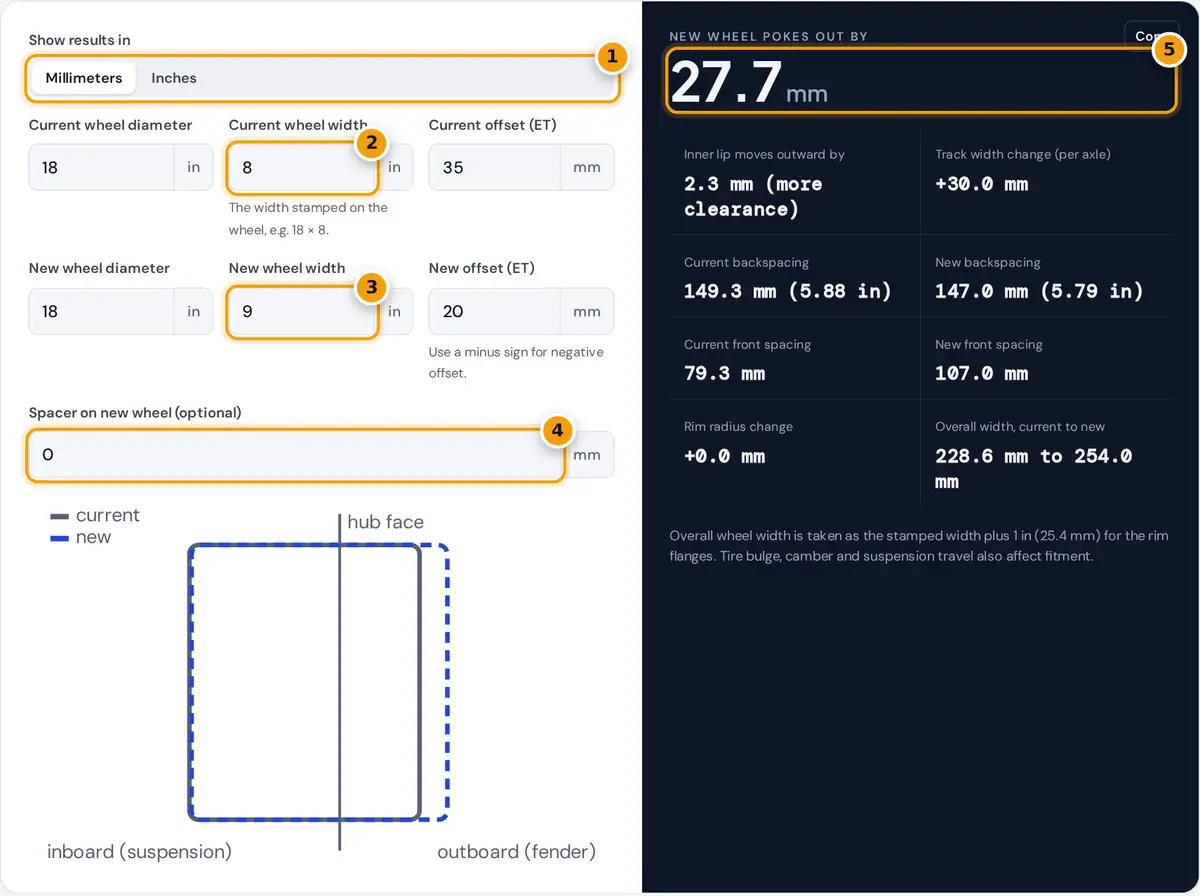
- Choose to show results in millimeters or inches.
- Enter the current wheel diameter, width and offset.
- Enter the new wheel diameter, width and offset.
- Add a spacer thickness if you plan to use one.
- Read the poke, inner clearance, track and backspacing.
Enter the diameter, width and offset of your current wheel, then the same three figures for the wheel you are considering. Width and diameter are stamped on the wheel, for example 18 × 8, and the offset is usually marked as ET followed by a number in millimeters, such as ET35. A negative offset, such as ET−12, is entered with a minus sign.
If you plan to run a spacer behind the new wheel, enter its thickness; a spacer reduces the effective offset by its own thickness. Choose whether to show results in millimeters or inches. The result shows how far the outer lip moves out toward the fender, how far the inner lip moves relative to the suspension, the change in track width and both backspacing figures.
Wheel Offset and Backspacing Formula
backspacing = overall width ÷ 2 + offset
front spacing = overall width − backspacing
poke change = new front spacing − current front spacing
inner clearance change = current backspacing − new backspacing
Offset is the distance from the wheel's centerline to its mounting face. Positive offset puts the mounting face toward the outside of the wheel, so the wheel sits further in. Backspacing is the distance from the mounting face to the inner lip. The stamped width is measured between the bead seats, and the rim flanges add about half an inch on each side.
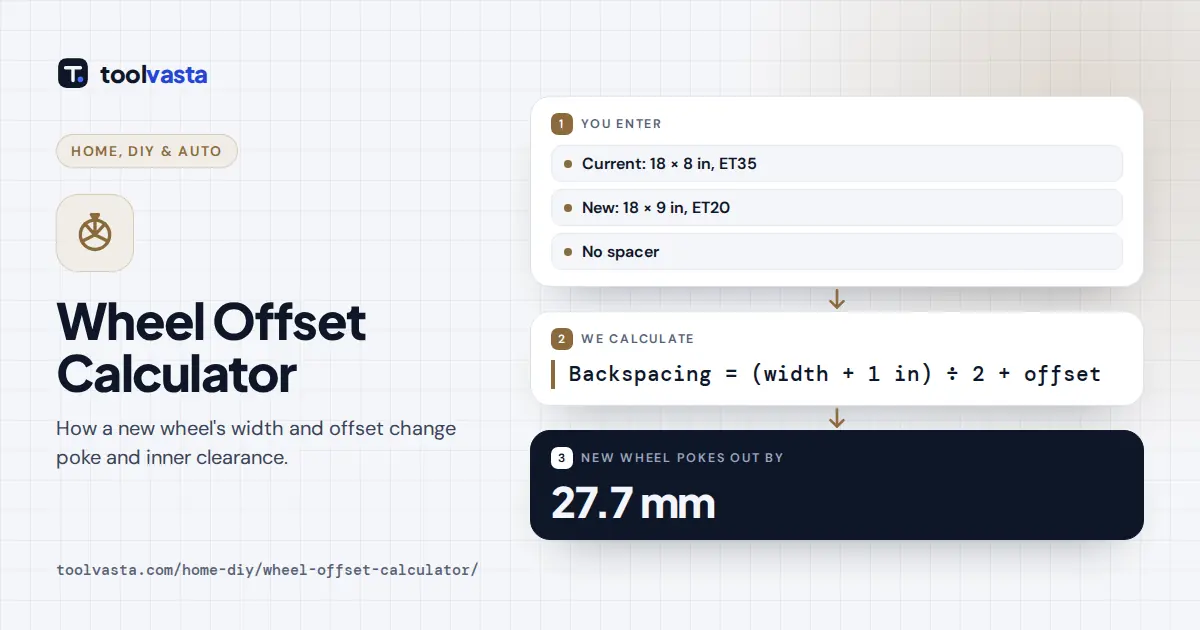
Worked Example: 18 × 8 ET35 to 18 × 9 ET20
The current wheel is 9 in (228.6 mm) wide overall. Its backspacing is 114.3 + 35 = 149.3 mm (5.88 in) and its front spacing is 79.3 mm. The new wheel is 10 in (254 mm) overall, so its backspacing is 127 + 20 = 147.0 mm (5.79 in) and its front spacing is 107.0 mm.
The new wheel pokes out 107.0 − 79.3 = 27.7 mm (1.09 in) further at the fender. Its inner lip actually moves 2.3 mm outward, away from the strut, because the lower offset pushes the whole wheel out by 15 mm while the extra width is split between both sides. The track widens by 30 mm across the axle.
How Width and Offset Changes Move the Wheel
| Change | Outer lip (poke) | Inner lip |
|---|---|---|
| Offset 10 mm lower, same width | 10 mm further out | 10 mm further from strut |
| Offset 10 mm higher, same width | 10 mm further in | 10 mm closer to strut |
| Width 1 in wider, same offset | 12.7 mm further out | 12.7 mm closer to strut |
| Width 1 in wider, offset 12.7 mm higher | No change | 25.4 mm closer to strut |
| 10 mm spacer added | 10 mm further out | 10 mm further from strut |
Each extra inch of width adds 12.7 mm on each side of the centerline, and offset shifts the whole wheel. Combining the two lets you keep the outer edge in the same place while using a wider wheel, at the cost of inner clearance.
Tips for Checking Fitment
- Measure the gap from your current tire to the strut, spring perch and fender before buying, then compare with the changes above.
- Tires bulge past the rim, so a wider or different tire changes clearance even with the same wheel.
- Check brake caliper clearance for a smaller diameter or different spoke design. Offset alone does not show it.
- Use hub-centric rings and the correct lug nuts or bolts for the new wheels, and torque them to the vehicle specification.
Assumptions and Limits
The calculator uses the common 1 in flange allowance; real overall widths vary slightly by wheel design. It compares positions only and does not check bolt pattern, center bore, load rating or local rules on wheels that stick out past the body. Confirm fitment with the wheel maker or a tire shop before driving.
Frequently asked questions
How do I convert wheel offset to backspacing?
Add 1 inch to the stamped width to get the overall width, halve it, then add the offset converted to inches. An 18 by 8 wheel at ET35 has about 4.5 plus 1.38, or 5.88 inches of backspacing.
What does wheel poke mean?
Poke is how far the outer edge of the wheel sits outward compared with another wheel or the fender. Lower offset or a wider wheel at the same offset increases poke.
Does a lower offset push the wheel out?
Yes. Lowering the offset by 10 mm moves the whole wheel 10 mm outward, so both the outer and inner lips move out by 10 mm and the track widens by 20 mm per axle.
What happens if I use a wider wheel with the same offset?
The extra width is split evenly. A wheel 1 inch wider with the same offset sticks out 12.7 mm more at the fender and sits 12.7 mm closer to the suspension.
Is positive or negative offset better?
Neither is better in general. Most modern cars use positive offset to suit their suspension design. Change offset only as far as the tire still clears the suspension, brakes and fenders.
How does a wheel spacer change offset?
A spacer moves the wheel outward by its thickness, which is the same as reducing the offset by that amount. A 10 mm spacer on an ET35 wheel behaves like ET25.