How to Use the Sod Calculator
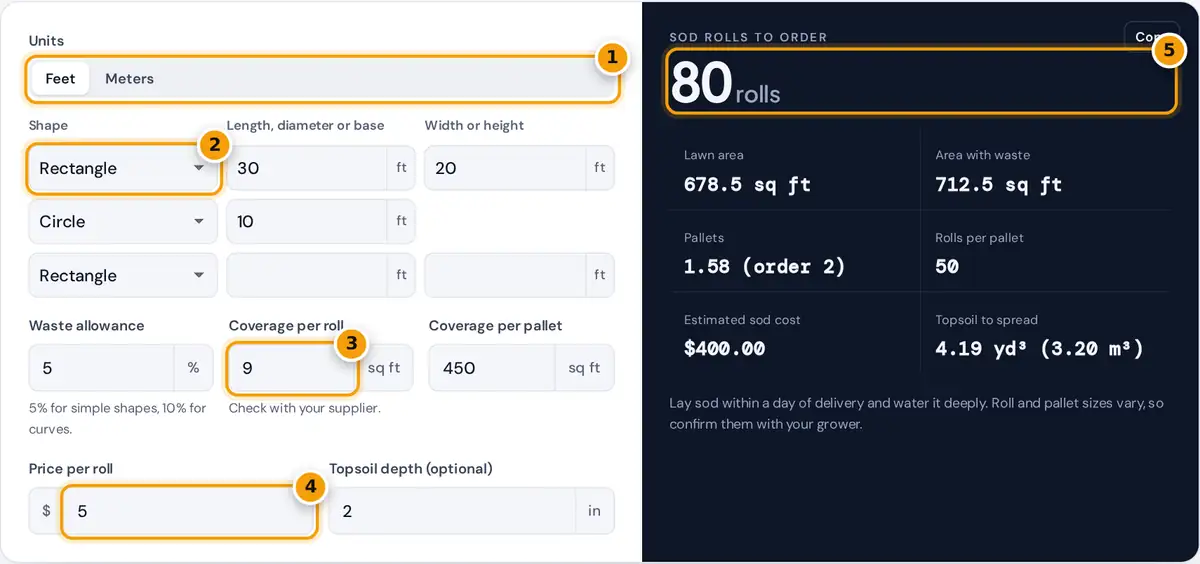
- Choose feet or meters.
- Describe each lawn area as a rectangle, circle or triangle and enter its size.
- Enter the coverage of one roll and of one pallet from your supplier.
- Add the price per roll and an optional topsoil depth.
- Read the rolls to order, then pallets, cost and topsoil.
Choose feet or meters, then describe your lawn as up to three simple shapes. For a rectangle enter the length and width, for a circle enter the diameter, and for a triangle enter the base and the height. Most lawns can be broken into a main rectangle plus a curved bed or a corner piece. Clear any row you do not need.
Set a waste allowance for cutting around edges, then enter the area one roll covers and the area per pallet from your sod grower. Roll sizes vary between suppliers and regions, so check before you order. Add a price per roll and an optional topsoil depth. The result lists the rolls, pallets, cost and the cubic yards or cubic meters of topsoil to spread first.
Sod Area Formula
area to order = total area × (1 + waste %)
rolls = round up (area to order ÷ area per roll)
pallets = area to order ÷ area per pallet
topsoil (cu ft) = lawn area × depth (in) ÷ 12
One square meter is 10.764 sq ft. A roll covering 9 sq ft is about 0.84 m². The topsoil volume uses the lawn area without waste, then converts to cubic yards (27 cu ft each) or cubic meters.
Worked Example: Lawn With a Round Bed Area
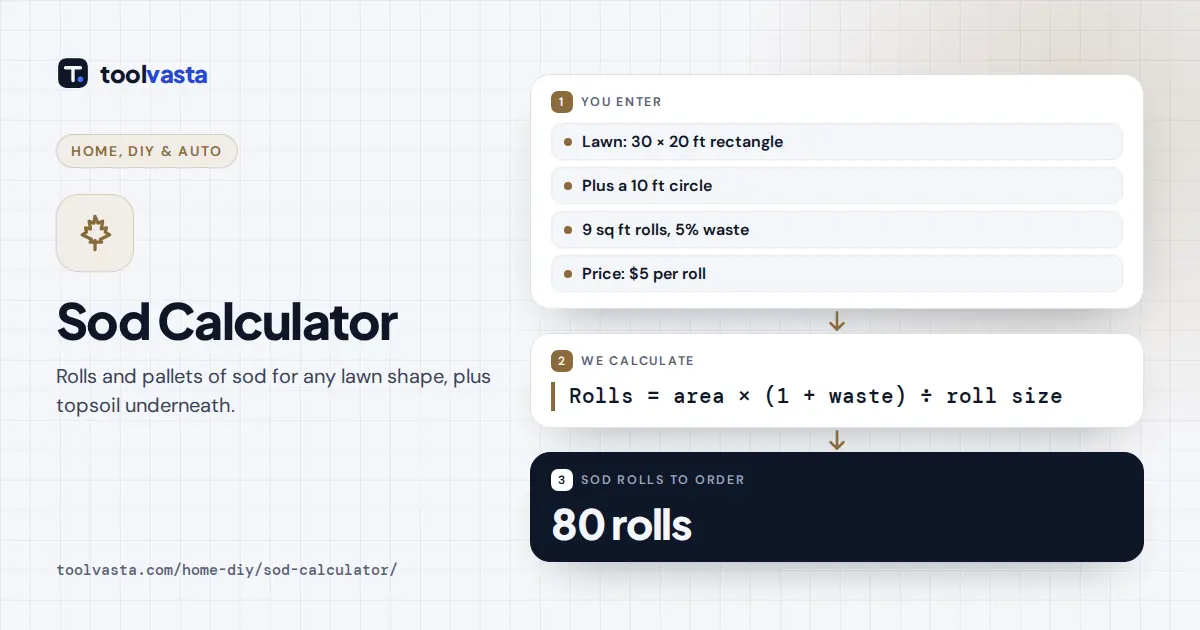
A back yard has a 30 by 20 ft lawn (600 sq ft) and a separate circular area 10 ft across (78.5 sq ft). The total is 678.5 sq ft, or 63.04 m². With 5% waste you need sod for 712.5 sq ft. At 9 sq ft per roll that is 79.2, so order 80 rolls. At $5 per roll the sod costs $400.
If a pallet covers 450 sq ft, the order is 1.58 pallets, so many growers would sell one full pallet plus loose rolls. Spreading 2 in of topsoil under 678.5 sq ft takes 113.1 cu ft, which is 4.19 cubic yards or 3.20 m³.
Lawn Size Quick Reference
| Lawn size | Area | Rolls at 9 sq ft (+5%) | Topsoil at 2 in |
|---|---|---|---|
| 10 × 10 ft | 100 sq ft (9.3 m²) | 12 | 0.62 yd³ |
| 20 × 20 ft | 400 sq ft (37.2 m²) | 47 | 2.47 yd³ |
| 30 × 20 ft | 600 sq ft (55.7 m²) | 70 | 3.70 yd³ |
| 40 × 25 ft | 1,000 sq ft (92.9 m²) | 117 | 6.17 yd³ |
| 50 × 40 ft | 2,000 sq ft (185.8 m²) | 234 | 12.35 yd³ |
Rolls are rounded up. Common roll sizes include about 9 sq ft in many Canadian markets and smaller slabs of about 2 to 3 sq ft elsewhere, so always enter your supplier's figure.
Tips for Laying Sod
- Prepare the soil first: remove old turf and weeds, loosen the ground, add topsoil where needed and rake it level, about an inch below paths and edging.
- Lay the first row along a straight edge such as a driveway, then stagger joints like brickwork.
- Butt edges tightly without overlapping, and cut pieces with a sharp knife around beds and curves.
- Water deeply right after laying, so the soil under the sod is moist, and keep it moist until the roots knit, usually two to three weeks.
- Avoid heavy traffic on new sod until it has rooted and you have mowed it a couple of times.
Assumptions and Limits
The calculator treats each area as a perfect shape on flat ground. Irregular lawns are best split into several rectangles and triangles. Slopes add a little surface area, and steep banks may need pegs. Pallet and roll coverage vary by grower, and the price is yours to enter, so the result is a planning estimate for your order.
Frequently asked questions
How much sod do I need?
Measure the lawn area, add 5 to 10% for cutting waste, then divide by the area one roll covers. A 678.5 sq ft lawn with 5% waste and 9 sq ft rolls needs 80 rolls.
How many square feet are in a roll of sod?
It varies by grower. Many Canadian suppliers sell rolls of about 9 sq ft, roughly 0.84 square meters, while some regions use smaller slabs of 2 to 3 sq ft.
How many rolls of sod are on a pallet?
A pallet often covers roughly 400 to 700 sq ft depending on the grower and roll size. Divide the pallet coverage by the roll coverage to get rolls per pallet.
How much topsoil do I need under sod?
Many installers spread 1 to 2 inches of good topsoil before laying sod on poor soil. For 678.5 sq ft at 2 inches, that is about 4.2 cubic yards.
How do I measure an irregular lawn for sod?
Break the lawn into rectangles, circles and triangles, measure each one and add the areas together. Add 10% waste for curved edges and many small cuts.
When is the best time to lay sod?
Cool, moist periods in spring and early fall are ideal in most of Canada and the northern US. Sod can be laid in summer with plenty of water.