How to Use the Sand Calculator
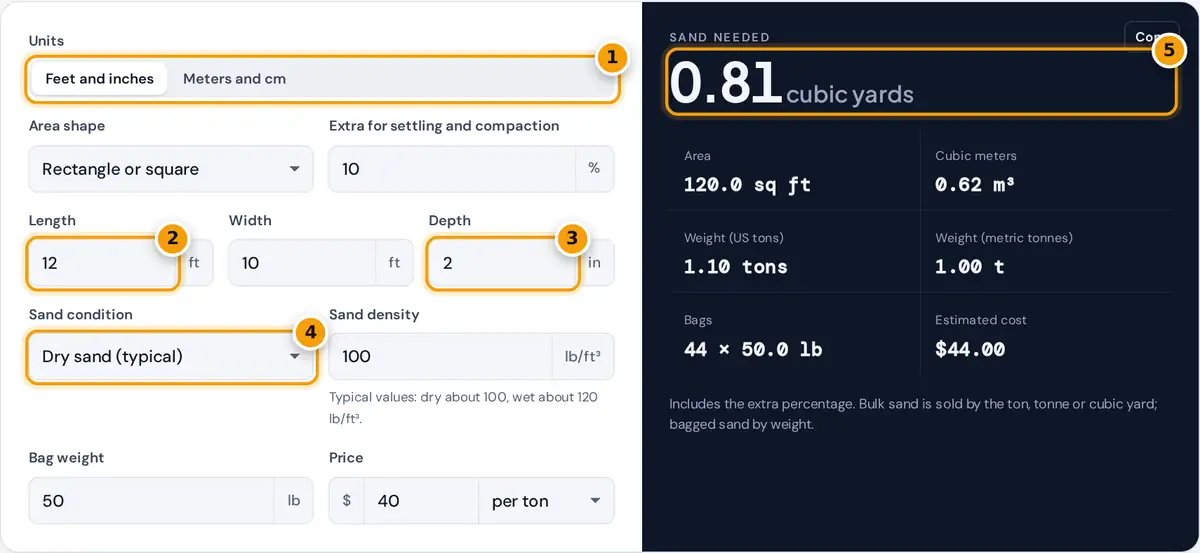
- Choose feet and inches or meters and centimeters.
- Enter the length and width, or pick a circle and enter the diameter.
- Enter the depth of sand you need.
- Pick dry or wet sand. A typical density fills in.
- Read the cubic yards, tons, bags and cost.
Choose feet and inches or meters and centimeters, then pick a rectangle or a circle. Enter the length and width, or the diameter for a round sandbox or fire pit surround, and the depth of sand you want. A paver bedding layer is usually about 1 in (2.5 cm) of screeded sand, while a sandbox is often filled 6 to 12 in deep.
Pick the sand condition. Dry sand is lighter than damp sand because water fills the spaces between the grains, so the same volume weighs more after rain. The density field fills with a typical value that you can replace with your supplier's figure. Enter the bag weight if you are buying bagged play sand or all-purpose sand, and your price per ton, per cubic yard or per bag.
Sand Volume and Weight Formula
volume (ft³) = area (sq ft) × depth (in) ÷ 12 × (1 + extra %)
cubic yards = ft³ ÷ 27 m³ = ft³ × 0.0283168
weight (lb) = volume (ft³) × density (lb/ft³)
bags = round up (weight ÷ bag weight)
Typical planning densities are about 100 lb/ft³ (1,600 kg/m³) for dry sand and about 120 lb/ft³ (1,920 kg/m³) for wet sand. That puts a cubic yard of dry sand at roughly 1.35 US tons. Real figures change with grain size, grading and moisture, which is why the density can be edited.
Worked Example: Paver Patio Bedding Sand
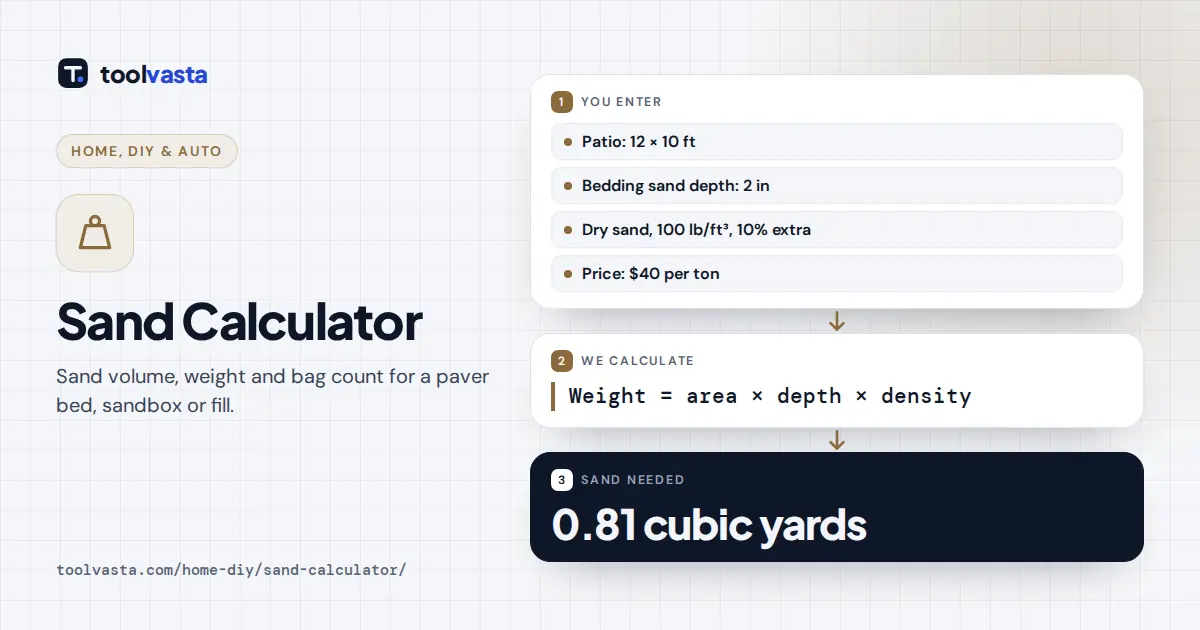
A patio is 12 ft by 10 ft, so the area is 120 sq ft. A 2 in layer of sand is 120 × 2 ÷ 12 = 20 cu ft. With 10% extra for screeding and compaction the order is 22 cu ft, which is 0.81 cubic yards or 0.62 m³.
At a dry density of 100 lb/ft³ the sand weighs 2,200 lb, or 1.10 US tons and 1.00 metric tonne. In 50 lb bags that is 2,200 ÷ 50 = 44 bags. At $40 per ton bulk sand costs about $44 before delivery, which shows why bulk is usually cheaper for anything larger than a small repair.
Common Sand Types and Depths
| Use | Typical sand | Typical depth |
|---|---|---|
| Paver and flagstone bedding | Coarse concrete sand | 1 in (2.5 cm) |
| Sandbox or play area | Washed play sand | 6 to 12 in (15 to 30 cm) |
| Lawn top dressing | Fine washed sand or sand mix | 0.25 to 0.5 in (6 to 12 mm) |
| Above-ground pool base | Mason or fine sand | 2 in (5 cm) |
| Pipe bedding | Clean sand | Per local specification |
The depths are common starting points, not specifications. Follow the paver manufacturer, pool installer or local code for structural or load-bearing work. Polymeric joint sand for paver gaps is sold by the bag and the bag label gives its coverage.
Tips for Buying Sand
- Use the dry density for bagged sand and for most bulk deliveries in dry weather. Use the wet density if the pile has been rained on.
- Measure an odd-shaped area as several rectangles and circles, then add the volumes.
- For a sandbox, check whether the sand is washed and sold for play use.
- Ask whether the supplier sells by weight or by volume, and whether delivery has a minimum load.
- Store leftover sand under a tarp so it stays clean and dry for joint filling later.
Assumptions and Limits
The result assumes a flat, even depth. Sloped ground or a dished base changes the real volume. Bag counts are rounded up to whole bags and assume the stated bag weight. The weight figures are typical, so treat them as estimates and confirm the order with your supplier.
Frequently asked questions
How much sand do I need for a sandbox?
Multiply length by width by depth. A 6 by 6 ft sandbox filled 12 inches deep needs 36 cu ft, which is 1.33 cubic yards or about 72 bags of 50 lb play sand.
How much does a cubic yard of sand weigh?
Dry sand weighs roughly 100 lb per cubic foot, so a cubic yard weighs about 2,700 lb or 1.35 US tons. Wet sand can weigh about 120 lb per cubic foot, or around 1.6 tons per cubic yard.
How many 50 lb bags of sand are in a cubic yard?
At a dry density of about 100 lb per cubic foot, a cubic yard weighs about 2,700 lb, so it takes about 54 bags of 50 lb. Wet or denser sand needs fewer bags per cubic yard by volume.
How much sand do I need under pavers?
Most paver installations use about 1 inch of bedding sand over a compacted gravel base. For 100 sq ft that is about 8.3 cu ft of sand before any extra for screeding.
How do I convert cubic meters of sand to tonnes?
Multiply the cubic meters by the density in tonnes per cubic meter. Dry sand at about 1.6 tonnes per cubic meter means 2 m³ weighs about 3.2 tonnes.
Why order extra sand?
Sand settles and compacts when it is spread, screeded and walked on, and some is lost at the edges. Adding about 5 to 15% helps you finish the job without a second trip.