How to Use the Quarter Mile Calculator
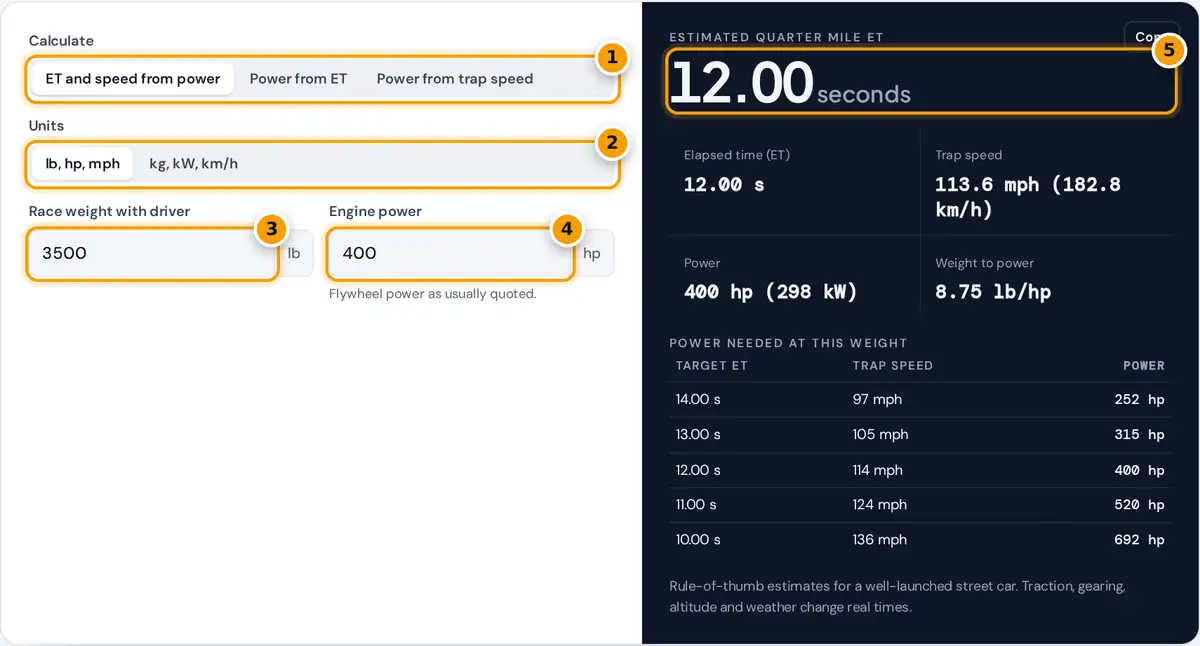
- Pick ET from power, or power from ET or trap speed.
- Choose lb, hp and mph or kg, kW and km/h.
- Enter the race weight with driver.
- Enter the engine power.
- Read the ET, trap speed and power table.
Pick what you want to work out. To predict a time, choose ET and speed from power, then enter the race weight of the car with the driver and fuel, and the engine power. To check how much power a car is really making, choose power from ET or power from trap speed and enter the figure from a timeslip along with the race weight.
Switch between pounds, horsepower and miles per hour or kilograms, kilowatts and kilometers per hour. The result shows the elapsed time, the trap speed, the power and the weight-to-power ratio. A small table lists the power needed at your weight for ETs from 14 down to 10 seconds, which helps when planning upgrades or weight reduction.
Quarter Mile ET and Trap Speed Formulas
trap speed (mph) = 234 × (hp ÷ weight lb)^(1/3)
hp from ET = weight × (5.825 ÷ ET)³
hp from trap speed = weight × (mph ÷ 234)³
These are the widely used drag racing rules of thumb associated with Patrick Hale and with the Fox horsepower-from-trap-speed method. Both scale with the cube root of the weight-to-power ratio, so halving the ratio cuts ET by about 21%. Trap speed depends mostly on power, while ET is also affected by the launch, which is why power estimated from trap speed is usually the more reliable figure.
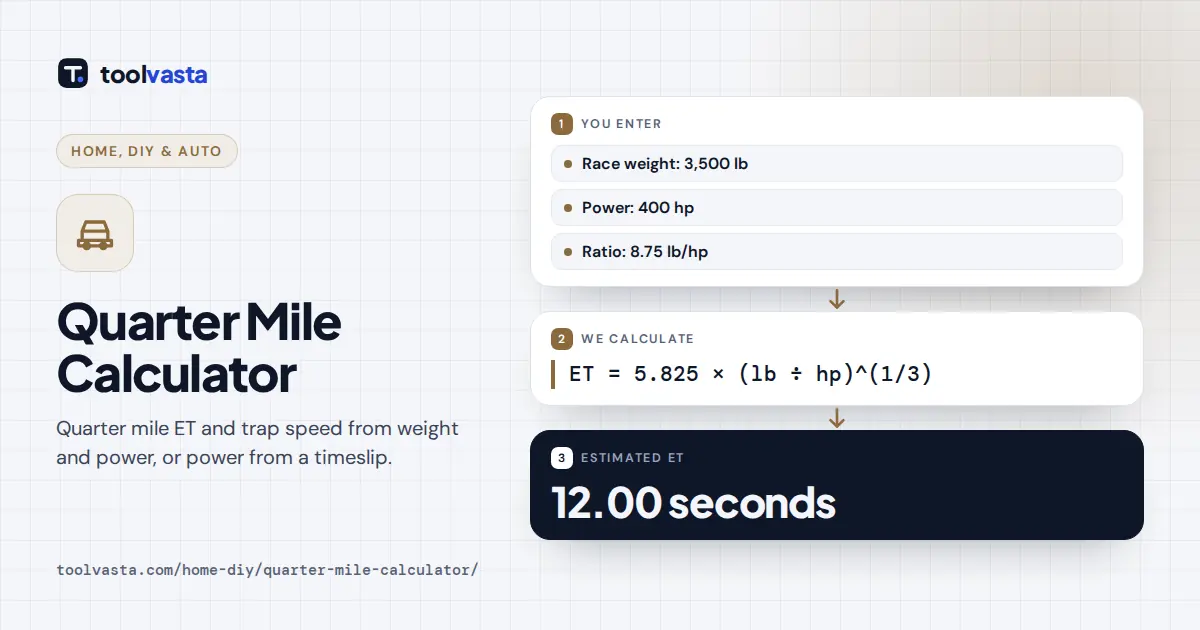
Worked Example: A 3,500 lb Car With 400 hp
The weight-to-power ratio is 3,500 ÷ 400 = 8.75 lb/hp. The cube root of 8.75 is 2.0606, so the predicted ET is 5.825 × 2.0606 = 12.00 seconds. The trap speed is 234 ÷ 2.0606 = 113.6 mph, or 182.8 km/h.
Working the other way, if the same car runs 11.50 seconds, the formula suggests about 3,500 × (5.825 ÷ 11.5)³ = 455 hp. If it traps at 120 mph, the estimate is 3,500 × (120 ÷ 234)³ = 472 hp. A gap between the two figures often points to a weak launch, wheelspin or gearing that does not suit the track.
Weight changes work the same way. Taking 200 lb out of the same car lowers the ratio to 8.25 lb/hp, which the formula turns into an ET of about 11.77 seconds, roughly a quarter of a second quicker without touching the engine.
Weight to Power and Quarter Mile Times
| Weight to power | Estimated ET | Estimated trap speed | Example |
|---|---|---|---|
| 16 lb/hp | 14.68 s | 92.9 mph | 3,200 lb, 200 hp |
| 12 lb/hp | 13.34 s | 102.2 mph | 3,600 lb, 300 hp |
| 8.75 lb/hp | 12.00 s | 113.6 mph | 3,500 lb, 400 hp |
| 6 lb/hp | 10.58 s | 128.8 mph | 3,600 lb, 600 hp |
| 4 lb/hp | 9.25 s | 147.4 mph | 3,200 lb, 800 hp |
The table comes straight from the formulas. Real street cars on street tires are often slower than these figures, while well-prepared drag cars with good traction can match or beat them.
Tips for Better Estimates
- Weigh the car with the driver and the fuel load you race with. Race weight matters as much as power.
- Use the trap speed to estimate power, since it is less affected by the launch than ET.
- Correct for weather if you compare runs. Hot, humid air and high altitude reduce power.
- Compare results from the same track and timing system. Track prep and timing setups vary.
Assumptions and Limits
The formulas are empirical rules of thumb, not physics simulations. They do not model traction, gearing, aerodynamics, tire size, drivetrain type or converter stall, so a single car can differ from the estimate by several tenths. Power estimates from a timeslip are not a substitute for a dyno test. Always race on a sanctioned track, never on public roads.
Frequently asked questions
How do I calculate quarter mile ET from horsepower?
Divide the race weight in pounds by the horsepower, take the cube root and multiply by 5.825. A 3,500 lb car with 400 hp has a ratio of 8.75 and an estimated ET of about 12.0 seconds.
How do I estimate horsepower from trap speed?
Divide the trap speed in mph by 234, cube the result and multiply by the race weight in pounds. A 3,500 lb car trapping 120 mph suggests about 472 hp.
Why is horsepower from trap speed more accurate than from ET?
ET depends heavily on the launch, traction and shifting, while trap speed mostly reflects power over the second half of the run. A poor launch slows ET but changes trap speed much less.
What weight should I use for the quarter mile calculator?
Use the race weight, which is the car with the driver, fuel and anything else on board during the run. A car that weighs 3,300 lb empty may race at 3,500 lb with a driver.
How much horsepower do I need for an 11 second quarter mile?
At 3,500 lb race weight the formula suggests about 520 hp for an 11.0 second ET. Lighter cars need less, because the result depends on the weight-to-power ratio.
Does the calculator use wheel or engine horsepower?
The rules of thumb are usually applied to engine horsepower as quoted by manufacturers. Wheel horsepower is lower because of drivetrain losses, so using it would predict slower times.