How to Use the Soap Calculator
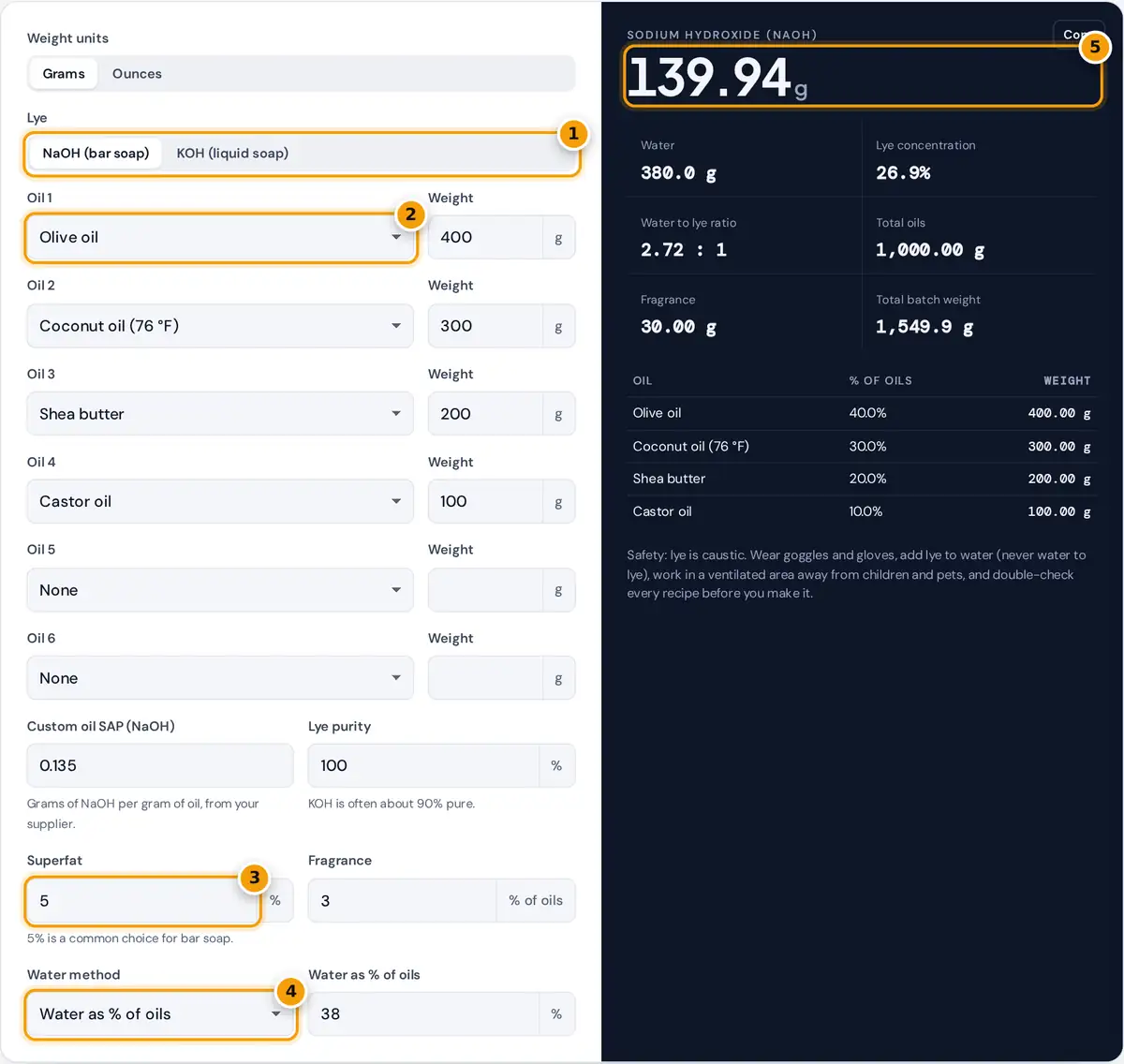
- Pick NaOH for bars or KOH for liquid soap.
- Choose up to six oils and enter their weights.
- Set the superfat and lye purity.
- Pick the water method and amount.
- Read the lye, water, fragrance and batch weight.
Choose grams or ounces, then pick the lye: sodium hydroxide (NaOH) makes hard bar soap, and potassium hydroxide (KOH) makes soft or liquid soap. Select up to six oils and enter the weight of each. If an oil is not listed, choose the custom option and enter its NaOH saponification value from your supplier.
Set the superfat, which is the share of oil left unsaponified for a milder bar, and the lye purity. Then pick how to set the water: as a percentage of the oils, as a lye concentration, or as a water to lye ratio. Add fragrance as a percentage of the oils if you use it. The result shows the lye, water, fragrance and total batch, with each oil's share of the recipe.
Lye Calculation Formula
KOH = NaOH result × 1.4027 (56.11 ÷ 40.00, the ratio of molar masses)
water = oils × water % or lye × (100 − concentration) ÷ concentration or lye × ratio
The saponification (SAP) value is the weight of lye needed to turn one unit of a particular oil into soap. The table uses commonly published NaOH values, such as 0.135 for olive oil and 0.183 for coconut oil. KOH values come from the NaOH values multiplied by the ratio of the molar masses of KOH and NaOH, and the purity setting adds extra lye when the product is not 100% pure.
Superfat and water work independently. Changing the water changes how fast the batter traces and how long the bars take to cure, but it does not change how much lye reacts with the oils, so the lye amount stays the same whichever water method you choose.
Worked Example: A Four-Oil Bar
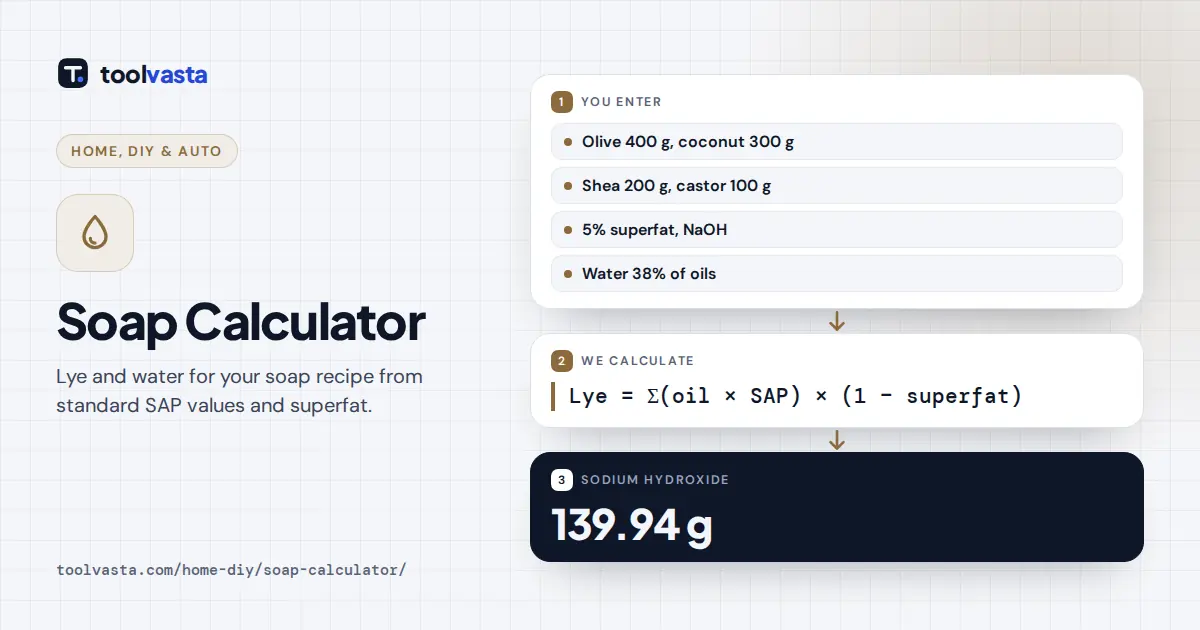
A recipe uses 400 g olive oil, 300 g coconut oil, 200 g shea butter and 100 g castor oil, 1,000 g in total. The lye needed for full saponification is 400 × 0.135 + 300 × 0.183 + 200 × 0.128 + 100 × 0.128 = 147.3 g of NaOH.
With a 5% superfat the recipe uses 147.3 × 0.95 = 139.94 g of NaOH. Water at 38% of the oils is 380 g, which gives a lye concentration of 26.9%. With 3% fragrance (30 g) the whole batch weighs about 1,549.9 g. Made as liquid soap with 90% pure KOH, the same oils would need about 218.10 g of KOH.
SAP Values Used
| Oil or butter | NaOH SAP | KOH SAP |
|---|---|---|
| Olive oil | 0.135 | 0.189 |
| Coconut oil (76 °F) | 0.183 | 0.257 |
| Palm oil | 0.142 | 0.199 |
| Castor oil | 0.128 | 0.180 |
| Shea butter | 0.128 | 0.180 |
| Cocoa butter | 0.137 | 0.192 |
| Sweet almond oil | 0.139 | 0.195 |
| Lard | 0.138 | 0.194 |
| Beef tallow | 0.143 | 0.201 |
SAP values vary slightly between batches and suppliers, which is one reason soapmakers use a superfat. If your supplier lists a different value, enter it as a custom oil.
Lye Safety
- Wear splash goggles, gloves and long sleeves whenever you handle lye or fresh soap batter.
- Always add lye to water, slowly, never water to lye. The solution heats up quickly and gives off fumes.
- Use heat-resistant containers made of stainless steel or suitable plastic, never aluminum.
- Keep vinegar away from skin burns: flush with plenty of cool running water and seek medical help if needed.
- Label lye clearly and store it out of reach of children and pets.
Assumptions and Limits
The calculator uses typical SAP values and does not predict hardness, lather or cure time. Always weigh ingredients on an accurate scale, and check any new recipe in a second calculator or against your supplier's data before you make it. This tool is for planning, and handling lye safely is your responsibility.
Frequently asked questions
How do I calculate lye for soap?
Multiply each oil's weight by its NaOH SAP value, add them up, then reduce by your superfat. For 1,000 g of oils needing 147.3 g of NaOH, a 5% superfat gives 139.94 g.
What is superfat in soap making?
Superfat is the percentage of oil left unsaponified by using a little less lye than needed. A 5% superfat is common for bar soap and gives a milder bar with a small safety margin.
How much water do I use for lye?
A common starting point is water equal to about 33 to 38% of the oil weight, or a lye concentration of about 30 to 33%. Less water speeds up trace and shortens the cure.
What is the difference between NaOH and KOH?
Sodium hydroxide (NaOH) makes hard bar soap, while potassium hydroxide (KOH) makes soft or liquid soap. KOH needs about 1.4 times the weight of NaOH for the same oils.
What is a SAP value?
A saponification value is the amount of lye needed to turn one unit of an oil into soap. Olive oil needs about 0.135 g of NaOH per gram, and coconut oil about 0.183 g.
Is it safe to make soap with lye at home?
It can be done safely with care. Wear goggles and gloves, always add lye to water, work with good ventilation and keep children and pets away. Double-check recipes before you start.