How to Use the Aquarium Calculator
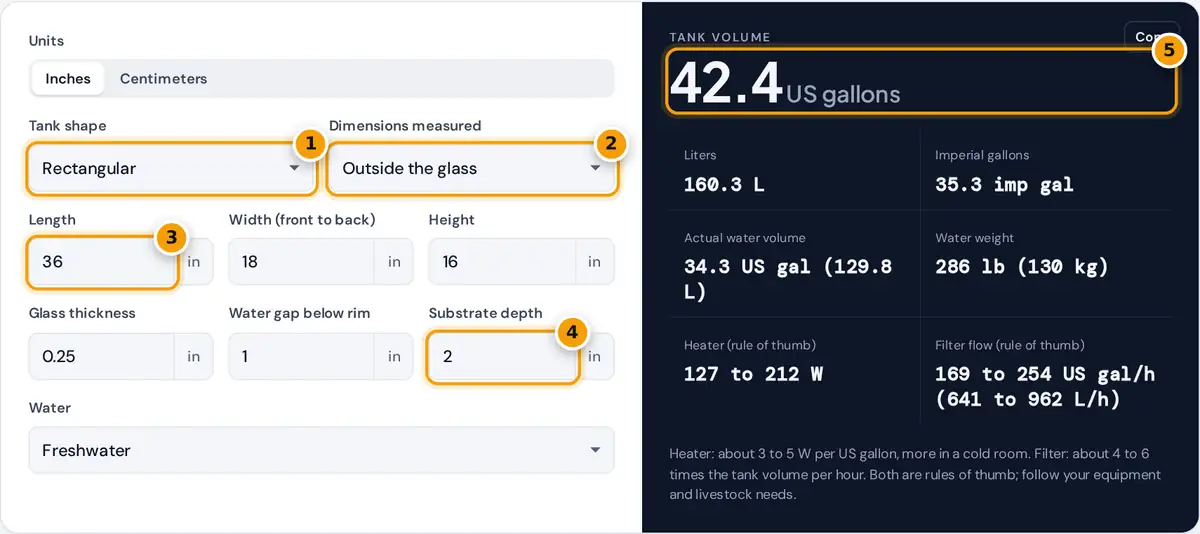
- Pick rectangular, cylinder or bow-front.
- Say whether you measured outside or inside the glass.
- Enter the tank dimensions.
- Enter the water gap and substrate depth.
- Read the volume, water weight, heater and filter sizes.
Choose inches or centimeters and pick the tank shape. For a rectangular tank enter the length, the width from front to back and the height. For a cylinder enter the diameter and height. For a bow-front tank enter the straight length across the back, the depth at the two sides, the depth at the center of the bow and the height.
Say whether you measured outside or inside the glass. Outside measurements are easier, and the calculator subtracts the glass on every side and under the tank. Enter how far below the rim you keep the water and how deep the substrate is, then pick freshwater or saltwater. The result shows the full tank volume, the actual water volume, its weight and heater and filter sizes.
Aquarium Volume Formulas
cylinder: V = π × diameter² ÷ 4 × height
bow-front: V = (length × side depth + circular segment) × height
segment: R = (L²/4 + s²) ÷ 2s, θ = 2 asin(L ÷ 2R), area = R²/2 (θ − sin θ)
1 US gal = 231 in³ = 3.785 L 1 imp gal = 4.546 L
In the bow-front formula, s is the bow depth, the center depth minus the side depth, and the front is treated as an arc of a circle. Freshwater weighs about 1 kg per liter, or 8.34 lb per US gallon, and seawater about 2.5% more. The tank, stand, rock and substrate add to that weight.
Worked Example: A 40 Gallon Breeder Tank
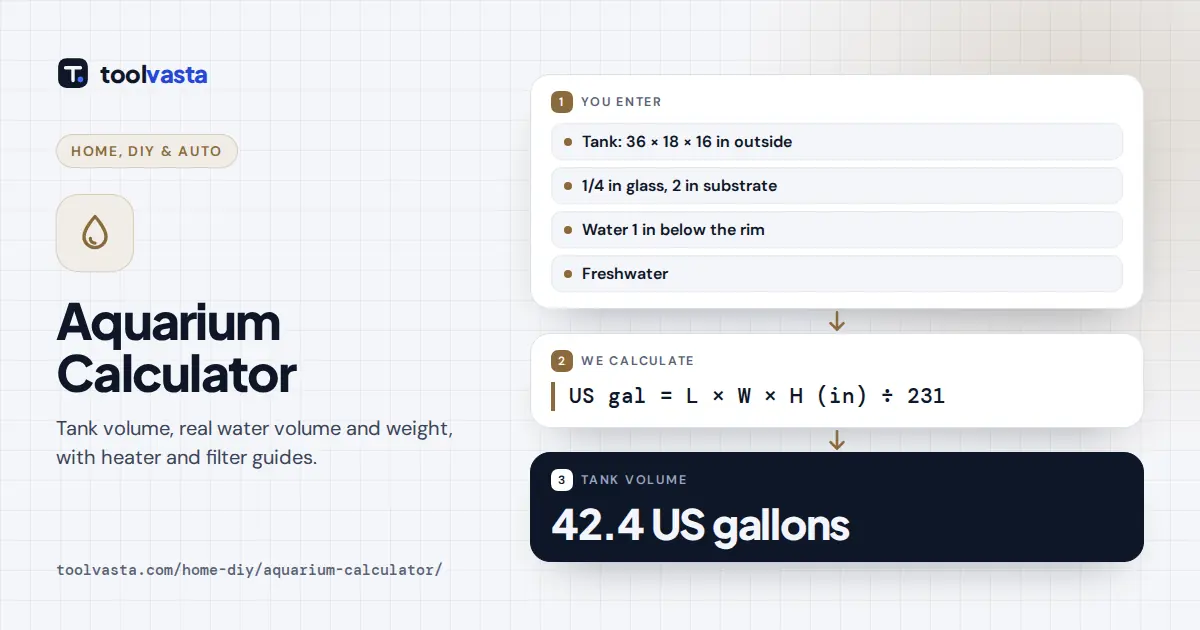
A tank measures 36 × 18 × 16 in outside, with 1/4 in glass. Inside it is 35.5 × 17.5 × 15.75 in, which is 9,784.7 cu in, or 42.4 US gallons, 160.3 L and 35.3 imperial gallons. That is why a tank sold as 40 gallons rarely holds exactly 40.
With 2 in of substrate and the water 1 in below the rim, the water column is 12.75 in tall, so the tank holds 34.3 US gallons (129.8 L) of water weighing about 286 lb. At 3 to 5 W per gallon of tank volume, a heater of about 127 to 212 W suits it, and a filter rated at about 169 to 254 gallons per hour turns the volume over 4 to 6 times an hour.
Common Tank Sizes
| Nominal tank | Typical outside size | Volume of that box | Liters |
|---|---|---|---|
| 10 gallon | 20 × 10 × 12 in | 10.4 gal | 39.3 L |
| 20 gallon long | 30 × 12 × 12 in | 18.7 gal | 70.8 L |
| 29 gallon | 30 × 12 × 18 in | 28.1 gal | 106.2 L |
| 55 gallon | 48 × 13 × 21 in | 56.7 gal | 214.7 L |
| 75 gallon | 48 × 18 × 21 in | 78.5 gal | 297.4 L |
The volumes are for the outside box with no glass, substrate or gap removed, so the real water volume is lower. Manufacturer sizes vary, so measure your own tank before dosing medication or salt.
Tips for Using the Results
- Dose medications, water conditioners and salt by the actual water volume, not the nominal tank size.
- Check that the floor and stand can carry the full weight, especially for large tanks on upper floors.
- Two smaller heaters at opposite ends spread heat evenly and give a backup if one fails.
- Filter ratings are often measured with no media and no head height, so real flow is lower than the label.
Assumptions and Limits
The calculator assumes straight sides and an even substrate depth. Rocks, wood and decorations displace water, and some water sits inside the substrate, so the true water volume differs slightly. Heater and filter figures are common rules of thumb, not requirements; room temperature, species and the equipment maker's guidance should guide your final choice.
Frequently asked questions
How do I calculate fish tank volume in gallons?
Multiply length, width and height in inches to get cubic inches, then divide by 231 for US gallons. A 36 by 18 by 16 inch tank is 10,368 cubic inches, about 44.9 gallons before glass and substrate.
How do I calculate tank volume in liters?
Multiply length, width and height in centimeters and divide by 1,000. A tank 90 by 45 by 40 cm holds 162,000 cubic centimeters, which is 162 liters.
How much does a full aquarium weigh?
Freshwater weighs about 8.34 lb per US gallon, or 1 kg per liter. A tank holding 34 gallons of water carries about 286 lb of water, plus glass, substrate, rock and the stand.
What size heater does my aquarium need?
A common rule of thumb is 3 to 5 watts per US gallon of tank volume, using the higher figure for a cool room or a large temperature difference. Check the heater maker's guidance.
How much filtration does an aquarium need?
Many keepers aim for a filter that turns the tank volume over about 4 to 6 times per hour. Heavily stocked tanks and some species need more, while others prefer gentle flow.
How do I measure a bow-front tank?
Measure the straight length across the back, the depth at each side, the depth at the middle of the bow and the height. The calculator treats the curved front as an arc of a circle.