How to Use the Rolling Offset Calculator
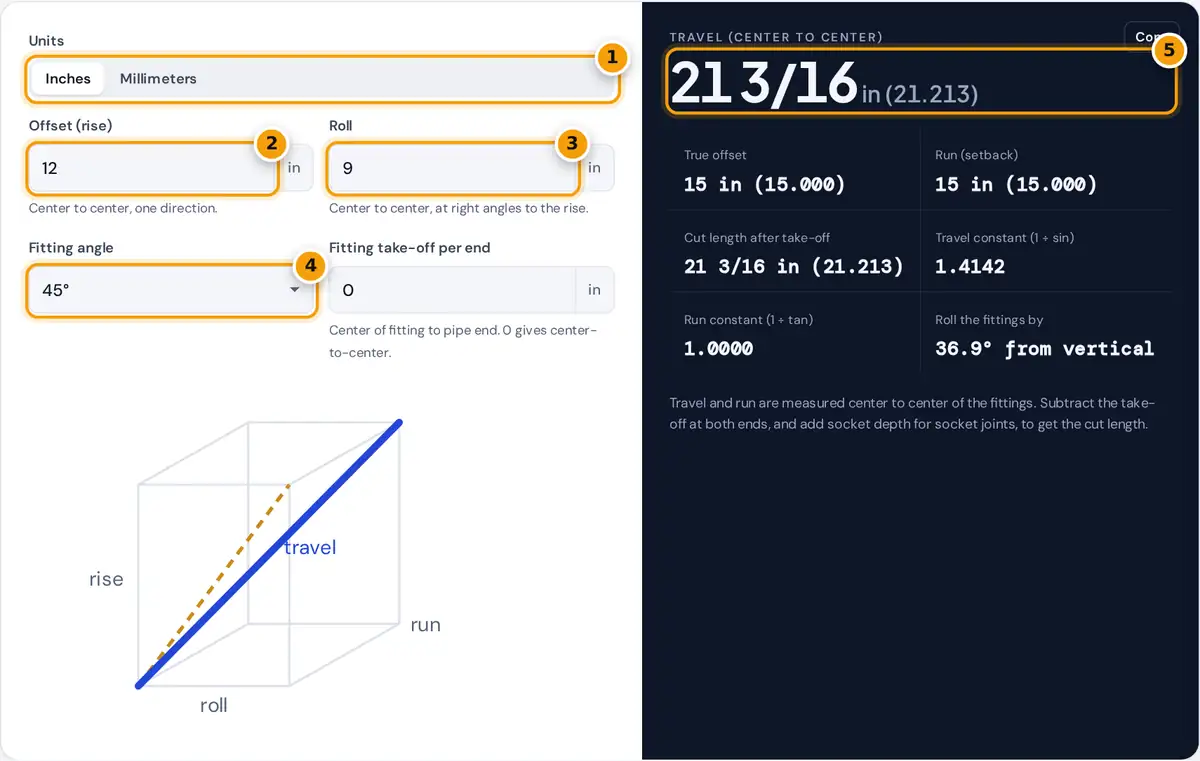
- Choose inches or millimeters.
- Enter the offset, or rise, center to center.
- Enter the roll at right angles to the rise.
- Pick the fitting angle and any take-off.
- Read the travel, true offset, run and cut length.
A rolling offset joins two parallel pipes that are shifted in two directions at once, for example up and to the side. Choose inches or millimeters and enter the offset, also called the rise, measured center to center in one direction. Then enter the roll, measured center to center at right angles to the rise. Use a level and square so both measurements are true.
Pick the angle of the fittings you will use: 45° is the most common, while 22.5°, 60° and 11.25° fittings suit longer or tighter offsets. Choose a custom angle for anything else. If you want the actual pipe cut length, enter the take-off of one fitting, which is the distance from its center to the end of the pipe it receives.
Rolling Offset Formula
travel = true offset ÷ sin(angle) = true offset × travel constant
run (setback) = true offset ÷ tan(angle)
cut length = travel − 2 × take-off
The rise and roll form the two short sides of a right triangle, so the true offset is the diagonal across the end of an imaginary box. The pipe then crosses that box at the fitting angle, which makes a second right triangle. The travel is its long side and the run is the distance gained along the line of the pipes. For 45° fittings the travel constant is 1.4142 and the run equals the true offset.
When either the rise or the roll is zero, the rolling offset becomes a simple offset in one plane and the same formulas still apply. The travel and run constants are shown in the result so you can check the numbers by hand on site.
Worked Example: A 45 Degree Rolling Offset
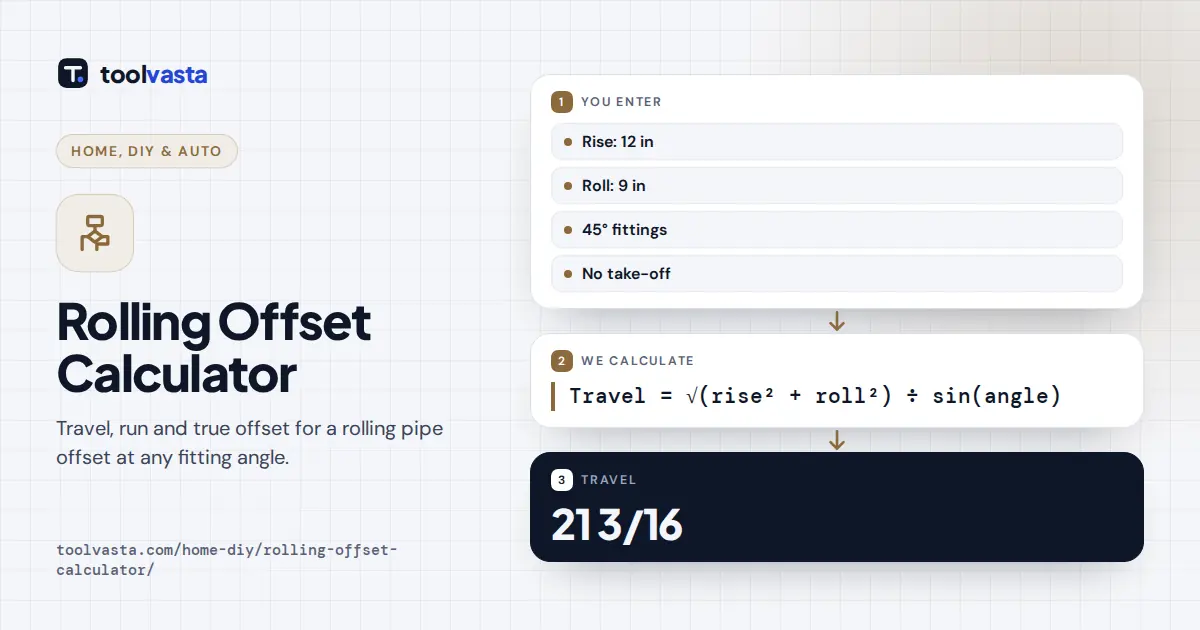
A pipe must move 12 in up and 9 in sideways. The true offset is √(12² + 9²) = √225 = 15 in. With 45° fittings, the travel is 15 × 1.4142 = 21.213 in, just over 21 3/16 in center to center, and the run along the pipe is also 15 in.
The fittings must be rolled 36.9° from vertical, the angle whose tangent is 9 ÷ 12, so the offset points along the true offset line. With 22.5° fittings the same offset needs a travel of 39.197 in and a run of 36.213 in, which takes more space along the pipe but changes direction more gently.
Offset Constants by Fitting Angle
| Fitting angle | Travel constant (1 ÷ sin) | Run constant (1 ÷ tan) |
|---|---|---|
| 11.25° | 5.1258 | 5.0273 |
| 22.5° | 2.6131 | 2.4142 |
| 30° | 2.0000 | 1.7321 |
| 45° | 1.4142 | 1.0000 |
| 60° | 1.1547 | 0.5774 |
Multiply the true offset by the travel constant to get the travel, and by the run constant to get the run. The same constants work for simple offsets in one plane, where the true offset is just the rise.
Tips for Fitting Rolling Offsets
- Measure both pipes from their centers, not from their outside edges, unless they are the same size and you measure the same side of each.
- Dry-fit the fittings and mark them before gluing, threading or welding, because the roll is easy to lose when assembling.
- For threaded pipe, take-off is the center-to-end dimension minus thread engagement. For welded fittings it is the center-to-end dimension.
- For drain lines, keep the required slope through the offset.
- Write down the rise, roll, angle and cut length of each offset. It makes it easy to repeat the same offset on parallel runs, such as hot and cold lines.
Assumptions and Limits
The calculator assumes both pipes are parallel and that both fittings have the same angle. Take-off values differ by fitting type, size and manufacturer, so use the dimensions from the fitting data. The diagram is a schematic, not to scale. Always confirm the layout on site before cutting expensive pipe.
Frequently asked questions
How do you calculate a rolling offset?
Square the rise and the roll, add them and take the square root to get the true offset. Then divide the true offset by the sine of the fitting angle to get the travel.
What is the true offset?
The true offset is the straight-line distance between the centers of the two pipes when viewed along the pipe run. It combines the rise and the roll as the diagonal of a right triangle.
What is the 45 degree offset constant?
For 45 degree fittings, the travel is the offset times 1.4142, which is the square root of 2. The run, or setback, equals the offset because the tangent of 45 degrees is 1.
What is the difference between travel and run?
Travel is the center-to-center length of the angled pipe. Run, also called setback or advance, is how far the offset moves along the direction of the parallel pipes.
How much should I roll the fittings?
Rotate the fittings from vertical by the angle whose tangent is the roll divided by the rise. For a 12 inch rise and 9 inch roll, roll them about 36.9 degrees.
What is fitting take-off?
Take-off is the distance from the center of a fitting to the end of the pipe inside it. Subtract the take-off of both fittings from the center-to-center travel to get the pipe cut length.