Quick answer: To convert mph to km/h, multiply the speed in miles per hour by 1.609344, because one international mile is exactly 1.609344 kilometres. So 30 mph is 48.3 km/h, 60 mph is 96.6 km/h and 70 mph is 112.7 km/h. To go back from km/h to mph, divide by 1.609344.

Who Needs to Convert Road Speeds?
An mph to km/h converter changes a speed in miles per hour, the unit on UK and US road signs and speedometers, into kilometres per hour, the unit used on roads in most of Europe and the rest of the world. Drivers taking a car abroad, people reading a foreign car review, runners setting a treadmill and anyone comparing a top speed from an American and a European spec sheet all run into the same question. This converter answers it in both directions, shows the exact sum, and adds metres per second, knots and feet per second for technical work.
How Do You Convert a Speed Here?

- Leave the direction on mph to km/h, or switch to km/h to mph if you are starting from a European speed.
- Type the speed, for example 70 or 12.5. Commas and unit letters such as mph are ignored.
- Read the result in km/h and the line beneath it, which shows the multiplication that was used.
- Check the extra units and the nearby values in the table if you need metres per second, knots or a quick reference.
Switching direction converts the number already in the box, so 70 mph becomes 112.65 km/h in the input and you can keep working from there without retyping.
What Is the Exact Conversion Factor?
The formula is km/h = mph × 1.609344. The factor is exact because the international yard was fixed at 0.9144 metres in 1959, which makes the 1,760 yard mile exactly 1,609.344 metres. The US National Institute of Standards and Technology lists the same factor for mile per hour to kilometre per hour in Appendix B of its Guide to the SI.
mph = km/h ÷ 1.609344 = km/h × 0.621371
m/s = km/h ÷ 3.6
Worked example: a car on a UK motorway at the 70 mph limit is travelling at 70 × 1.609344 = 112.654 km/h, which rounds to 112.7 km/h. In metres per second that is 112.654 ÷ 3.6 = 31.29 m/s, so the car covers about 31 metres every second, a useful figure when thinking about stopping distances.
What Is a Quick Mental Shortcut?
Multiply by 1.6 for an answer within half a percent: 50 mph × 1.6 = 80 km/h, against an exact 80.47 km/h. An easier trick is to add 60 percent: take the speed, halve it, add a tenth, then add both to the original. For 40 mph, half is 20 and a tenth is 4, so 40 + 20 + 4 = 64 km/h (exact answer 64.37 km/h).
For the reverse, multiply km/h by 0.6 or by 5 and divide by 8. A 100 km/h limit is about 60 to 62 mph, and 130 km/h, the usual French motorway limit, is about 81 mph. Distances use the same factor, so the miles to km converter and the km to miles converter work exactly the same way for route lengths.
mph to km/h Conversion Table
Values are rounded to one decimal place.
| Miles per hour | Kilometres per hour |
|---|---|
| 5 mph | 8.0 km/h |
| 10 mph | 16.1 km/h |
| 15 mph | 24.1 km/h |
| 20 mph | 32.2 km/h |
| 25 mph | 40.2 km/h |
| 30 mph | 48.3 km/h |
| 35 mph | 56.3 km/h |
| 40 mph | 64.4 km/h |
| 45 mph | 72.4 km/h |
| 50 mph | 80.5 km/h |
| 55 mph | 88.5 km/h |
| 60 mph | 96.6 km/h |
| 65 mph | 104.6 km/h |
| 70 mph | 112.7 km/h |
| 75 mph | 120.7 km/h |
| 80 mph | 128.7 km/h |
| 90 mph | 144.8 km/h |
| 100 mph | 160.9 km/h |
| 120 mph | 193.1 km/h |
| 150 mph | 241.4 km/h |
Common European limits the other way round:
| Kilometres per hour | Miles per hour |
|---|---|
| 30 km/h | 18.6 mph |
| 50 km/h | 31.1 mph |
| 60 km/h | 37.3 mph |
| 80 km/h | 49.7 mph |
| 90 km/h | 55.9 mph |
| 100 km/h | 62.1 mph |
| 110 km/h | 68.4 mph |
| 120 km/h | 74.6 mph |
| 130 km/h | 80.8 mph |
What Are UK Speed Limits in km/h?
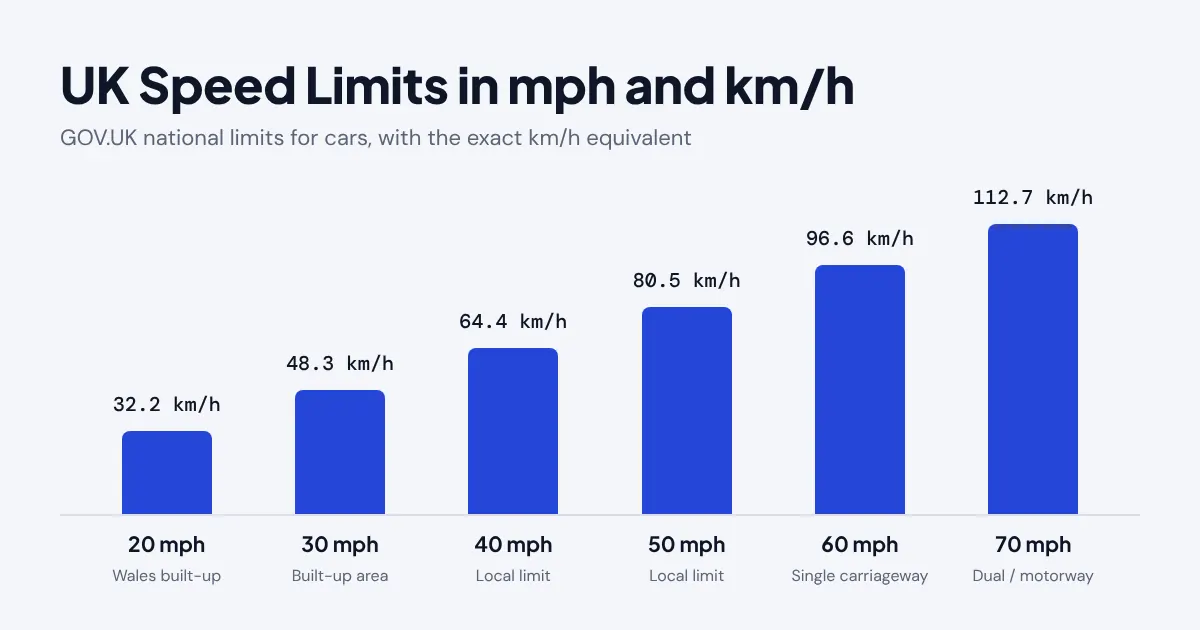
For cars and motorcycles the national limits are 30 mph (48 km/h) in built-up areas in England, Scotland and Northern Ireland, 20 mph (32 km/h) in most built-up areas in Wales, 60 mph (96 km/h) on single carriageways and 70 mph (112 km/h) on dual carriageways and motorways. These figures are published on the GOV.UK speed limits page, which also lists lower limits for vans, buses, lorries and vehicles towing a caravan. Note that GOV.UK rounds the km/h values down, while this converter shows the exact figure.
Driving the other way, a UK car in France or Spain will meet signs in km/h while its speedometer may show mph in large figures and km/h in small ones. Converting the common limits before you travel avoids squinting at the inner scale. For sailing and flying speeds, the knots to mph converter covers nautical miles, and the speed converter handles every speed unit at once, including Mach and running pace.
Related Converters
- Speed Converter
- Miles to Km Converter
- Km to Miles Converter
- Knots to mph Converter
- kW to hp Converter
- Bar to PSI Converter
Frequently asked questions
How do I convert mph to km/h?
Multiply the speed in mph by 1.609344. For example, 50 mph × 1.609344 = 80.47 km/h. For a quick estimate, multiply by 1.6.
What is 70 mph in km/h?
70 mph is 112.65 km/h. It is the UK limit for cars on motorways and dual carriageways.
What is 100 km/h in mph?
100 km/h is 62.14 mph. Divide by 1.609344, or multiply by 0.621371.
Is 1 mph the same as 1.6 km/h?
Almost. 1 mph is exactly 1.609344 km/h, so using 1.6 makes results about 0.6% too low, which is fine for a rough estimate but not for calibration or speed records.
How fast is 1 mph in metres per second?
1 mph is 0.44704 metres per second exactly. Multiply mph by 0.44704, or convert to km/h first and divide by 3.6.
Why does the UK still use mph?
UK road signs were never converted to metric, and road traffic law continues to set limits in miles per hour. Speedometers on UK cars show mph as the main scale with km/h alongside.