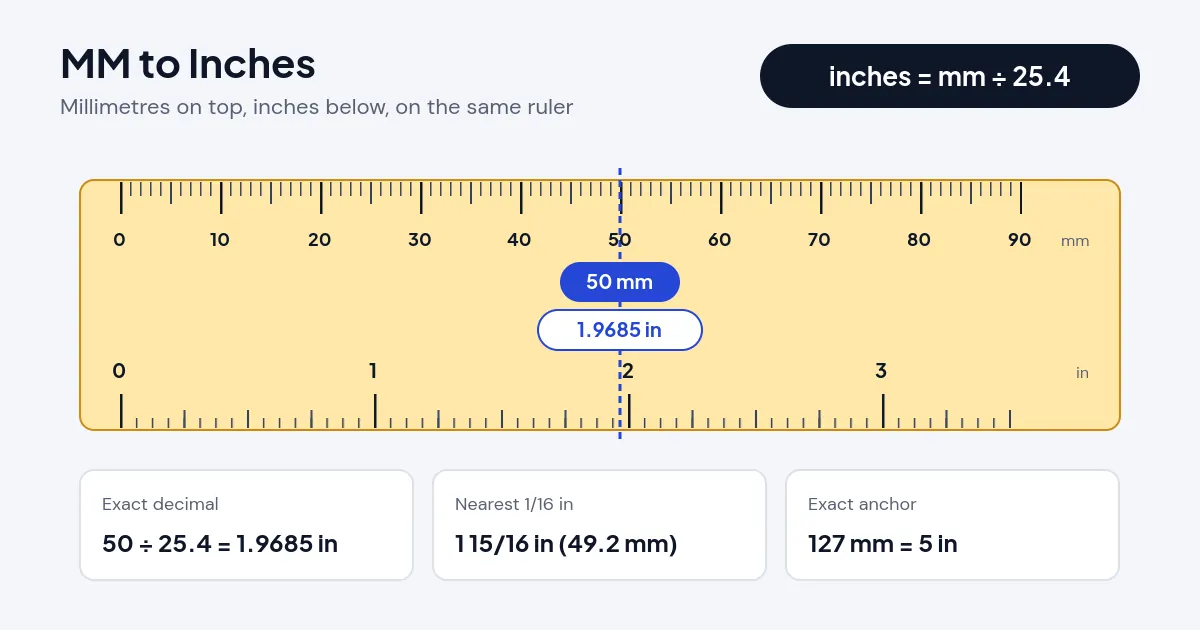
Quick answer: To convert millimetres to inches, divide the millimetres by 25.4. So 50 mm is 50 ÷ 25.4 = 1.9685 inches, which a tape measure shows as just under 1 15/16 in. The converter above does this for any value, gives the nearest fraction of an inch and works the other way too.
What Is an MM to Inches Converter?
An mm to inches converter turns a metric length into imperial inches. It is handy whenever metric and imperial parts meet: a 12 mm drill bit next to a 1/2 inch socket set, a phone screen protector listed in millimetres, or a woodworking plan from the US that you are building with a metric tape in the UK. The tool gives the exact decimal answer and the nearest practical fraction, because most rulers and tape measures in inches are marked in sixteenths rather than decimals.
How Do You Use the MM to Inches Converter?
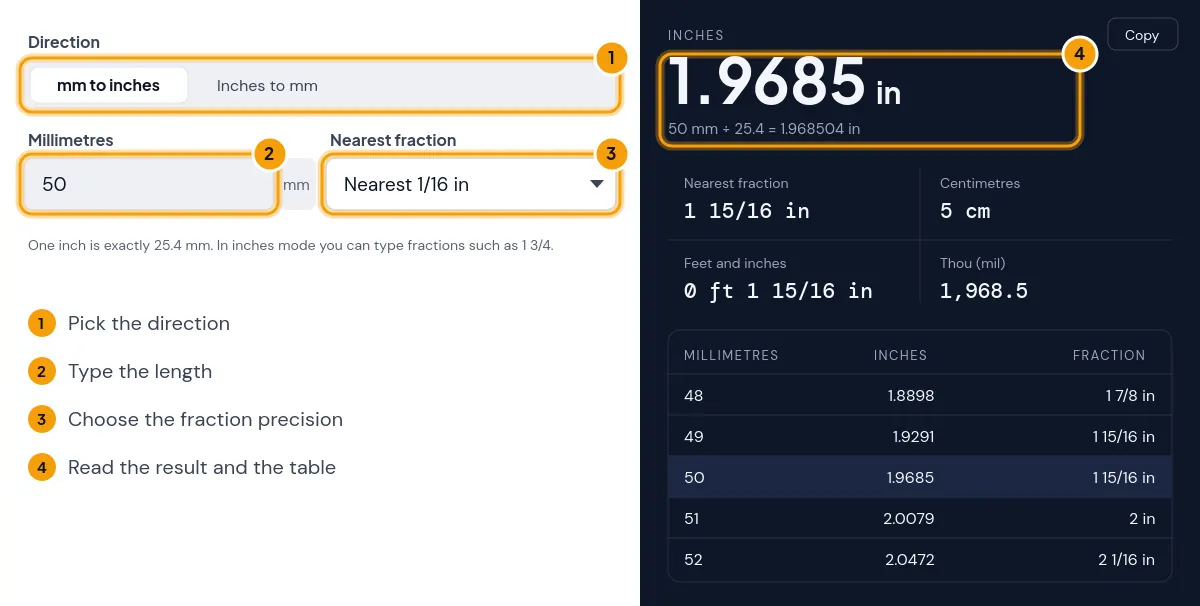
- Leave the direction on mm to inches, or switch to Inches to mm if you are starting from an imperial size.
- Type the length. Millimetres take decimals such as 12.7; inches also accept fractions such as 1 3/4 or 5/8.
- Choose how fine the fraction should be, from 1/8 in for rough work to 1/64 in for machining.
- Read the main result, then the centimetres, feet and inches, and thou values below it. The small table shows the neighbouring values so you can see which marking on the tape is closest.
The line under the result always shows the sum it used, for example 50 mm ÷ 25.4 = 1.968504 in, so you can check the working or copy it into a report.
What Is the MM to Inches Formula?
Since the international yard and pound agreement of 1959, the inch has been defined as exactly 0.0254 metres, which is 25.4 mm. The same figure is written into UK law in Schedule 1 of the Weights and Measures Act 1985 and used by the US National Institute of Standards and Technology. Because the factor is exact, the only error in any conversion comes from rounding the answer.
millimetres = inches × 25.4
nearest fraction = round(inches × 16) ÷ 16 (for sixteenths)
How Do You Convert 42 mm to Inches?
A shelf bracket is listed as 42 mm deep. 42 ÷ 25.4 = 1.6535 inches. To find the nearest sixteenth, multiply by 16: 1.6535 × 16 = 26.46, which rounds to 26. Twenty-six sixteenths is 1 10/16, or 1 5/8 in. That marking is 1.625 × 25.4 = 41.275 mm, so it sits about 0.7 mm short of the real size.
Going the other way, a 1 3/4 inch hole saw is 1.75 × 25.4 = 44.45 mm. If you need a fraction of an inch as a decimal first, the fraction calculator will simplify or convert it for you.
MM to Inches Conversion Table
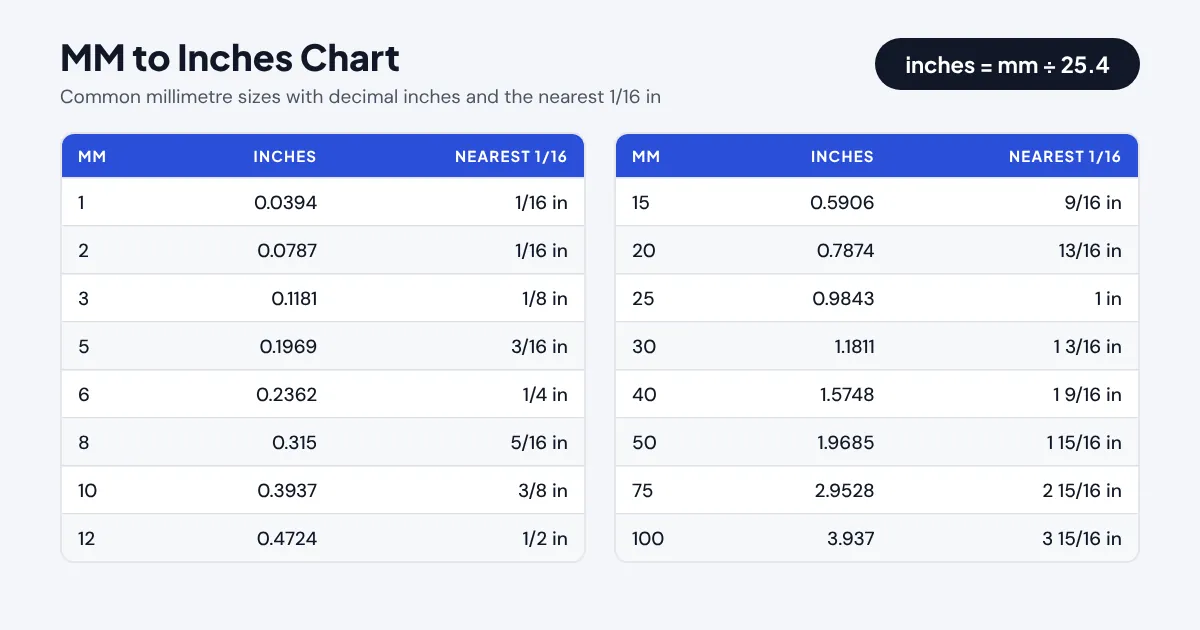
Fractions are rounded to the nearest 1/16 inch, the finest marking on most tape measures.
| Millimetres | Inches (decimal) | Nearest 1/16 in |
|---|---|---|
| 1 | 0.0394 | 1/16 in |
| 2 | 0.0787 | 1/16 in |
| 3 | 0.1181 | 1/8 in |
| 5 | 0.1969 | 3/16 in |
| 6 | 0.2362 | 1/4 in |
| 8 | 0.315 | 5/16 in |
| 10 | 0.3937 | 3/8 in |
| 12 | 0.4724 | 1/2 in |
| 15 | 0.5906 | 9/16 in |
| 20 | 0.7874 | 13/16 in |
| 25 | 0.9843 | 1 in |
| 30 | 1.1811 | 1 3/16 in |
| 40 | 1.5748 | 1 9/16 in |
| 50 | 1.9685 | 1 15/16 in |
| 75 | 2.9528 | 2 15/16 in |
| 100 | 3.937 | 3 15/16 in |
| 150 | 5.9055 | 5 7/8 in |
| 200 | 7.874 | 7 7/8 in |
| 300 | 11.811 | 11 13/16 in |
| 500 | 19.685 | 19 11/16 in |
| 1000 | 39.3701 | 39 3/8 in |
Which Metric and Imperial Sizes Are Close but Not Equal?
Several everyday sizes look interchangeable but are not. A 12 mm bolt is 0.472 in, slightly smaller than a 1/2 inch (12.7 mm) one, so a 1/2 inch spanner will slip on it. A 6 mm Allen key is 0.236 in, a touch smaller than 1/4 in (6.35 mm). A 3 mm drill is 0.118 in, close to 1/8 in (3.175 mm). In each case the difference is under 1 mm, which is enough to strip a fastener or leave a loose fit. Use the 1/32 or 1/64 setting when the fit matters, and check the decimal value rather than the rounded fraction.
For bigger measurements such as room sizes or a person's height, convert millimetres to inches here and then use the inches to feet converter to express the result in feet and inches.
How Can You Convert mm to Inches in Your Head?
- 127 mm is exactly 5 inches, and 254 mm is exactly 10 inches. These are useful anchors for checking any answer.
- For a quick estimate of inches, multiply the millimetres by 4 and divide by 100, then take off about 1.6%. For 42 mm: 42 × 4 = 168, so about 1.68, less 1.6% gives 1.65 in.
- For inches to millimetres, multiply by 25 and add 1.6%. For 3 in: 75 plus 1.2 gives 76.2 mm, which is exact.
- 1/16 in is about 1.6 mm, 1/8 in is about 3.2 mm and 1/4 in is about 6.4 mm.
Related Converters
Sources
Checked on 8 October 2026 by the ToolVasta Team. See our editorial policy for how tools are built and reviewed.
- Weights and Measures Act 1985, Schedule 1 (legislation.gov.uk)
- NIST Office of Weights and Measures: unit conversion
Frequently asked questions
How do I convert mm to inches?
Divide the number of millimetres by 25.4, because one inch is exactly 25.4 mm. For example, 30 mm divided by 25.4 is 1.181 inches, which is close to 1 3/16 in on a tape measure.
How many inches is 10 mm?
10 mm is 0.3937 inches. The nearest sixteenth is 3/8 in, which is 9.525 mm, so a 3/8 inch part is about half a millimetre smaller than a 10 mm one.
Is 25 mm the same as 1 inch?
No, but it is close. 25 mm is 0.984 inches, so it falls 0.4 mm short of a full inch. For rough work the two are often swapped, but for bolts, pipes or anything that has to fit, treat them as different sizes.
How do I convert inches to mm?
Multiply the inches by 25.4. A 2 inch length is 50.8 mm and 5/8 in is 0.625 × 25.4 = 15.875 mm. Switch the converter to inches to mm and you can type the fraction directly.
Why is an inch exactly 25.4 mm?
In 1959 the US, UK and other Commonwealth countries agreed a common international yard of exactly 0.9144 metres. Dividing by 36 gives an inch of exactly 0.0254 metres, or 25.4 mm, and that definition is still used today.
What is a thou or mil?
A thou, called a mil in the US, is one thousandth of an inch, or 0.0254 mm. Engineers use it for small tolerances and sheet thicknesses, so the converter shows the thou value for every millimetre length you enter.