To convert mm to inches, divide the millimetres by 25.4, because one inch is exactly 25.4 mm. To go the other way, multiply inches by 25.4. That division is awkward to do in your head, though, so this guide shows three shortcuts that get you within a hair of the right answer, plus a way to turn the result into the fractions printed on a tape measure. When you need an exact figure, the mm to inches converter does the sum and shows the nearest fraction for you.
Quick answer: One inch is exactly 25.4 mm, so to convert mm to inches you divide by 25.4 and multiply inches by 25.4 to get millimetres. For a quick mental estimate, multiply the millimetres by 4, divide by 100 and take off about 1.6%. So 50 mm is about 1.97 inches.
Why Is One Inch Exactly 25.4 mm?
The inch has not been an approximate unit since 1959, when the United States, the United Kingdom and other Commonwealth countries agreed on an international yard of exactly 0.9144 metres. Divide that by 36 and you get an inch of exactly 0.0254 metres. The definition is published by the US National Institute of Standards and Technology and appears in UK law in the Weights and Measures Act 1985.
Because 25.4 is exact, any error in a conversion comes only from the way you round the answer. That matters when you choose a shortcut: a good mental method should be close enough that the rounding you would do anyway hides the difference.
mm = inches × 25.4
How Can You Convert mm to Inches in Your Head?
1. Divide by 25, then take off 1.6%
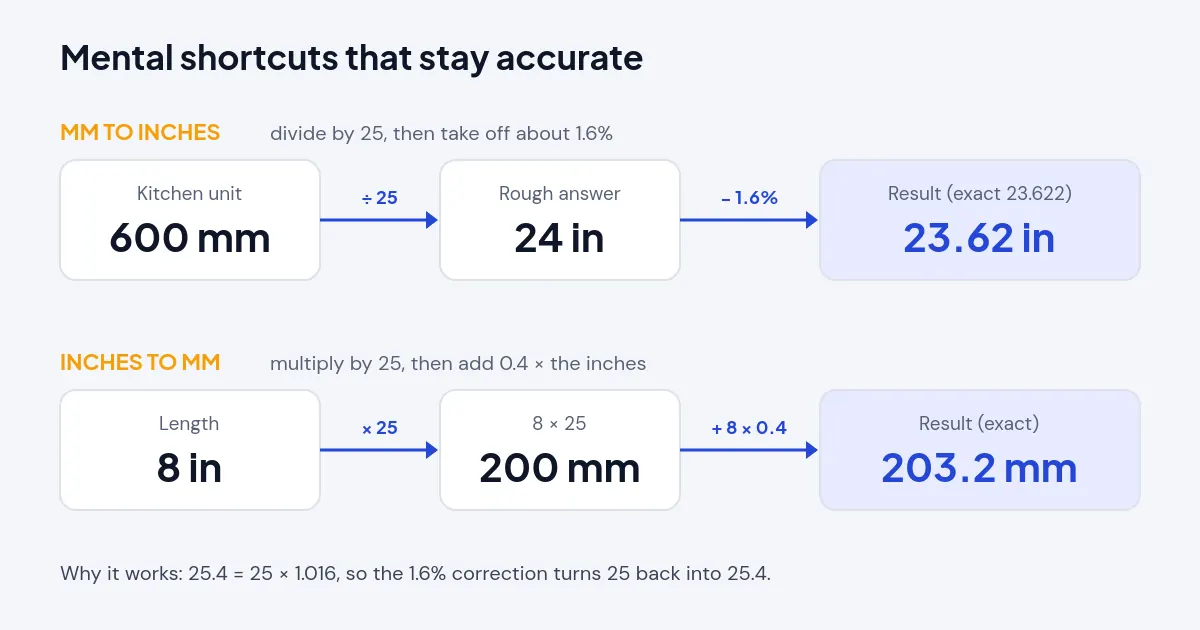
Dividing by 25 is easy, because it is the same as multiplying by 4 and dividing by 100. The answer will be slightly too big, since you divided by 25 instead of 25.4, so trim about 1.6% off the result. For a 600 mm kitchen unit: 600 ÷ 25 = 24, and 1.6% of 24 is about 0.38, so the unit is roughly 23.62 inches wide. The exact figure is 23.622 inches.
For small values the trim barely matters. A 42 mm bracket gives 42 × 4 = 168, or 1.68 inches. Taking off 1.6% (about 0.03) gives 1.65 inches, against an exact answer of 1.6535.
2. Use the 127 mm anchor
There is one very tidy pairing in the two systems: 127 mm is exactly 5 inches, which means 254 mm is exactly 10 inches and 508 mm is exactly 20 inches. When a measurement sits near one of these anchors, start from the anchor and adjust. For 260 mm, you are 6 mm over 10 inches. Six millimetres is just under a quarter of an inch (a quarter inch is 6.35 mm), so 260 mm is about 10 1/4 inches. The exact answer is 10.236 inches.
3. Learn a handful of landmarks
If you work with small parts, a few landmarks are faster than any arithmetic. Roughly 3 mm is 1/8 inch, 6 mm is 1/4 inch, 12.7 mm is exactly 1/2 inch, 19 mm is 3/4 inch and 25.4 mm is 1 inch. A 10 mm socket is therefore a little over 3/8 inch, and a 20 mm pipe is a little over 3/4 inch.
How Do You Convert Inches Back to mm?
The reverse direction is easier, because multiplying by 25.4 splits neatly into two parts: multiply by 25, then add 0.4 times the original number. For 8 inches, 8 × 25 = 200 and 8 × 0.4 = 3.2, so the answer is 203.2 mm, which is exact. This method never loses accuracy, since 25 plus 0.4 is 25.4.
Another way to say the same thing is: multiply by 25 and add 1.6%. For 3 inches that gives 75 plus 1.2, or 76.2 mm. Use whichever version feels more natural; both give exact results.
Fractions work the same way once you turn them into decimals. Half an inch is 0.5, so 0.5 × 25.4 = 12.7 mm. Five eighths is 0.625, so 0.625 × 25 = 15.625, plus 0.625 × 0.4 = 0.25, giving 15.875 mm. If a fraction is awkward to turn into a decimal, the fraction calculator will do that step for you.
How Do You Turn Decimal Inches into Tape Measure Fractions?
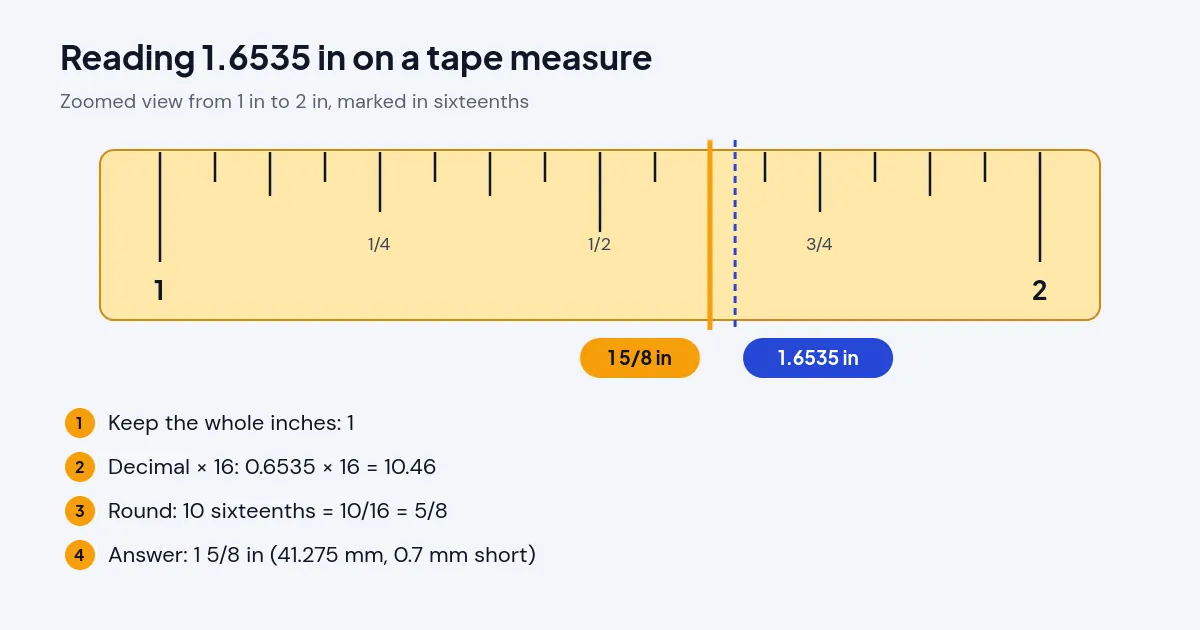
Most imperial rulers and tape measures are marked in sixteenths of an inch, not decimals. To read a decimal like 1.6535 inches on a tape, multiply the decimal part by 16 and round to the nearest whole number:
- Keep the whole inches to one side. In 1.6535, that is 1 inch.
- Multiply the decimal by 16: 0.6535 × 16 = 10.46.
- Round to the nearest whole number: 10.
- Write it as sixteenths and simplify: 10/16 is 5/8. The answer is 1 5/8 inches.
For finer work, multiply by 32 or 64 instead. Take 18 mm plywood, which is 0.7087 inches. Multiplied by 16 that is 11.34, so the nearest sixteenth is 11/16 inch. Multiplied by 32 it is 22.68, which rounds to 23/32 inch. That is why 18 mm sheet is often sold in the US as 23/32 inch, and why it is a little thinner than a true 3/4 inch board at 19.05 mm.
Fraction to mm Cheat Sheet
Print or bookmark this table if you regularly switch between metric drawings and imperial tools. Values are exact to three decimal places.
| Inches | Decimal | Millimetres |
|---|---|---|
| 1/32 | 0.03125 | 0.794 |
| 1/16 | 0.0625 | 1.588 |
| 1/8 | 0.125 | 3.175 |
| 3/16 | 0.1875 | 4.763 |
| 1/4 | 0.25 | 6.35 |
| 5/16 | 0.3125 | 7.938 |
| 3/8 | 0.375 | 9.525 |
| 7/16 | 0.4375 | 11.113 |
| 1/2 | 0.5 | 12.7 |
| 5/8 | 0.625 | 15.875 |
| 3/4 | 0.75 | 19.05 |
| 7/8 | 0.875 | 22.225 |
| 1 | 1 | 25.4 |
What Do Common Metric Sizes Measure in Inches?
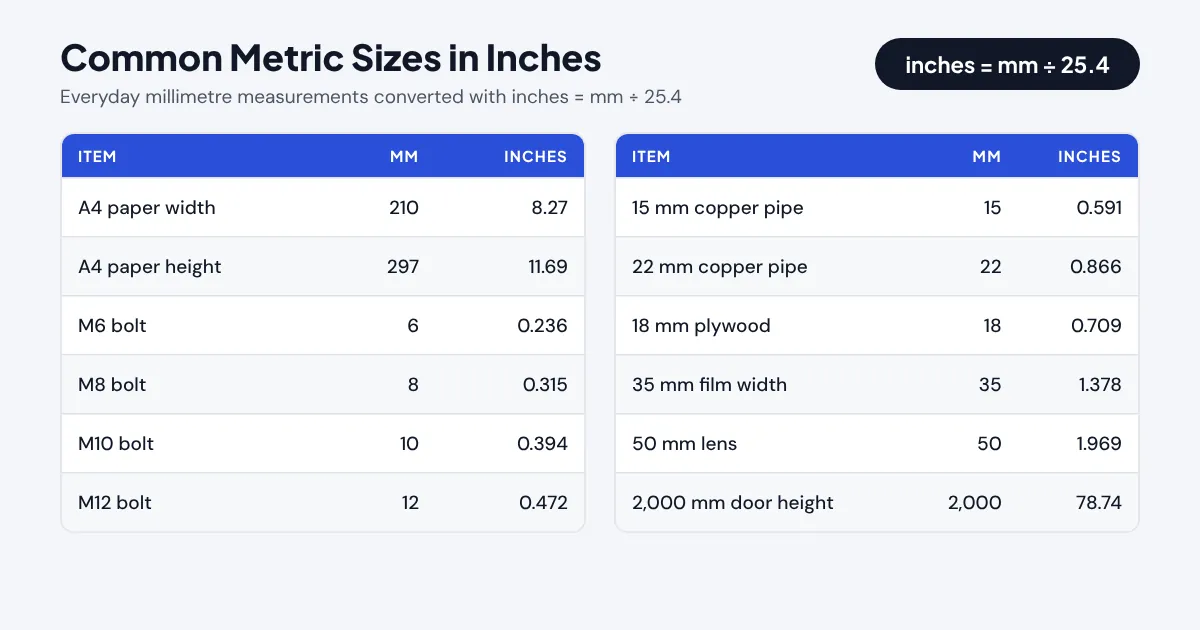
Most of the time you convert mm to inches for a real object: a sheet of paper, a bolt, a pipe or a door. The table below covers sizes that come up again and again in offices, workshops and DIY stores, worked out with the same rule of dividing by 25.4.
| Item | Millimetres | Inches | Nearest 1/16 in |
|---|---|---|---|
| A4 paper (width x height) | 210 x 297 | 8.27 x 11.69 | 8 1/4 x 11 11/16 |
| M6 bolt | 6 | 0.236 | 1/4 |
| M8 bolt | 8 | 0.315 | 5/16 |
| M10 bolt | 10 | 0.394 | 3/8 |
| M12 bolt | 12 | 0.472 | 1/2 |
| 15 mm copper pipe | 15 | 0.591 | 9/16 |
| 22 mm copper pipe | 22 | 0.866 | 7/8 |
| 18 mm plywood | 18 | 0.709 | 11/16 |
| 2,000 mm door height | 2,000 | 78.74 | 78 3/4 |
Two patterns stand out. First, metric bolts sit close to imperial sizes but never match them, so an M8 bolt (0.315 in) is a touch larger than a 5/16 inch one (0.3125 in) and a 1/2 inch spanner will feel loose on an M12 head. Second, A4 paper is narrower and taller than US Letter, which is 8.5 x 11 inches, so a document laid out for one size will shift when printed on the other.
How Can You Practise Converting mm to Inches?
The quickest way to get comfortable is to convert mm to inches for things you already know. Take three measurements from around you, estimate each one with the divide-by-25 shortcut, then check the answer with the converter. After a week or two the anchors become automatic: 25 mm is just under an inch, 100 mm is just under 4 inches and 300 mm is just under a foot.
A good second exercise is to read a metric tape and an imperial tape side by side. Line up the zero marks and look at where 127 mm falls: exactly on the 5 inch mark. Then look at 50 mm, which lands just short of 2 inches, and 200 mm, which lands a little short of 7 7/8 inches. Seeing the two scales together makes it obvious why every mental method needs a small correction, and it helps you spot a slipped decimal point before it costs you a piece of timber.
If you work with drawings, practise in both directions. Convert mm to inches for a few hole sizes, then convert the rounded fractions back to millimetres and see how far they drift. A 6 mm hole rounded to 1/4 inch is 6.35 mm, so the fraction is 0.35 mm larger. That gap is harmless for a shelf pin but too much for a bearing, which is exactly the judgement the shortcuts in this guide are meant to support.
What Mistakes Should You Avoid?
Most errors when people convert mm to inches come from one of these five slips.
- Treating 25 mm as an inch. The gap is only 0.4 mm, but over ten inches it grows to 4 mm, which is enough to stop a shelf fitting into an alcove.
- Mixing up centimetres and millimetres. If a product lists 2.5 cm, that is 25 mm, not 2.5 mm. Multiply centimetres by 10 before you start, or divide centimetres by 2.54 directly.
- Reading decimal inches as fractions. 1.5 inches is 1 1/2 inches, not 1 5/16. The decimal is a proportion of a whole inch, not a count of sixteenths.
- Rounding too early. If you convert to the nearest 1/8 inch and then convert back to mm, you can be 1.5 mm out. Keep the decimal until the final step.
- Assuming close sizes swap. A 12 mm bolt is 0.472 inch and a 1/2 inch bolt is 0.5 inch. They look alike, but a 1/2 inch spanner will slip on the metric head.
How Do You Convert Bigger Lengths to Feet and Inches?
For room sizes, furniture and heights, inches alone get unwieldy. Convert mm to inches first, then divide by 12 to get feet, keeping the remainder as inches. A 2,000 mm door is 2,000 ÷ 25.4 = 78.74 inches. Twelve goes into 78 six times with 6 left over, so the door is about 6 feet 6 3/4 inches tall. The inches to feet converter handles that second step and rounds the leftover inches to the fraction you choose.
When Should You Use a Calculator Anyway?
Mental shortcuts are ideal when you convert mm to inches for a quick check in a shop or on site, but they are not the right choice for engineering drawings, 3D printing tolerances or anything you are ordering to size. In those cases, type the exact value into the millimetre to inch converter, read the decimal to four places and choose a fraction precision of 1/32 or 1/64 inch. The converter also shows the result in thou (thousandths of an inch), which machinists and sheet metal suppliers often use.
A sensible habit is to do the mental estimate first and then confirm it with the tool. If the two disagree by more than a millimetre or so, you have probably slipped a decimal point, and it is far better to catch that before you cut.
Sources
Checked on 8 October 2026 by the ToolVasta Team. See our editorial policy for how tools are built and reviewed.
- Weights and Measures Act 1985, Schedule 1 (legislation.gov.uk)
- NIST Office of Weights and Measures: unit conversion
Frequently asked questions
What is the quickest way to convert mm to inches?
Multiply the millimetres by 4 and divide by 100, then take off about 1.6%. For 50 mm that gives 2.0, less 1.6%, or about 1.97 inches. The exact answer is 1.9685 inches.
Is there an exact mm to inch match I can memorise?
Yes. 127 mm is exactly 5 inches and 254 mm is exactly 10 inches, because 25.4 multiplied by 5 is 127. These make useful reference points for checking an estimate.
How do I convert inches to mm without a calculator?
Multiply the inches by 25, then add 0.4 times the inches. For 6 inches, 150 plus 2.4 gives 152.4 mm, which is exact.
How many mm is 1/16 of an inch?
One sixteenth of an inch is 1.5875 mm, usually rounded to 1.6 mm. It is the smallest marking on most imperial tape measures.
Why do UK products list both mm and inches?
The UK uses metric units for most trade, but inches remain common for screen sizes, pipe threads, tyres and many tools. Dual labelling helps buyers match parts from either system.