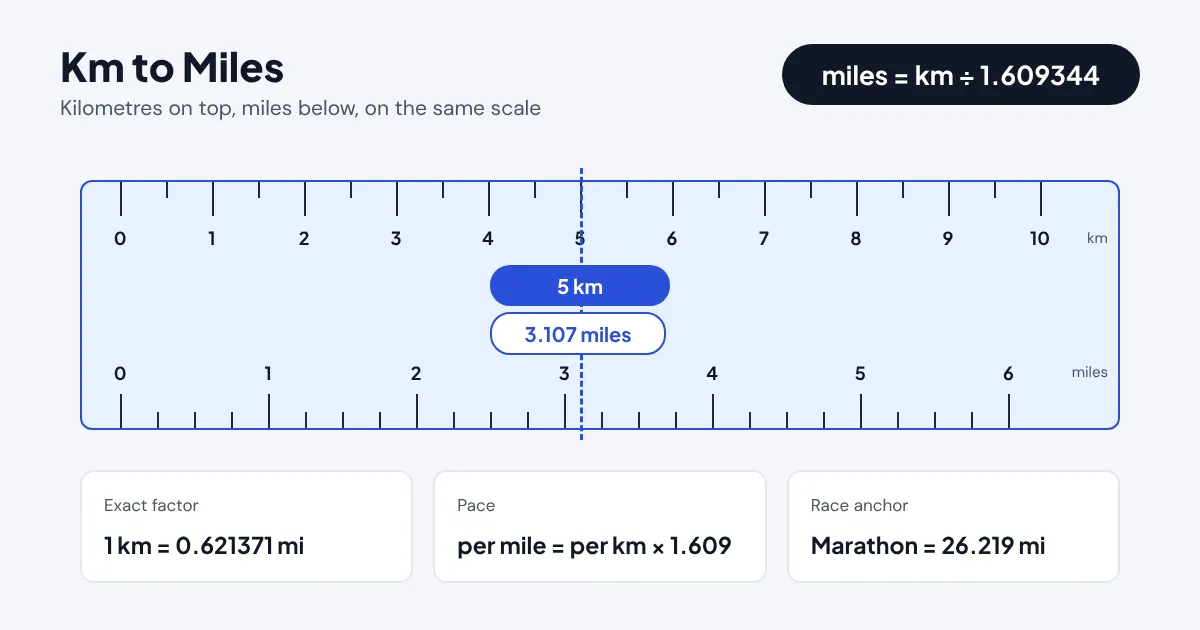
Quick answer: To convert kilometres to miles, divide the kilometres by 1.609344, or multiply by 0.621371. So 5 km is 3.107 miles, 10 km is 6.214 miles and 100 km is 62.137 miles. Type any distance above for the exact answer, and add a finish time if you would like your running pace per kilometre and per mile as well.
What Is a Km to Miles Converter?
A km to miles converter turns a metric distance into the miles used on British road signs, speedometers and most fitness apps set to UK defaults. It is useful for runners comparing a 10K time with a mile split, for drivers reading a European route plan, and for walkers following an Ordnance Survey map in kilometre grid squares while thinking in miles. Alongside the miles, the tool gives miles and yards, metres and feet, and turns an optional finish time into pace and speed.
How Do You Use the Km to Miles Converter?
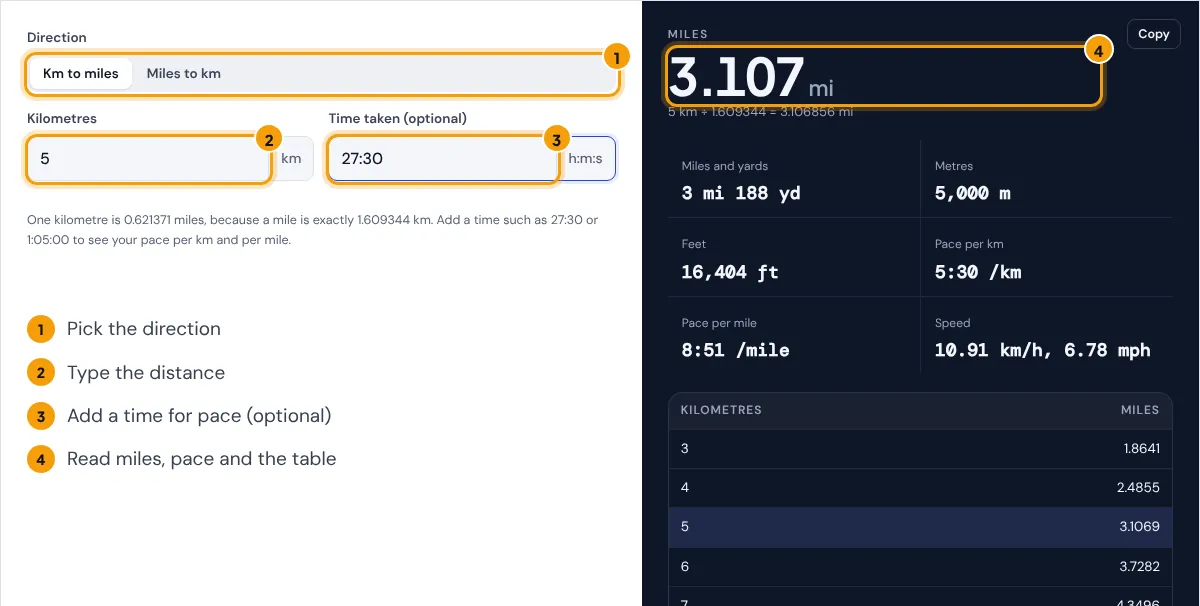
- Leave the direction on Km to miles, or switch to Miles to km if you are starting from miles.
- Type the distance in kilometres, for example 5, 21.0975 or 1,000.
- Optionally add the time it took, as minutes and seconds such as 27:30 or hours, minutes and seconds such as 1:05:00.
- Read the miles, then the miles and yards, metres and feet. With a time entered you also get pace per km, pace per mile and average speed.
The line under the main figure shows the sum used, for example 5 km ÷ 1.609344 = 3.106856 mi, so you can see exactly where the answer comes from.
What Is the Km to Miles Formula?
A mile is 1,760 yards and a yard is exactly 0.9144 metres, so one mile is exactly 1,609.344 metres. That definition is written into Schedule 1 of the Weights and Measures Act 1985. One kilometre is therefore 1 ÷ 1.609344 = 0.621371 miles, rounded to six decimal places. The National Physical Laboratory, the UK's measurement institute, explains how the metre itself is defined.
miles = kilometres × 0.621371 (rounded)
pace per mile = pace per km × 1.609344
How Many Miles Is a 5 Km Parkrun?
You finish a 5 km parkrun in 27 minutes 30 seconds. The distance is 5 ÷ 1.609344 = 3.107 miles, which is 3 miles and 188 yards. Your pace is 27.5 ÷ 5 = 5.5 minutes, or 5:30 per km. Multiply that by 1.609344 to get 8.85 minutes, which is 8:51 per mile. Average speed is 5 km in 0.4583 hours, or 10.91 km/h and 6.78 mph. For splits over a whole race plan, the running pace calculator takes it further.
Km to Miles Conversion Table
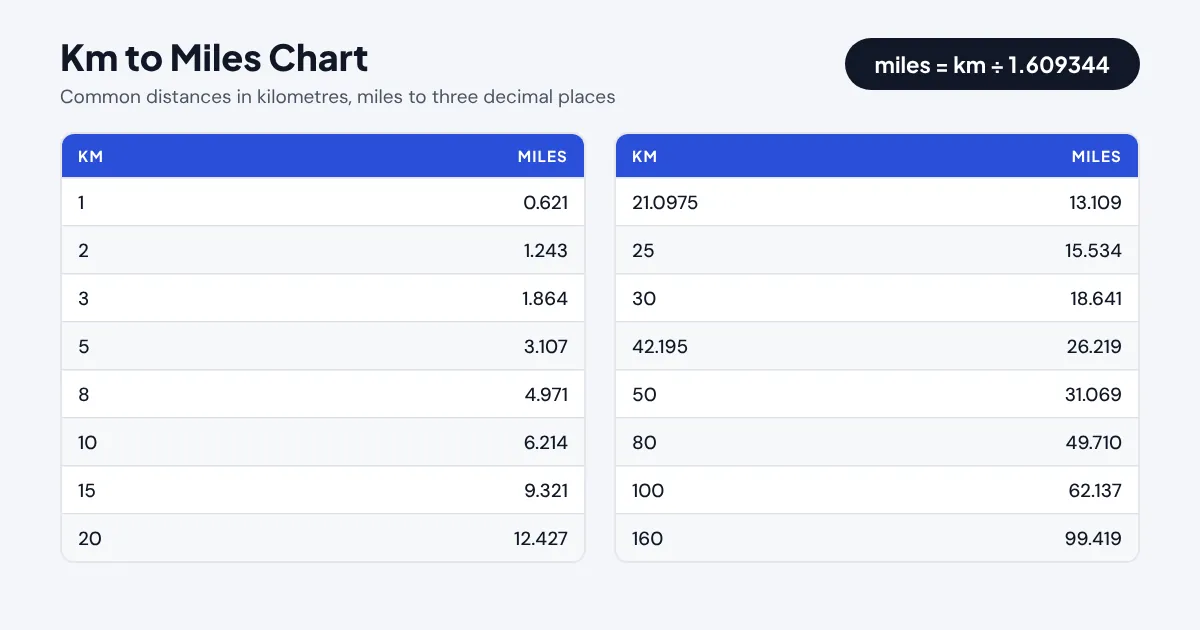
Values are rounded to three decimal places.
| Kilometres | Miles |
|---|---|
| 1 | 0.621 |
| 2 | 1.243 |
| 3 | 1.864 |
| 5 | 3.107 |
| 8 | 4.971 |
| 10 | 6.214 |
| 15 | 9.321 |
| 20 | 12.427 |
| 25 | 15.534 |
| 30 | 18.641 |
| 40 | 24.855 |
| 50 | 31.069 |
| 80 | 49.710 |
| 100 | 62.137 |
| 160 | 99.419 |
| 200 | 124.274 |
| 500 | 310.686 |
| 1000 | 621.371 |
How Long Are Race Distances in Miles?
Road races in the UK are measured in metric units, but many runners still think in miles. These are the standard distances converted exactly.
| Race | Kilometres | Miles |
|---|---|---|
| parkrun / 5K | 5 km | 3.107 mi |
| 10K | 10 km | 6.214 mi |
| Half marathon | 21.0975 km | 13.109 mi |
| Marathon | 42.195 km | 26.219 mi |
| 50K ultra | 50 km | 31.069 mi |
| 100K ultra | 100 km | 62.137 mi |
The pace table below links common per-kilometre paces to their per-mile equivalents and the finish times they give for 5K and 10K.
| Pace per km | Pace per mile | 5K time | 10K time |
|---|---|---|---|
| 4:00 /km | 6:26 /mile | 20:00 | 40:00 |
| 5:00 /km | 8:03 /mile | 25:00 | 50:00 |
| 6:00 /km | 9:39 /mile | 30:00 | 1:00:00 |
| 7:00 /km | 11:16 /mile | 35:00 | 1:10:00 |
| 8:00 /km | 12:52 /mile | 40:00 | 1:20:00 |
How Can You Estimate Km in Miles Quickly?
- Halve it, then add a quarter of the half. For 40 km: half is 20, a quarter of that is 5, so about 25 miles. The exact answer is 24.85, so this rule runs about 0.6% high.
- Multiply by 0.6 and add a little. 100 km × 0.6 = 60, and the real figure is 62.1, so add roughly 3.5%.
- Use Fibonacci pairs in reverse. 8 km is about 5 miles, 13 km is about 8 miles and 21 km is about 13 miles.
- Know the anchors. 1.609 km is one mile, 8.047 km is five miles and 16.093 km is ten miles.
Cyclists can feed the converted distance into the cycling speed calculator, and for speeds in km/h, mph or knots the speed converter handles every common unit.
Related Converters
- Miles to Km Converter
- Speed Converter
- Running Pace Calculator
- Knots to MPH Converter
- MM to Inches Converter
- Steps to Miles Calculator
Sources
Checked on 8 October 2026 by the ToolVasta Team. See our editorial policy for how tools are built and reviewed.
- Weights and Measures Act 1985, Schedule 1 (legislation.gov.uk)
- National Physical Laboratory: the SI units
Frequently asked questions
How do I convert km to miles?
Divide the kilometres by 1.609344, or multiply by 0.621371. For example, 30 km ÷ 1.609344 = 18.641 miles.
How many miles is 5 km?
5 km is 3.107 miles, or 3 miles and 188 yards. That is the distance of every parkrun and most 5K fun runs.
How many miles is 10 km?
10 km is 6.214 miles. A 10K run at 6 minutes per km takes one hour, which is a pace of 9:39 per mile.
Is a km longer than a mile?
No. A kilometre is shorter, at about 0.62 miles. A mile is roughly 1.6 km, so any distance in kilometres is a bigger number than the same distance in miles.
How do I convert pace per km to pace per mile?
Multiply the pace per km by 1.609344. A 5:00 per km pace is 5 × 1.609344 = 8.05 minutes, or 8:03 per mile. Enter a distance and time above and the converter does this for you.
Why are UK race distances metric when road signs use miles?
Athletics adopted metric distances internationally, so British races follow the same 5K, 10K and half marathon lengths used everywhere else. Road signs and speed limits stayed in miles because changing them would be costly, so runners in the UK often need both units.