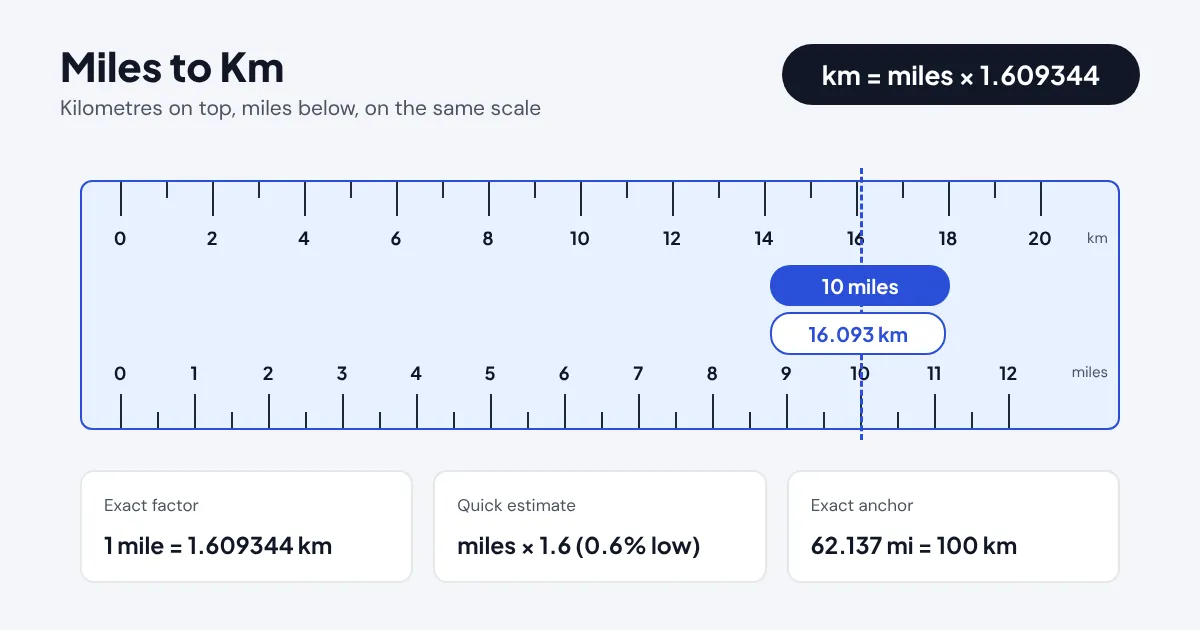
Quick answer: To convert miles to kilometres, multiply the miles by 1.609344. So 10 miles is 10 × 1.609344 = 16.093 km, and a marathon of 26.2 miles is 42.165 km. The converter above does the sum for any distance, shows the working and also gives the answer in metres, yards, feet and nautical miles.
What Is a Miles to Km Converter?
A miles to km converter changes a distance in imperial miles into metric kilometres. The UK and the US still sign roads and measure car journeys in miles, while almost every other country, and most running races, use kilometres. That gap shows up all the time: planning a drive in France from a UK route, comparing a US hiking trail with a European one, or checking how far a 10 mile training run really is in race terms. The converter gives the exact figure, not a rough guess, and you can flip it to go from kilometres back to miles.
How Do You Use the Miles to Km Converter?
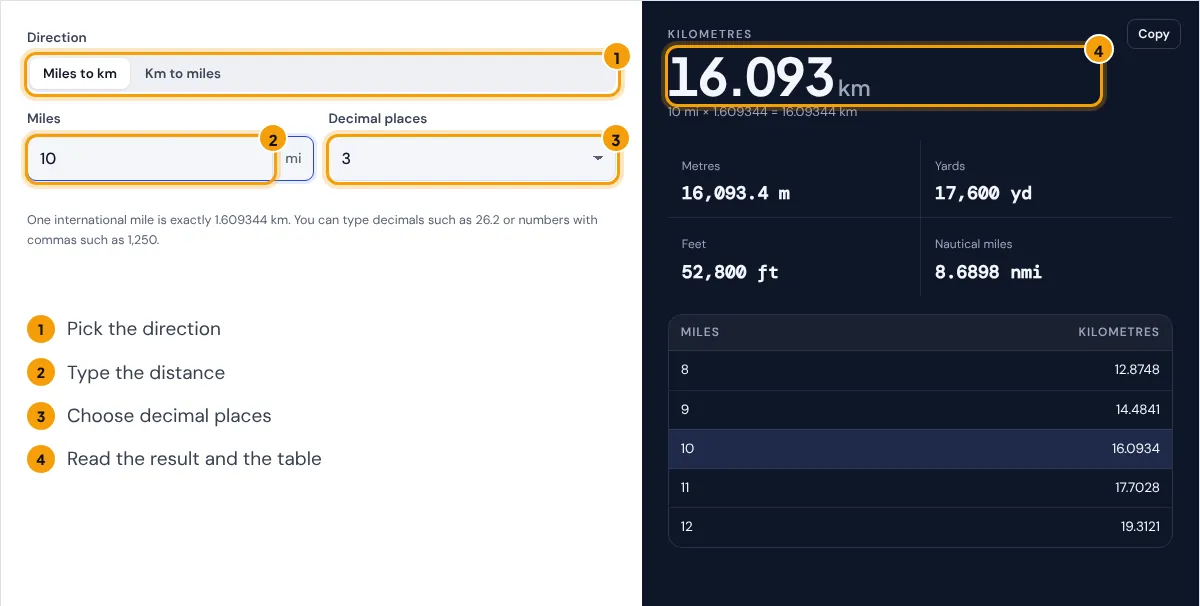
- Leave the direction on Miles to km, or switch to Km to miles if your starting figure is metric.
- Type the distance. Decimals such as 26.2 and large numbers such as 1,250 both work.
- Choose how many decimal places you want in the main answer. Three is plenty for most uses.
- Read the kilometres, then the metres, yards, feet and nautical miles underneath. The table shows whole-mile values either side of your figure.
The grey line under the result shows the exact sum used, for example 10 mi × 1.609344 = 16.09344 km, so you can quote the working in a report or a training log.
What Is the Miles to Km Formula?
The international mile is 1,760 yards, and since 1959 the yard has been defined as exactly 0.9144 metres. That makes one mile exactly 1,609.344 metres, or 1.609344 km. The UK sets the same value in Schedule 1 of the Weights and Measures Act 1985, and the US National Institute of Standards and Technology publishes the same factor. Because it is exact, any difference between two converters comes only from rounding.
miles = kilometres ÷ 1.609344 (or × 0.621371)
How Far Is 200 Miles in Km?
A drive from London to Manchester is about 200 miles. Multiply by the factor: 200 × 1.609344 = 321.869 km. If your hire car in Spain shows fuel economy in litres per 100 km, that figure lets you estimate the fuel for the same distance, and the fuel cost calculator will price the trip for you.
For a runner, a 13.1 mile half marathon is 13.1 × 1.609344 = 21.082 km. The official half marathon is 21.0975 km, so 13.1 miles is about 15 metres short. That is why race organisers quote the metric distance and why a watch set to miles will read 13.11 at the finish.
Miles to Km Conversion Table
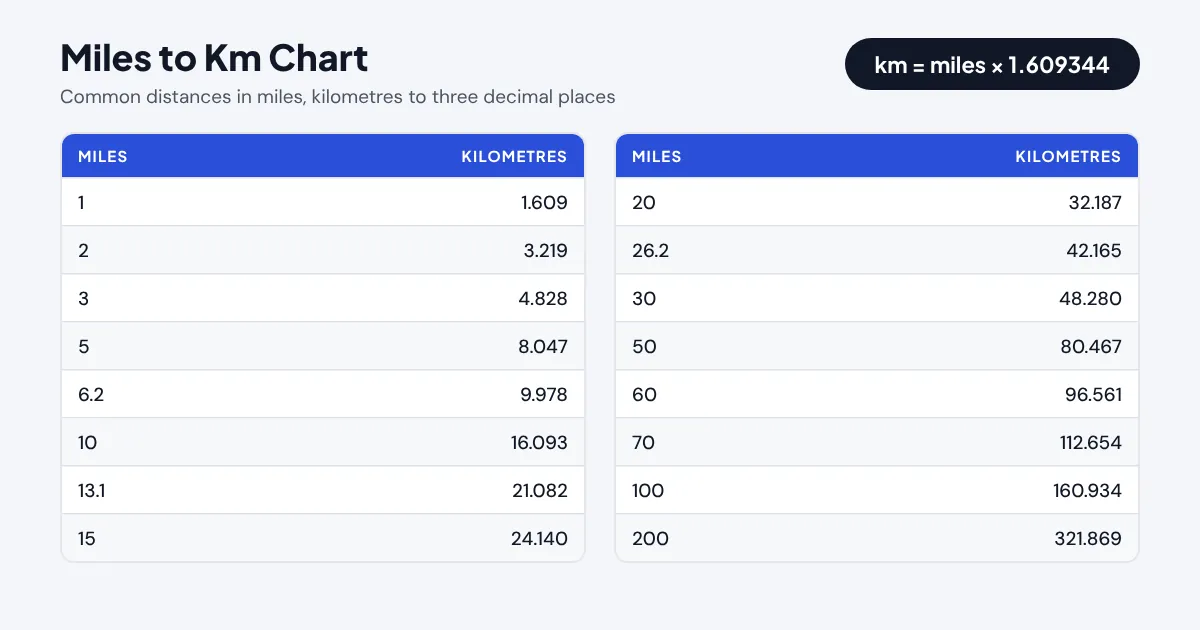
Values are rounded to three decimal places.
| Miles | Kilometres |
|---|---|
| 1 | 1.609 |
| 2 | 3.219 |
| 3 | 4.828 |
| 5 | 8.047 |
| 6.2 | 9.978 |
| 10 | 16.093 |
| 13.1 | 21.082 |
| 15 | 24.140 |
| 20 | 32.187 |
| 26.2 | 42.165 |
| 30 | 48.280 |
| 50 | 80.467 |
| 60 | 96.561 |
| 70 | 112.654 |
| 100 | 160.934 |
| 200 | 321.869 |
| 500 | 804.672 |
| 1000 | 1,609.344 |
How Do Speed Limits Convert Between mph and km/h?
The same factor converts speeds, because mph and km/h both measure distance per hour. A 70 mph motorway limit is 70 × 1.609344 = 112.7 km/h, 30 mph is 48.3 km/h and 60 mph is 96.6 km/h. Driving abroad, the reverse matters more: 130 km/h on a French autoroute is 80.8 mph and 50 km/h in a town is 31.1 mph. For speeds in knots, metres per second or feet per second, use the speed converter. UK road signs show distances in miles and yards, as the Highway Code shows, so a sign reading 800 yards means about 0.73 km.
How Can You Convert Miles to Km in Your Head?
- Multiply by 1.6. This is 0.6% low, which is close enough for road trips. 50 miles is about 80 km (the exact answer is 80.47 km).
- Add 60%. The same rule said another way: take the miles, add half, then add a tenth. For 30 miles: 30 + 15 + 3 = 48 km.
- Use Fibonacci pairs. Neighbouring Fibonacci numbers have a ratio close to 1.6, so 3 miles is about 5 km, 5 miles is about 8 km, 8 miles is about 13 km and 13 miles is about 21 km.
- Remember the exact anchors. 5 miles is 8.047 km, 100 miles is 160.934 km, and 100 km is 62.137 miles to three decimal places.
If you count distance in steps rather than miles, the steps to miles calculator turns a step count into miles first, and this page then gives the kilometres.
Related Converters
- Km to Miles Converter
- Speed Converter
- Knots to MPH Converter
- MM to Inches Converter
- Inches to Feet Converter
- Mileage Reimbursement Calculator
Sources
Checked on 8 October 2026 by the ToolVasta Team. See our editorial policy for how tools are built and reviewed.
- Weights and Measures Act 1985, Schedule 1 (legislation.gov.uk)
- NIST Office of Weights and Measures: unit conversion
Frequently asked questions
How do I convert miles to km?
Multiply the number of miles by 1.609344. For example, 25 miles × 1.609344 = 40.234 km. For a quick estimate, multiply by 1.6.
How many km is 1 mile?
One mile is exactly 1.609344 kilometres, or 1,609.344 metres. The figure is exact because the yard is defined as 0.9144 metres and a mile is 1,760 yards.
How many km is a 10 mile run?
10 miles is 16.093 km. That sits between a 15 km race and a half marathon, which is 21.0975 km.
Is a nautical mile the same as a mile?
No. A nautical mile is exactly 1.852 km, about 15% longer than a land mile of 1.609 km. Ships and aircraft use nautical miles, so the converter lists them separately.
Why do the UK and US still use miles?
Road signs, speed limits and car odometers in both countries were built around miles long before metrication, and changing every sign is costly. Most science, sport and trade in the UK already uses kilometres, so both units are in daily use.
Is multiplying by 1.6 accurate enough?
For journeys it is fine, because it is only 0.6% low: about 1 km short over 100 miles. For race distances, survey work or anything you will publish, use the full factor of 1.609344.