
Quick answer: The fairest way to pick teams at random is to shuffle every name once and deal them out in turn, so each person has the same chance of landing on any team. Use a coin or a die to decide who goes first, and a snake draft when teams also need to be balanced by skill.
Picking teams sounds simple until two captains choose their friends, the same child is picked last every week, or a game night stalls over who goes first. Random methods fix that by taking the choice away from people. A random team generator splits a whole list in one click, a dice roller settles turn order, and a random color generator can hand out team colors without an argument. This guide covers the methods that are fair, the ones that only look fair, and how to choose between them for a classroom, a sports session, a work event or a board game.
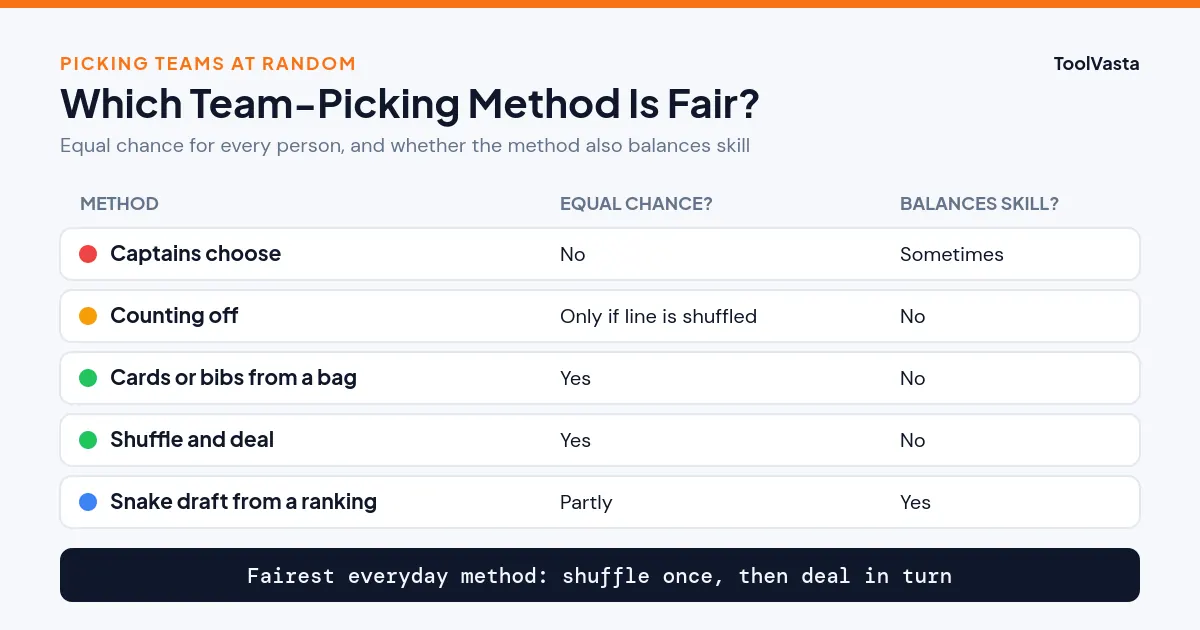
Why Is Picking Teams at Random Fairer Than Choosing?
Picking at random is fairer because nobody's choice decides where anyone else ends up. When captains choose, the order of picks tells everyone who is valued most, and the last few people hear that message every time.
Random selection also removes accusations of bias. A coach who builds teams by hand can be accused of favoring friends, and a teacher who pairs students can be accused of punishing someone. When a neutral method decides, the result is easier to accept, even when it is not the result someone wanted. It also mixes groups that would never form on their own, which is often the point of group work in the first place.
There is one honest limit. Pure chance does not guarantee balanced teams. If you split 10 players at random, one side can still get the three strongest players. When the score matters, combine randomness with a balancing step, which is covered below.
How Do You Pick Teams at Random Fairly?
The most reliable way is to shuffle the full list of names once and then deal them into teams one at a time, like dealing cards. Every possible line-up then has the same chance, and team sizes never differ by more than one person.
Shuffle and deal
Write every name on a slip, shuffle them, and deal them to Team 1, Team 2, Team 3 and back to Team 1 until the slips run out. The random team generator does exactly this with a Fisher-Yates shuffle, which moves through the list and swaps each name with a randomly chosen one, so no position is favored. For 12 people in 3 teams there are 5,775 different ways to split the group, so the same teams rarely repeat.
Counting off
Counting off ("one, two, three, one, two, three") is quick and works without any equipment, but it is only as random as the line. Friends who stand together end up on different teams, which may be what you want, but people who know the trick can choose a spot to land with each other. Shuffle the line first, or ask people to line up by birthday month, to make it fairer.
Playing cards or colored bibs
Hand out shuffled playing cards and group people by suit, or put colored bibs in a bag and let each player draw one. For four teams of five, use five cards from each suit. If you need team colors and have no bibs, a random color generator can pick distinct colors for each team, along with codes you can use on name badges or slides.
Snake draft for balanced teams
A snake draft balances teams by skill while keeping an element of chance. Rank the players, then let teams take turns choosing in the order 1, 2, 3, then 3, 2, 1, so the team that picks first in one round picks last in the next.
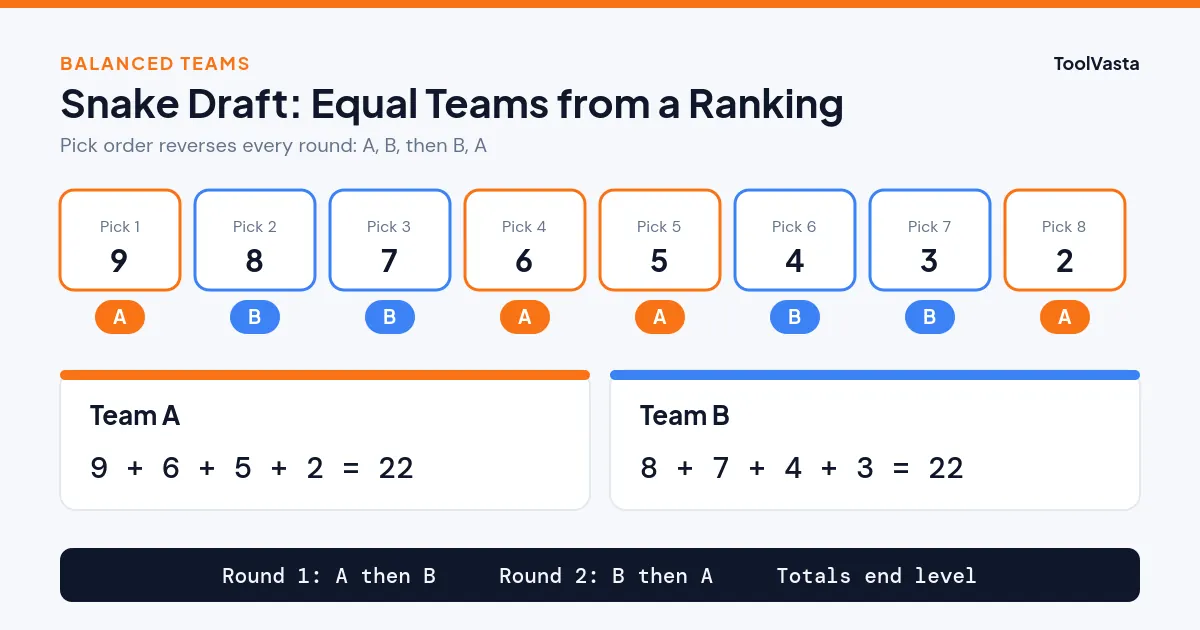
For eight players rated 9 down to 2, a two-team snake draft gives Team A the players rated 9, 6, 5 and 2, and Team B the players rated 8, 7, 4 and 3. Both teams total 22. To add the balancing step in the random team generator, put a number after each name, such as "Ava, 7", and tick Balance teams by skill. Players with equal ratings are shuffled first and the first pick goes to a random team, so balanced teams still change each time.
| Method | Best for | Equal chance for everyone? | Balances skill? |
|---|---|---|---|
| Captains choose | Nothing, if you can avoid it | No | Sometimes |
| Counting off | Quick PE or workshop groups | Only if the line is shuffled | No |
| Cards or bibs from a bag | Groups with no phones or screens | Yes | No |
| Shuffle and deal (team generator) | Classes, offices, any list | Yes | No |
| Snake draft from a ranking | Sports and competitive games | Partly | Yes |
How Do You Decide Who Goes First?
The simplest fair way to decide who goes first is a single random event that each side has the same chance of winning, such as a coin toss for two players or a die roll for more. Agree on the rule before anyone rolls, so nobody can change it after seeing the result.
Coin toss for two sides
A coin flip is ideal when there are exactly two choices. One side calls heads or tails in the air, or you simply assign heads to one side beforehand. A real coin is very slightly biased toward the side that starts face up: a 2023 study of 350,757 hand flips found coins landed on their starting side 50.8% of the time. A virtual coin has no starting side, so it is exactly 50/50.
Highest roll for three or more
For three or more players, everyone rolls one die and the highest goes first. Use a d20 rather than a d6 when you can: with four players and a d6, the chance of a tie for the top roll is about 31%, while a d20 cuts that to under 10%. If there is a tie, only the tied players roll again. Many tabletop role-playing games use the same idea for initiative, adding a small bonus to a d20 roll and acting from the highest total to the lowest.
Full turn order
To set the order for every player, not just the first, shuffle the list of names and read it from top to bottom. The random name picker has a shuffle mode that does this, and it can also draw a single winner or a few names at once. Turn order then rotates clockwise from the first player in games that use a table, which keeps the shuffle to one per game.
What Makes a Random Method Truly Fair?
A random method is fair when every outcome has the same chance, each draw is independent of the last, and everyone can see how it works. If any of those three is missing, people will doubt the result, often with good reason.
- Equal chance. Every name, team or face must be equally likely. A shuffled deck and a fair die meet this; a hat where some names are folded smaller does not.
- Independence. One result should not affect the next. Software tools that use a cryptographically secure source, such as the browser function described in the W3C Web Cryptography API, produce numbers that cannot be predicted from earlier results.
- Transparency. Run the draw where everyone can see it, such as on a projected screen, and share the result straight away. Hidden draws invite suspicion even when they are honest.
- No re-rolls. Decide in advance whether a result can be redrawn. Re-rolling until someone is happy quietly turns a random choice back into a chosen one.
Behind the scenes, good digital randomness comes from tested generators. The NIST random bit generation project publishes the standards that secure generators are built and tested against, which is why browser-based tools can be trusted for everyday draws such as team picks and raffles.
Which Random Method Should You Use?
Use the method that matches the size of the group and how much the outcome matters. For a quick classroom activity, shuffle and deal is enough. For a league match, add a snake draft. For a board game, a single die roll or coin toss decides who starts.
- Classroom groups: paste the class list into the team generator and project the result. Mark a random captain in each group to give someone the job of keeping time.
- Sports sessions: rate players from 1 to 10, use the balanced option, then hand out colored bibs to match each team.
- Office events and quizzes: split by number of teams, name each team, and give each one a color for scorecards or slides.
- Board and tabletop games: roll a d20 for who goes first, then play clockwise. For complicated rolls such as advantage or 4d6 drop lowest, the dice roller handles the notation and shows the odds.
Whichever method you choose, say it out loud before you start: "We shuffle once, deal into three teams, and nobody swaps." Agreeing on the rules first is what makes a random pick feel fair to everyone in the room.
Frequently asked questions
What is the fairest way to pick teams?
Shuffle every name once and deal them into teams in turn. Each person has the same chance of joining any team, and team sizes stay within one person of each other.
How do you make random teams balanced?
Rank players by skill and use a snake draft, where the pick order reverses every round (1, 2, 3, then 3, 2, 1). Shuffle players with equal ratings first so the teams still vary.
Is counting off a fair way to split a group?
Only if the line is in a random order. People can choose where they stand to land on the same team, so shuffle the line or sort it by something unrelated, such as birthday month, first.
How do you pick who goes first in a game?
Use a coin toss for two players or have everyone roll a die, with the highest going first. A d20 gives fewer ties than a d6, and only tied players roll again.