Quick answer: This dice roller rolls any virtual dice from a d4 to a d100, plus full dice notation such as 2d6+3, 4d6kh3 or advantage on a d20. Each die is a fair, independent roll. The average of NdS + M is N × (S + 1) ÷ 2 + M, so 2d6+3 averages 10.

What Is an Online Dice Roller?
An online dice roller is a tool that replaces physical dice with random results generated in your browser. It is handy when the dice are lost under the couch, when a game needs a d12 nobody owns, or when you play tabletop games such as Dungeons & Dragons over a video call.
This roller handles every standard polyhedral die (d4, d6, d8, d10, d12, d20 and d100) and any custom die from 2 to 1,000 sides. Every roll uses your browser's cryptographic random number source, described in the W3C Web Cryptography API specification, with rejection sampling so each face has exactly the same chance. Alongside the total, it shows the full range, the true average and the exact chance of what you rolled, the same numbers the dice probability calculator works out in more depth.
How Do You Roll Dice with This Tool?
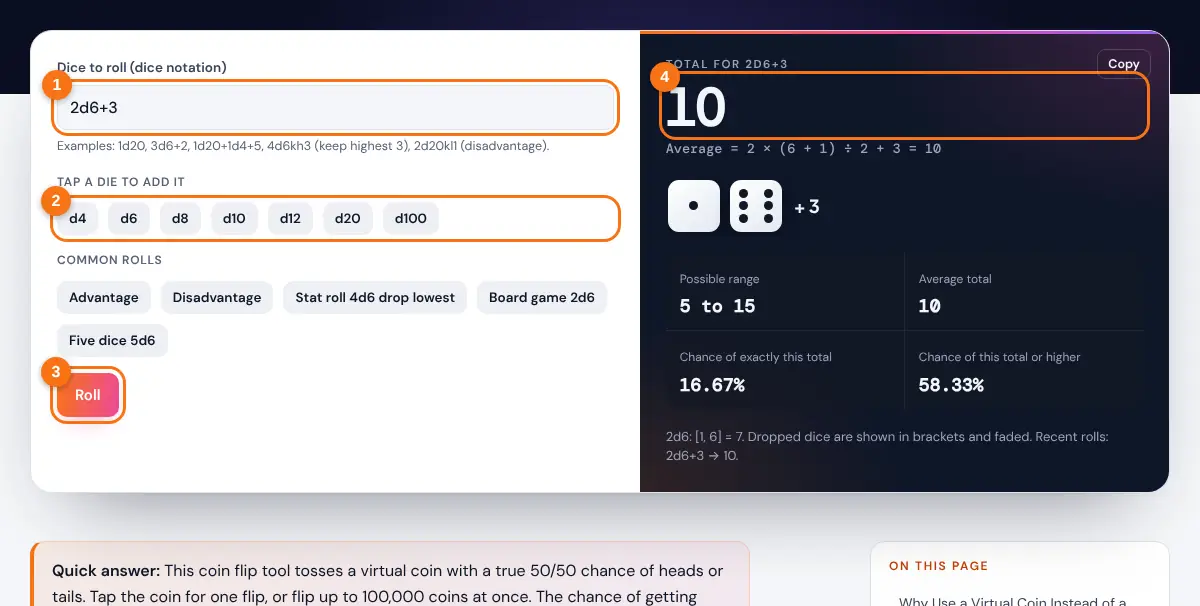
- Type your roll in dice notation, such as 1d20 or 3d6+2, or tap a die button. Tapping the same die again adds another one, so three taps on d6 gives 3d6.
- For common game rolls, press a preset: Advantage, Disadvantage, a 4d6 drop lowest stat roll, 2d6 for board games or 5d6 for dice games.
- Press Roll or the Enter key. Every die appears on screen, and any dropped dice are faded.
- Read the total, the possible range, the average and the chance of rolling exactly that total or higher. Use Copy to paste the full result into a chat.
The last eight rolls stay listed under the result, which helps when a group wants to check a roll after the fact. Nothing is stored or sent anywhere; refreshing the page clears the list.
How Does Dice Notation Work?
Dice notation writes a roll as NdS, where N is the number of dice and S is the number of sides, so 3d6 means three six-sided dice added together. A plus or minus number after it is a flat modifier, and you can chain several groups, such as 1d20+1d4+5.
Average = N × (S + 1) ÷ 2 ± M
Range = (N + M) to (N × S + M)
Worked example: for 2d6+3, the average is 2 × (6 + 1) ÷ 2 + 3 = 7 + 3 = 10, and the range runs from 2 + 3 = 5 up to 12 + 3 = 15. Keep and drop codes change the shape of the roll: kh keeps the highest dice, kl keeps the lowest and dl drops the lowest. A d% is read as a d100.
| Notation | Meaning | Range | Average |
|---|---|---|---|
| 1d20 | One twenty-sided die | 1 to 20 | 10.5 |
| 2d6+3 | Two six-sided dice plus 3 | 5 to 15 | 10 |
| 3d8−2 | Three eight-sided dice minus 2 | 1 to 22 | 11.5 |
| 2d20kh1 | Advantage: roll two d20, keep the higher | 1 to 20 | 13.825 |
| 2d20kl1 | Disadvantage: keep the lower d20 | 1 to 20 | 7.175 |
| 4d6kh3 | Roll 4d6, drop the lowest die | 3 to 18 | 12.24 |
| 1d100 | Percentile die (d%) | 1 to 100 | 50.5 |
Keep and drop rolls do not follow the simple average formula, so for those the tool adds up every possible outcome to give the exact average. That is why 4d6 drop lowest averages 12.24 rather than the 10.5 of plain 3d6, which explains why the method gives stronger characters.
What Are the Odds for 2d6 and a d20?
On two six-sided dice, 7 is the most likely total at 6 in 36, or 16.7%, because six different pairs make it. The totals 2 and 12 each have only one pair and come up 1 in 36 times, about 2.8%.
| 2d6 total | Ways | Chance | Total | Ways | Chance |
|---|---|---|---|---|---|
| 2 | 1 | 2.78% | 8 | 5 | 13.89% |
| 3 | 2 | 5.56% | 9 | 4 | 11.11% |
| 4 | 3 | 8.33% | 10 | 3 | 8.33% |
| 5 | 4 | 11.11% | 11 | 2 | 5.56% |
| 6 | 5 | 13.89% | 12 | 1 | 2.78% |
| 7 | 6 | 16.67% |
A single d20 is flat: every number from 1 to 20 has a 5% chance. Advantage changes that a lot. The chance of rolling 15 or higher rises from 30% on one d20 to 1 − 0.7² = 51% with advantage, and the chance of a natural 20 rises from 5% to 9.75%. For other targets, such as at least one 6 in four dice, use the probability calculator; for a simple yes or no, a coin flip is quicker.
Related Tools
- Dice Probability Calculator
- Random Number Generator
- Coin Flip
- Random Team Generator
- Wheel Spinner
- Fantasy Name Generator
Need a fair pick for a group? See our guide to fair ways to pick teams, players and turns at random.
Frequently asked questions
Is this dice roller fair?
Yes. Each die uses your browser's cryptographic random number generator with rejection sampling, so every face has exactly the same chance and no roll depends on the one before it.
How do I roll with advantage or disadvantage?
Press Advantage to roll 2d20kh1, which keeps the higher of two d20 rolls, or Disadvantage for 2d20kl1, which keeps the lower. Add a modifier after it if you need one, for example 2d20kh1+5.
What does 4d6 drop lowest mean?
You roll four six-sided dice and add the three highest. It is a common way to roll character stats in tabletop role-playing games, and it averages 12.24 instead of 10.5.
How many dice can I roll at once?
Up to 200 dice in one roll, split across up to 12 groups, with any die from 2 to 1,000 sides. The exact odds are shown whenever the number of outcomes is small enough to count in the browser.
What is the most common roll on two dice?
Seven. Six of the 36 possible pairs add up to 7, so it comes up 16.7% of the time. Totals of 2 and 12 are the rarest at about 2.8% each.