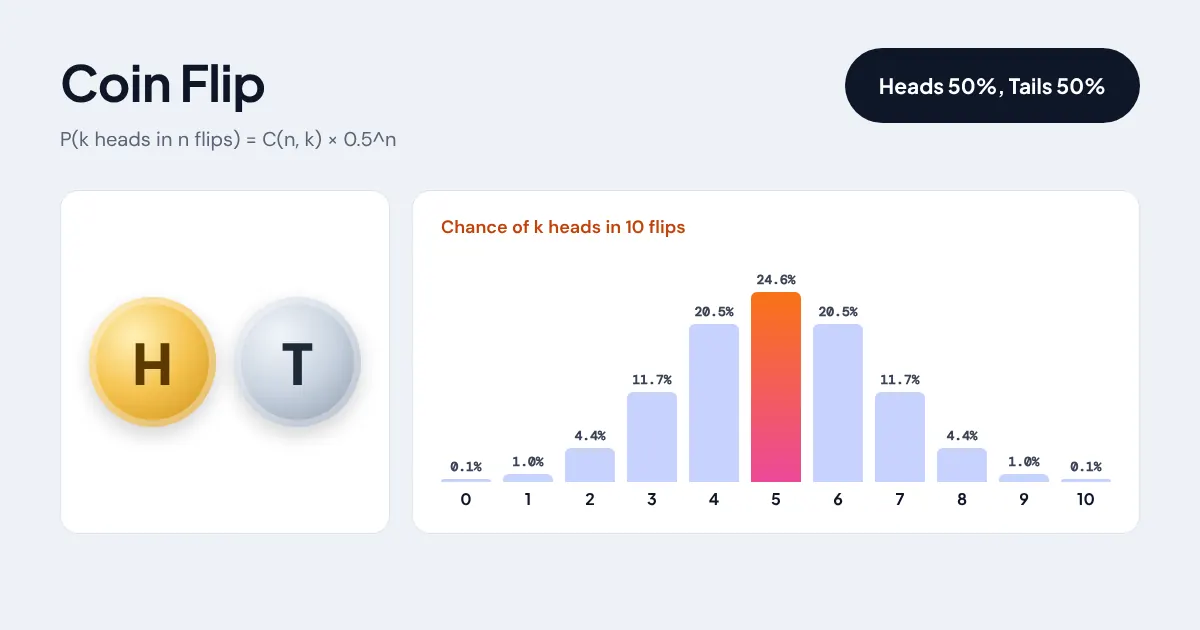
Quick answer: This coin flip tool tosses a virtual coin with a true 50/50 chance of heads or tails. Tap the coin for one flip, or flip up to 100,000 coins at once. The chance of getting exactly k heads in n flips is C(n, k) × 0.5^n, so 5 heads in 10 flips happens 24.6% of the time.
Why Use a Virtual Coin Instead of a Real One?
A coin flip simulator is an online tool that replaces a physical coin toss with a random result of heads or tails. It settles quick decisions, starts games, and lets you test probability by flipping hundreds of coins in a second instead of by hand.
Each flip here comes from your browser's cryptographic random number generator, so heads and tails each have exactly a 50% chance and no flip depends on the one before. You can rename the two sides (for example "Pizza" and "Tacos"), run a best of 3, or flip 1,000 coins to watch the share of heads settle close to 50%. For choices with more than two options, the decision maker picks from a list.
How Do You Flip One Coin or Hundreds at Once?

- Tap the coin or press Flip to toss one coin.
- To flip several coins at once, type a number up to 100,000 or press a preset such as Best of 3 or 1,000.
- Optionally rename heads and tails to the two choices you are deciding between.
- Read the result, the heads and tails shares, the longest run and the chance of that exact count. The session tally keeps adding up every flip until you reset it.
The first 200 results are shown as a sequence of H and T, so you can spot streaks. Long runs look suspicious but are normal: in 100 fair flips, a run of 6 or more of the same side turns up about 81% of the time, and a run of 7 or more about 54% of the time.
What Are the Odds of Heads or Tails?
The odds of heads on a single fair flip are 1 in 2, or 50%, and the same is true for tails. Across several flips, the binomial formula gives the chance of any exact number of heads.
C(n, k) = n! ÷ (k! × (n − k)!)
P(n heads in a row) = 0.5^n
Worked example: for 10 flips, C(10, 5) = 252 ways to get exactly 5 heads, and 0.5^10 = 1 ÷ 1,024. So P(5 heads) = 252 ÷ 1,024 = 0.246, or 24.6%. Exactly half heads is the single most likely outcome, yet it still fails three times out of four.
| Outcome | Probability | About 1 in |
|---|---|---|
| Heads on one flip | 50% | 2 |
| 2 heads in a row | 25% | 4 |
| 3 heads in a row | 12.5% | 8 |
| 5 heads in a row | 3.125% | 32 |
| 10 heads in a row | 0.098% | 1,024 |
| Exactly 5 heads in 10 flips | 24.6% | 4 |
| Exactly 50 heads in 100 flips | 7.96% | 13 |
Past flips do not change the next one. After 5 heads in a row, the sixth flip is still 50% heads; believing tails is "due" is the gambler's fallacy. To explore other two-event and repeated-event odds, use the probability calculator, and for dice games try the dice probability calculator.
Is a Real Coin Toss Really 50/50?
A real coin toss is very close to 50/50, but not exactly, because a flipped coin is slightly more likely to land on the side that was facing up when it left the thumb. In 2007, Stanford statistician Persi Diaconis and colleagues predicted a same-side bias of about 51%.
A 2023 experiment led by researchers at the University of Amsterdam tested this with 350,757 hand flips by 48 people and found that coins landed on the starting side 50.8% of the time; the Utrecht University research record for the study lists the full author group. The bias is small, but it is real. A virtual flip avoids it entirely, because it has no starting side, thumb or air resistance.
The same study found no difference between heads and tails themselves: once you hide which side starts up, the result is a fair toss. Any small edge only appears when the caller knows which side started face up.
Related Tools
- Decision Maker
- Random Name Picker
- Random Number Generator
- Wheel Spinner
- Probability Calculator
- Dice Probability Calculator
Need a fair pick for a group? See our guide to fair ways to pick teams, players and turns at random.
Frequently asked questions
Is this coin flip truly random?
Yes. Each flip uses one bit from your browser's cryptographic random number generator, which is designed to be unpredictable. Heads and tails each have exactly a 50% chance.
What are the odds of flipping heads 10 times in a row?
0.5^10 = 1 in 1,024, or about 0.098%. If you keep flipping long enough, a run of 10 will eventually appear; it takes about 2,046 flips on average.
Is it better to call heads or tails?
On a fair flip it makes no difference. With a real coin, calling the side that is facing up before the toss gives a tiny edge of about 50.8%, according to the 2023 study of 350,757 flips.
How does best of 3 work?
Flip 3 coins and the side that lands at least twice wins. Because 3 is odd there can be no tie, and each side still has a 50% chance of winning overall.
Can a coin land on its edge?
It can, but it is rare. Physics models suggest roughly 1 in 6,000 for a US nickel tossed onto a hard surface. A virtual coin never lands on its edge.