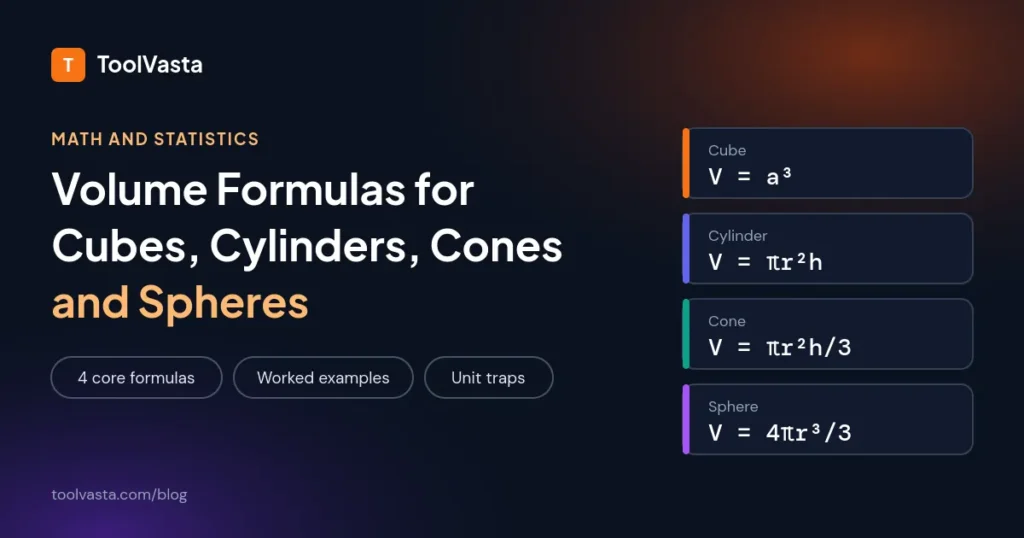
Volume tells you how much space a solid takes up, or how much a container can hold. Every formula you meet at school, from the cube to the sphere, comes from just two ideas: a prism is its cross-section multiplied by its length, and a shape that narrows to a point holds one third of the matching prism. This guide walks through the formulas for cubes, cuboids, cylinders, cones and spheres with worked examples, the unit traps that cost marks, and quick checks that catch mistakes. If you only need an answer, the volume calculator covers 9 shapes and converts the result to litres and gallons.
What Is Volume and How Is It Measured?
Volume is the amount of three-dimensional space inside a shape, measured in cubic units. A cube with edges of 1 cm has a volume of 1 cm³, and any other volume is simply the number of those little cubes that would fit inside. Because three lengths are multiplied together, the unit is always cubed: mm³, cm³ or m³.
For liquids we usually talk about capacity in millilitres and litres. The link is exact: 1 ml is 1 cm³, and 1 litre is 1,000 cm³, which is a 10 cm cube. The NIST overview of SI units of volume sets out how the cubic metre and the litre relate, and it is worth remembering that 1 m³ is 1,000 litres, the volume of a tonne of water.
How Do You Find the Volume of a Cube or Cuboid?
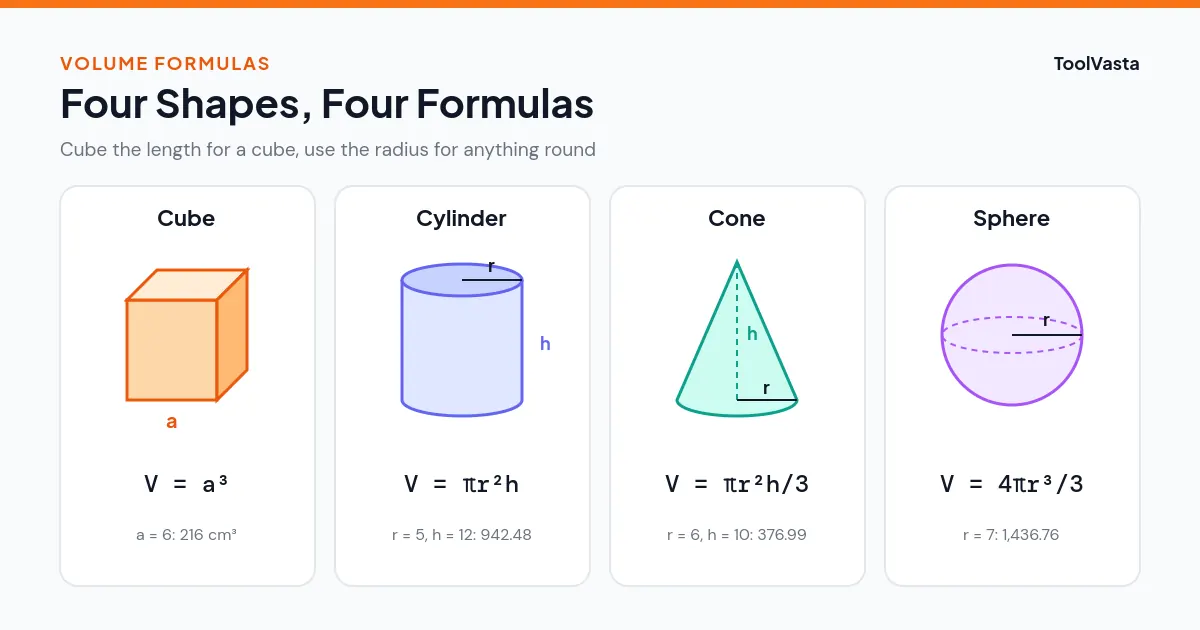
Multiply length by width by height. For a cube every edge is the same, so the formula shortens to the edge cubed.
Worked example: a storage box
A storage box measures 40 cm long, 30 cm wide and 25 cm high. V = 40 × 30 × 25 = 30,000 cm³. Dividing by 1,000 turns that into 30 litres, which is how storage boxes are usually sold.
Worked example: a cube
A cube with 6 cm edges has V = 6³ = 216 cm³. Doubling the edge to 12 cm gives 1,728 cm³, which is 8 times as much, not twice as much. Scaling every length by k always scales volume by k³, a fact that turns up in similar-shapes questions at GCSE.
The cube numbers you get this way, 1, 8, 27, 64, 125 and so on, form a sequence with a constant third difference of 6. Type them into the nth term calculator and it confirms the rule n³, which is a neat way to see where cubic sequences come from.
How Do You Find the Volume of a Cylinder?
A cylinder is a prism with a circular cross-section, so its volume is the area of the circle multiplied by the height: V = πr²h.
Worked example: a tin of beans
A tin has a diameter of 7.4 cm and a height of 11 cm. First halve the diameter: r = 3.7 cm. The base area is π × 3.7² = 43.01 cm², and the volume is 43.01 × 11 = 473.0 cm³, or about 473 ml. Forgetting to halve the diameter is the single most common cylinder mistake; it makes the answer four times too big.
Worked example: a water tank in metres
A round tank is 1.2 m across and 1.5 m tall. With r = 0.6 m, V = π × 0.36 × 1.5 = 1.696 m³. Multiplying by 1,000 gives about 1,696 litres. Working in metres and converting at the end is cleaner than converting each length to centimetres first.
How Do You Find the Volume of a Cone?
A cone holds exactly one third of the cylinder with the same base and height, so V = ⅓πr²h. The height here is the vertical height, measured straight up from the centre of the base, not the sloping side.
Worked example: an ice cream cone
A wafer cone has a radius of 2.5 cm and a vertical height of 11 cm. V = ⅓ × π × 2.5² × 11 = ⅓ × π × 6.25 × 11 = 72.0 cm³. If a question gives the slant length instead, use Pythagoras first: with a slant of 12 cm and radius 5 cm, the height is √(12² − 5²) = √119 = 10.91 cm.
The same one-third rule covers pyramids. A square-based pyramid with base edge 9 cm and height 12 cm holds ⅓ × 81 × 12 = 324 cm³, one third of the 972 cm³ cuboid around it.
How Do You Find the Volume of a Sphere?
Use V = ⁴⁄₃πr³: cube the radius, multiply by π, then multiply by 4 and divide by 3. A hemisphere is half of that, ⅔πr³.
Worked example: a football
A size 5 football has a radius of about 11 cm. V = ⁴⁄₃ × π × 11³ = ⁴⁄₃ × π × 1,331 = 5,575 cm³, or roughly 5.6 litres of air.
Worked example: a hemispherical bowl
A mixing bowl is a hemisphere with an inside radius of 12 cm. V = ⅔ × π × 12³ = ⅔ × π × 1,728 = 3,619 cm³, so it holds about 3.6 litres when filled to the brim.
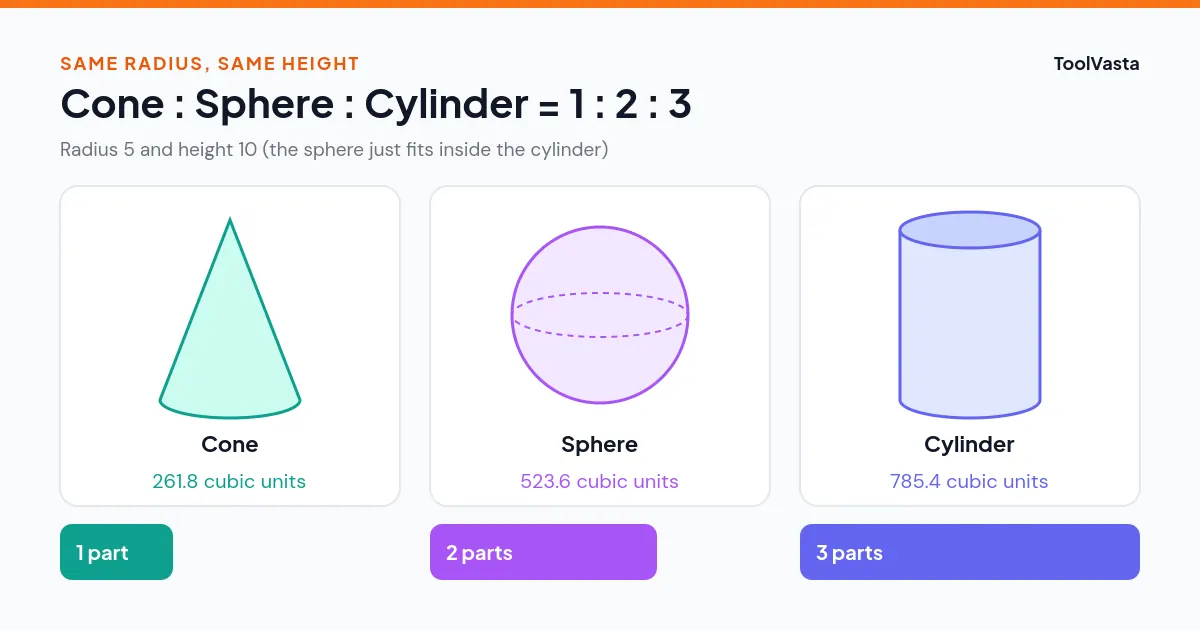
The picture above shows why these formulas belong together. Take a cylinder of radius 5 and height 10. The cone that fits inside it holds 261.8, the sphere holds 523.6 and the cylinder holds 785.4: exactly 1 : 2 : 3. Archimedes proved the sphere result over two thousand years ago, and it is still the easiest way to remember ⁴⁄₃.
Which Volume Formula Should You Use?
Match the shape to its row, check you have the right measurements, and substitute.
| Shape | Formula | You need | Example answer |
|---|---|---|---|
| Cube | a³ | Edge | a = 6: 216 |
| Cuboid | l × w × h | Three edges | 40 × 30 × 25: 30,000 |
| Cylinder | πr²h | Radius, height | r = 5, h = 12: 942.48 |
| Cone | ⅓πr²h | Radius, vertical height | r = 6, h = 10: 376.99 |
| Sphere | ⁴⁄₃πr³ | Radius | r = 7: 1,436.76 |
| Hemisphere | ⅔πr³ | Radius | r = 7: 718.38 |
| Square-based pyramid | ⅓a²h | Base edge, vertical height | a = 9, h = 12: 324 |
The Department for Education GCSE mathematics subject content expects students to know the cuboid, prism and cylinder formulas, while the cone and sphere formulas are normally printed on the exam paper. Even so, knowing where they come from helps you spot an answer that cannot be right.
What Are the Most Common Volume Mistakes?
Most lost marks come from units and radii, not from the formulas themselves.
- Using the diameter as the radius. Always halve the diameter before squaring or cubing.
- Mixing units. A tank 1.2 m long and 45 cm wide must use one unit throughout.
- Converting cubic units with a single factor. 1 m = 100 cm, but 1 m³ = 100³ = 1,000,000 cm³.
- Using the slant height. Cones and pyramids need the vertical height for volume.
- Rounding too early. Keep π and intermediate values unrounded until the last line.
A packing problem that uses factors
Volume questions sometimes ask for the largest identical cubes that can fill a box with nothing left over. The cube edge must divide every side, so it is the highest common factor of the three dimensions. For a crate 84 cm by 120 cm by 60 cm, the HCF calculator gives 12, so 12 cm cubes fit exactly: 7 × 10 × 5 = 350 of them, and 350 × 12³ = 604,800 cm³, which matches 84 × 120 × 60.
Volume in 3D graphics and games
Block-based games and 3D printers store solids as grids of tiny cubes called voxels. A chunk 16 voxels on each side holds 16³ = 4,096 blocks, and programmers like that size because 4,096 is 2¹², an exact power of two. The binary calculator shows why: 16 is 10000 in binary, and 10000 × 10000 × 10000 is simply 1 followed by twelve zeros, so the computer can find any block's position with fast bit shifts instead of slow division.
Frequently asked questions
What is the formula for volume?
It depends on the shape. Prisms and cylinders use cross-section area × length; cones and pyramids use one third of that; a sphere uses ⁴⁄₃πr³.
Why is a cone one third of a cylinder?
Slicing a cone into thin discs and adding them up (or filling a cylinder three times with a cone of water) gives exactly one third of the cylinder with the same base and height.
How do I convert cm³ to litres?
Divide by 1,000. 30,000 cm³ is 30 litres, and 473 cm³ is 0.473 litres, or 473 ml.
Do I use radius or diameter in volume formulas?
Radius. If you are given the diameter, halve it first. Using the diameter makes a cylinder four times too big and a sphere eight times too big.
What happens to volume if I double every length?
It multiplies by 2³ = 8. Tripling every length multiplies the volume by 27.