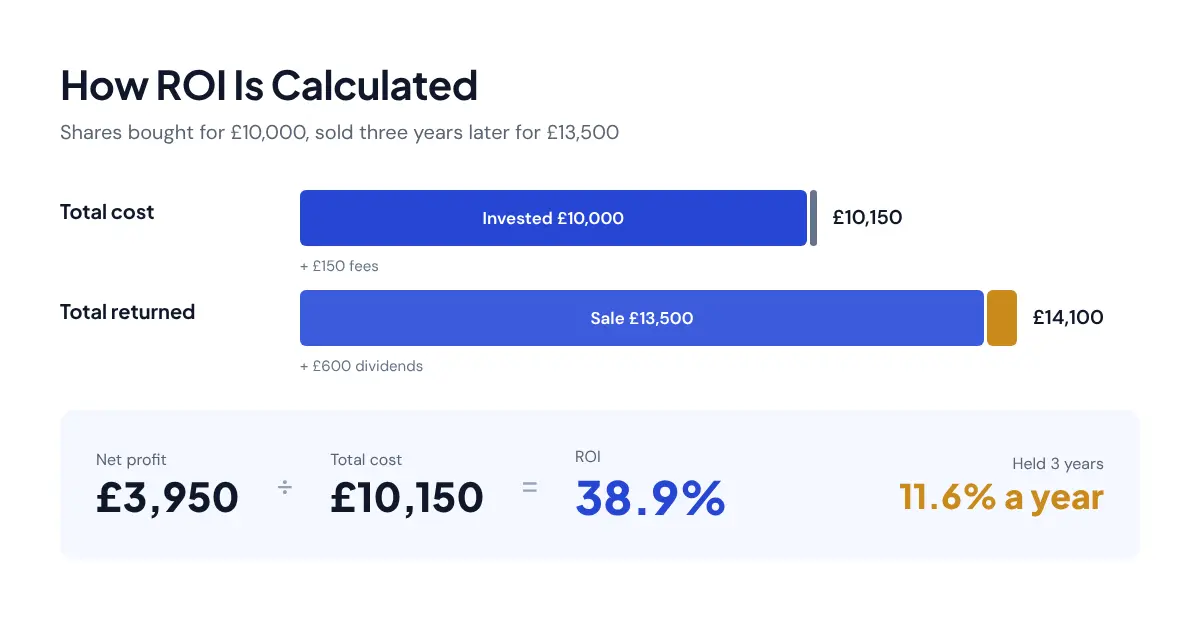
Quick answer: ROI = (final value + income − total cost) ÷ total cost × 100. Buy shares for £10,000 plus £150 in fees, sell for £13,500 and collect £600 in dividends, and the ROI is £3,950 ÷ £10,150 = 38.9%. Over three years that is 11.6% a year. This ROI calculator does both steps for you.
What Does Return on Investment Measure?
An ROI calculator measures how much an investment earned compared with what it cost, expressed as a percentage. Return on investment works for almost anything you put money into: shares, a buy-to-let flat, new equipment for a business, a marketing campaign or even a course of study. Because the answer is a percentage, it lets you compare a £500 side project with a £50,000 property on the same scale.
This calculator goes one step further than the basic formula. It counts income you received along the way, such as dividends or rent, subtracts extra costs like dealing fees, and converts the total ROI into an annualised figure so that a five-year investment can be compared fairly with a one-year one.
How Do You Work Out the Return on an Investment?
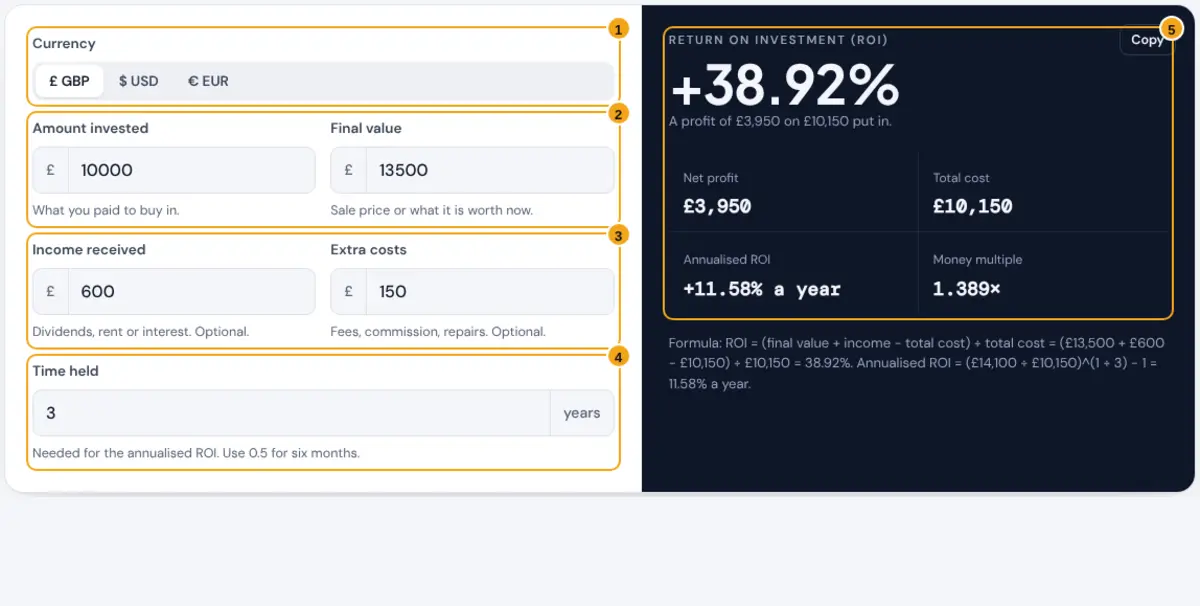
- Choose pounds, dollars or euros. The maths is the same for every currency.
- Enter the amount you invested and the final value, which is the sale price or what the investment is worth today.
- Add any income received while you held it, such as dividends, rent or interest.
- Add extra costs such as commission, stamp duty, platform fees or repairs.
- Enter how many years you held the investment to see the annualised ROI, then copy the result if you need it.
Leave income and extra costs blank if they do not apply. If you still hold the investment, use its current market value as the final value; the result is then an unrealised ROI that can still change. For property, the dedicated rental property ROI calculator handles mortgages, deposits and running costs in more detail.
What Is the ROI Formula?
ROI is net profit divided by total cost. Net profit is everything you got back minus everything you paid in, so the formula treats fees as part of the cost and income as part of the return.
Net profit = final value + income received − total cost
ROI = net profit ÷ total cost × 100
Annualised ROI = [ (final value + income) ÷ total cost ]1 ÷ years − 1
Worked example. You buy shares for £10,000 and pay £150 in dealing fees. Three years later you sell for £13,500, having received £600 in dividends.
- Total cost = £10,000 + £150 = £10,150.
- Net profit = £13,500 + £600 − £10,150 = £3,950.
- ROI = £3,950 ÷ £10,150 = 0.3892, or 38.92%.
- Annualised ROI = (£14,100 ÷ £10,150)1/3 − 1 = 11.58% a year.
A negative ROI means you lost money. Paying £5,000 plus £100 in fees for something you later sell for £4,200 gives an ROI of −£900 ÷ £5,100 = −17.65%.
Why Does Annualised ROI Matter?
Annualised ROI matters because a total ROI hides how long the money was tied up. A 50% gain sounds the same whether it took one year or ten, but the yearly rate behind it is very different, and the yearly rate is what you should compare with a savings account, a bond or another investment.
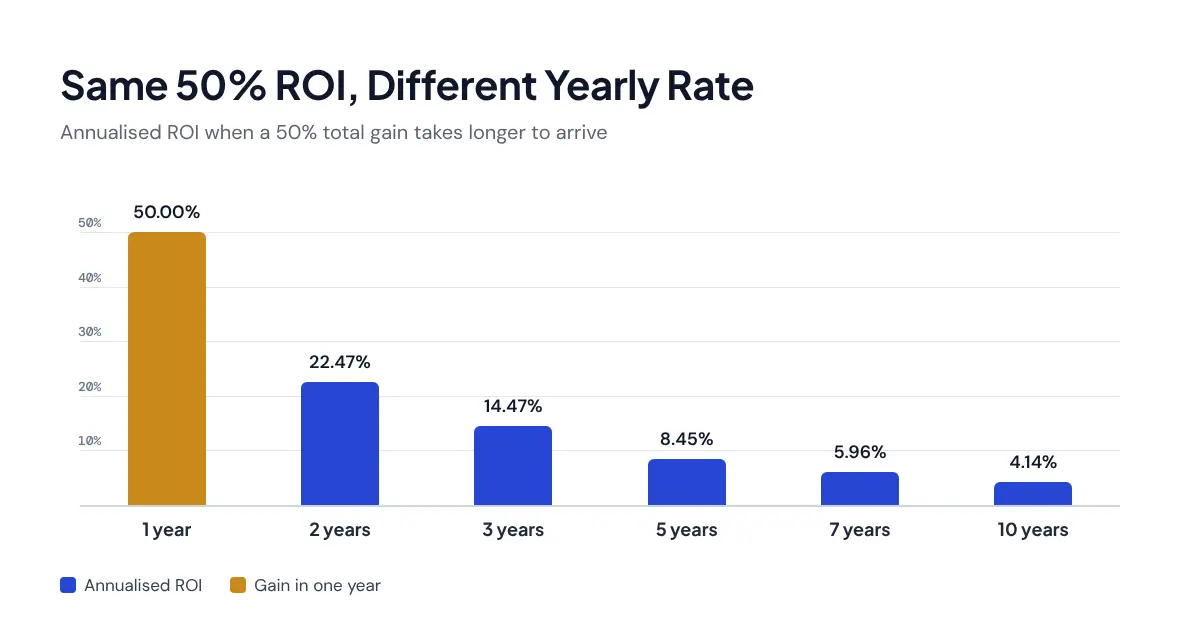
| Total ROI | Years held | Annualised ROI |
|---|---|---|
| 50% | 1 | 50.00% a year |
| 50% | 2 | 22.47% a year |
| 50% | 3 | 14.47% a year |
| 50% | 5 | 8.45% a year |
| 50% | 7 | 5.96% a year |
| 50% | 10 | 4.14% a year |
Annualised ROI is the same calculation as compound annual growth rate, so the CAGR calculator gives the same answer when you only have a start and end value. For a held period under a year the annualised figure can look dramatic: a 30% gain in six months annualises to 69%, which assumes you could repeat it, and you usually cannot.
What Counts as a Good ROI?
A good ROI is one that beats what you could have earned elsewhere for the same risk, after inflation. There is no single number, because a guaranteed return on cash and a risky return on a start-up are not comparable. Three checks help:
- Beat the risk-free rate. If a savings account or government bond pays 4% a year, an investment that annualises at 4% has taken risk for no extra reward.
- Beat inflation. Rising prices shrink what your profit can buy. The Bank of England explains how this works in its guide to what inflation is and why it matters, and subtracting the inflation rate from your annualised ROI gives a rough real return.
- Count every cost. Fees, tax and your own time all lower the true return, so a project that looks like 20% on paper may be closer to 10% once they are included.
For marketing spend, return on ad spend is the more common measure, and the ROAS calculator works it out from revenue and ad cost. For a project with cash flows spread over many years, net present value is more reliable than simple ROI, because it values early money more highly than late money.
Related Tools
- Rental Property ROI Calculator
- CAGR Calculator
- Investment Calculator
- Stock Profit Calculator
- ROAS Calculator
- NPV Calculator
Wondering how your figure compares? Read what is a good ROI and how to measure return on any investment.
Frequently asked questions
How do you calculate ROI?
Subtract the total cost from everything you got back, then divide by the total cost and multiply by 100. For example, £1,000 that becomes £1,250 has an ROI of £250 ÷ £1,000 = 25%.
What is a good ROI?
A good ROI beats the return on a low-risk alternative such as a savings account or government bond, after inflation and costs. Compare the annualised figure, not the total, so that investments held for different lengths of time are judged fairly.
What is the difference between ROI and annualised ROI?
ROI is the total gain over the whole period. Annualised ROI spreads that gain into an equivalent yearly rate with compounding. A 50% ROI over five years is an annualised ROI of 8.45%.
Should I include dividends and fees?
Yes. Dividends, rent and interest are part of what the investment returned, and fees, commission and taxes on purchase are part of what it cost. Leaving them out overstates or understates the ROI.
Can ROI be negative?
Yes. A negative ROI means you got back less than you put in. An ROI of −100% means the investment lost all its value.
Is ROI the same as profit margin?
No. ROI divides profit by the money invested, while profit margin divides profit by sales revenue. A shop can have a thin margin on each sale and still earn a high ROI on the money tied up in stock.