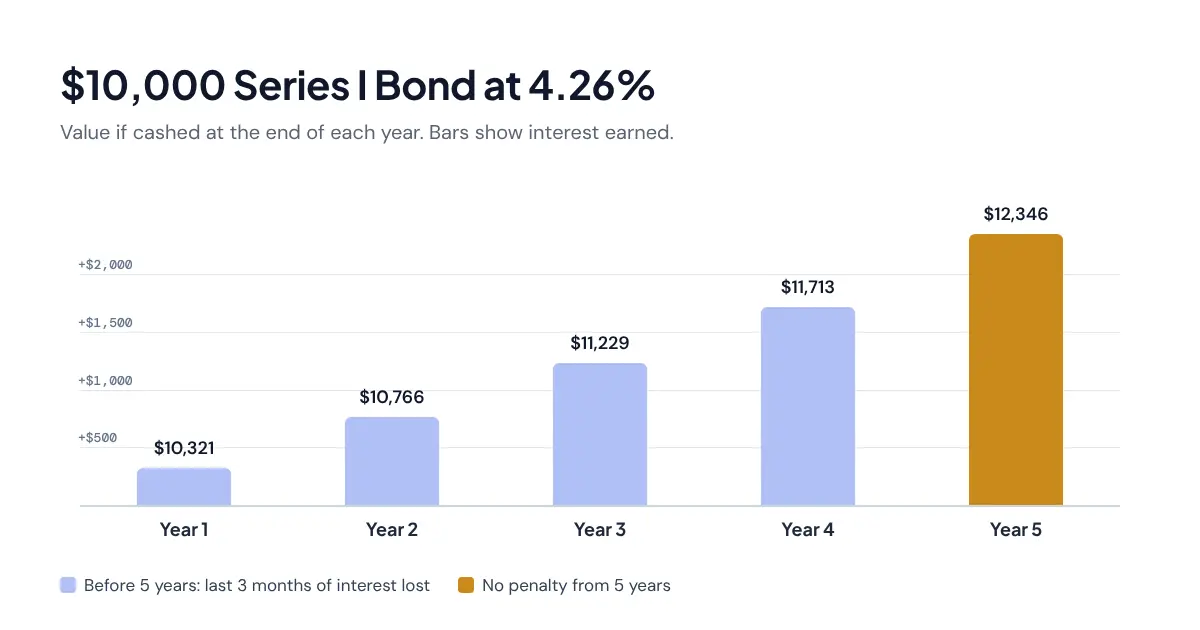
Quick answer: A savings bond grows as value = price × (1 + rate ÷ 2)periods, compounding every six months. A $10,000 Series I bond at the 4.26% rate for May to October 2026 is worth about $12,346 after five years. Cash it sooner and you lose three months of interest. This savings bond calculator shows both.
What Is a Savings Bond Worth When You Cash It?
A savings bond calculator estimates what a US Treasury savings bond will be worth when you cash it. You choose Series I or Series EE, enter the purchase amount, the interest rate and how long you will hold it, and the calculator returns the redemption value, the interest earned, any early cash-in penalty and the federal tax due on the interest.
It is built for planning a new purchase or checking an electronic bond you already hold in TreasuryDirect. Because I bond rates change every six months, the projection assumes the current rate continues, which makes it an estimate rather than a promise. For the exact value of a bond you already own, your TreasuryDirect account or the Treasury's own tools show the official figure.
How Do You Value a Series I or EE Bond?
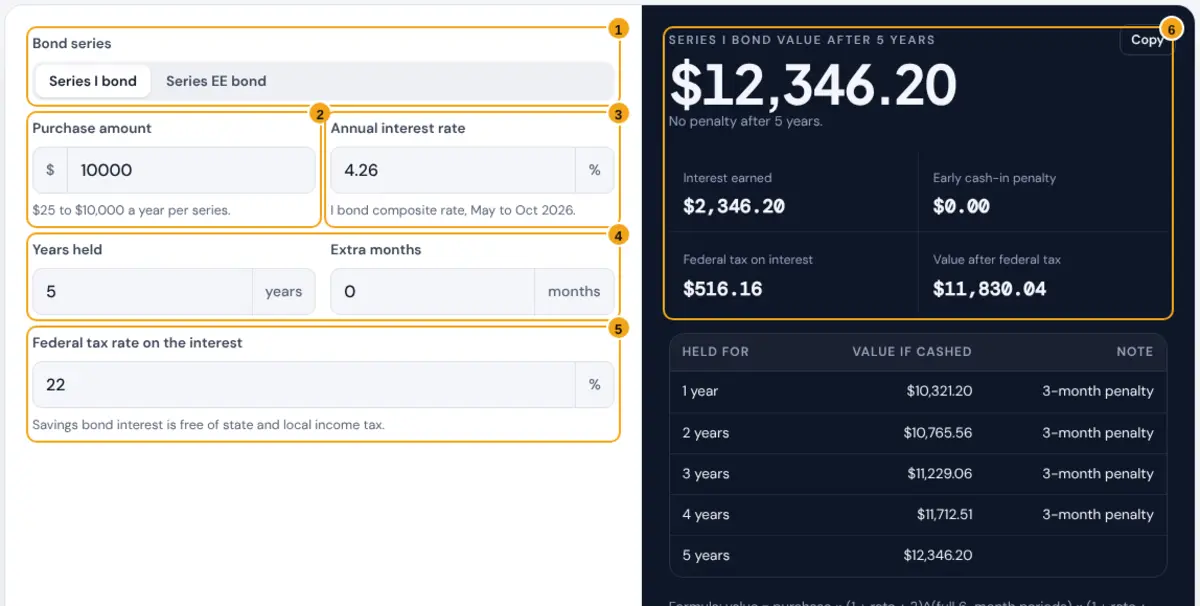
- Choose Series I bond or Series EE bond. The rate box switches to that series' current rate.
- Enter the purchase amount, between $25 and $10,000.
- Keep the current rate or type another one, for example a rate you expect in later years.
- Enter how long you plan to hold the bond in years and extra months. The minimum is 12 months.
- Add your federal tax rate, then read the value, the penalty and the year-by-year table.
Electronic bonds are bought at face value, so a $10,000 purchase is a $10,000 bond. You can cash a bond any time after 12 months, but the calculator applies the three-month interest penalty automatically if you hold it for less than five years. Bonds stop earning interest after 30 years, so the calculator stops there too.
How Is Savings Bond Interest Calculated?
Savings bond interest is added every month but compounds every six months, so each half-year the bond earns half the annual rate on its whole value, including earlier interest.
Cashed before 5 years: use the value from 3 months earlier
I bond composite rate = fixed + (2 × semiannual inflation) + (fixed × semiannual inflation)
Worked example. You buy a $10,000 Series I bond at 4.26% and keep it for five years:
- Five years is ten six-month periods, and half the rate is 2.13%.
- Value = $10,000 × 1.021310 = $12,346.20.
- Interest earned = $2,346.20. At a 22% federal rate the tax is $516.16, leaving $11,830.04.
- Cash a $1,000 bond after two years instead and you are paid interest for 21 months only: $1,076.56, which is $11.40 less than the full 24 months.
The same half-yearly compounding is shown step by step in the compound interest calculator, which is useful for comparing a bond with a savings account that compounds monthly.
What Are the Current I Bond and EE Bond Rates?
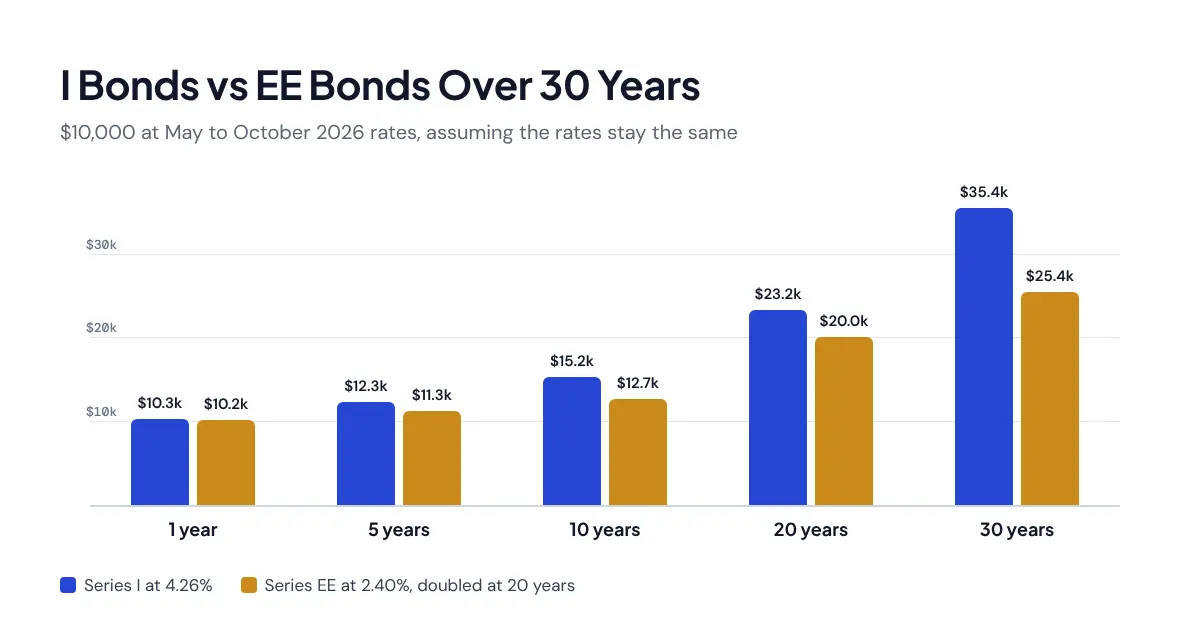
For bonds bought from May 1 to October 31, 2026, Series I bonds earn a composite rate of 4.26% and Series EE bonds earn a fixed 2.40%. The I bond rate combines a 0.90% fixed rate, which lasts for the life of the bond, with a semiannual inflation rate of 1.67%. Treasury publishes the full history on its I bond interest rates page and sets new rates each May 1 and November 1.
| Held for | $10,000 I bond at 4.26% | $10,000 EE bond at 2.40% |
|---|---|---|
| 1 year (penalty applies) | $10,321.20 | $10,180.54 |
| 5 years | $12,346.20 | $11,266.92 |
| 10 years | $15,242.87 | $12,694.34 |
| 20 years | $23,234.50 | $20,000.00 |
| 30 years | $35,416.03 | $25,388.69 |
The I bond column assumes the 4.26% rate holds for 30 years, which it will not: the inflation part resets every six months. The EE column is more certain because its rate is fixed, and Treasury guarantees an EE bond will be worth at least twice its price after 20 years, as set out on its EE bonds page.
Should You Buy I Bonds or EE Bonds?
Choose I bonds if you may need the money within 20 years or want protection from inflation, and EE bonds only if you are confident you will hold them for the full 20 years. Doubling in 20 years works out to about 3.53% a year, which is attractive for money you will not touch, but an EE bond cashed at year 19 has earned only its 2.40% rate.
- Purchase limit. Up to $10,000 a year in electronic bonds for each series, per person.
- Tax. Interest is subject to federal income tax but exempt from state and local income tax. You can defer the tax until you cash the bond or it stops earning interest.
- Education. Interest may be tax free if used for qualified higher education costs and your income is under the IRS limits.
Because the I bond rate tracks inflation, it is worth checking how much prices have risen with the inflation calculator. For long-term retirement saving, an account such as the one in the IRA calculator usually offers higher expected returns, with more risk.
Related Tools
- Compound Interest Calculator
- Inflation Calculator
- Savings Calculator
- Interest Calculator
- IRA Calculator
- Investment Calculator
Frequently asked questions
How much is a $10,000 I bond worth after 5 years?
At the 4.26% composite rate for May to October 2026, about $12,346, assuming the rate stayed the same for all five years. The real figure depends on the inflation rate Treasury sets every six months.
When can I cash a savings bond?
After 12 months. If you cash it before five years, you lose the last three months of interest. After five years there is no penalty, and bonds stop earning interest at 30 years.
Do EE bonds really double in 20 years?
Yes. Treasury guarantees that an EE bond bought today will be worth at least twice its purchase price after 20 years. If the fixed rate has not doubled it by then, Treasury makes a one-time adjustment to bring it up to double.
Are savings bonds taxed?
The interest is subject to federal income tax but not state or local income tax. Most people report it when they cash the bond, and it may be tax free if used for qualified education expenses.
How often do I bond rates change?
Every six months, on May 1 and November 1. Each bond's rate changes every six months from its own issue date, so a bond bought in July moves to the new rate in January.
How much can I buy in savings bonds each year?
Up to $10,000 a year in electronic Series I bonds and another $10,000 in electronic Series EE bonds per person. You can also buy up to $5,000 in paper I bonds with your federal tax refund.