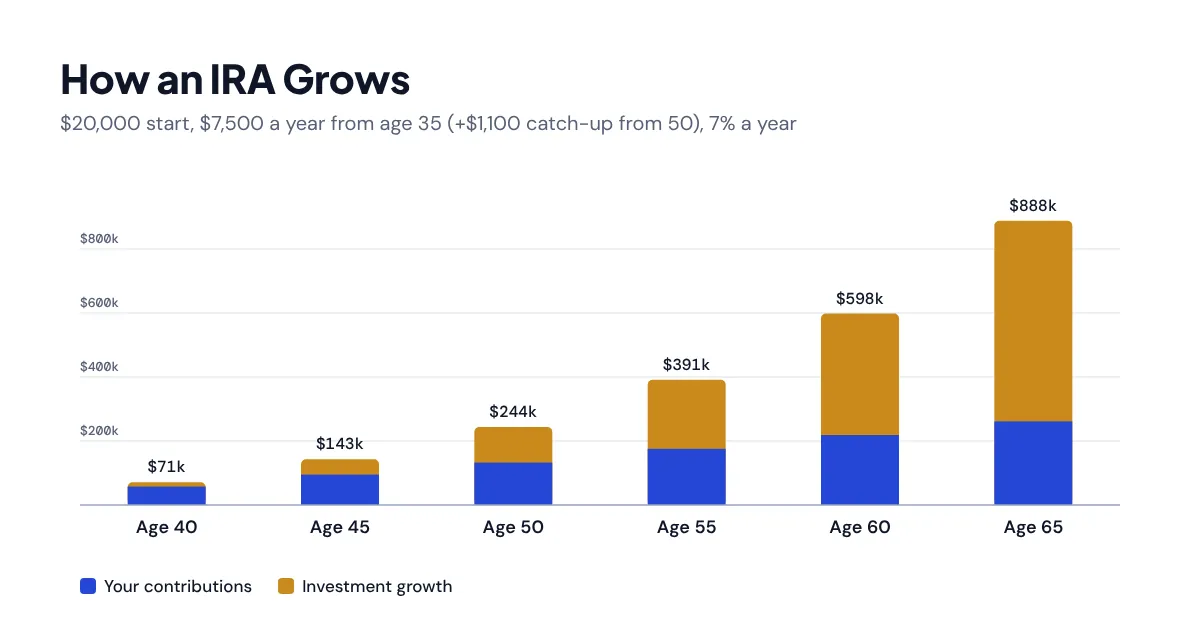
Quick answer: An IRA grows as: balance = last balance × (1 + return) + contribution, repeated each year. Saving the 2026 limit of $7,500 a year from age 35 to 65 at 7%, plus $1,100 catch-up from 50 and a $20,000 start, builds about $888,000. This IRA calculator compares Traditional and Roth after tax.
How Much Could Your Retirement Account Grow?
An IRA calculator projects how much an individual retirement account could be worth when you retire. You enter your age, retirement age, current balance, yearly contribution and expected return, and it shows the balance at retirement, how much of it came from your own contributions, how much came from growth and what the money is worth after tax.
Because Traditional and Roth IRAs are taxed at opposite ends, the calculator also shows the after-tax value of the other account type for the same contributions. That makes the Roth versus Traditional question concrete: it comes down to your tax rate now compared with your tax rate in retirement.
How Do You Project Your Balance at Retirement?
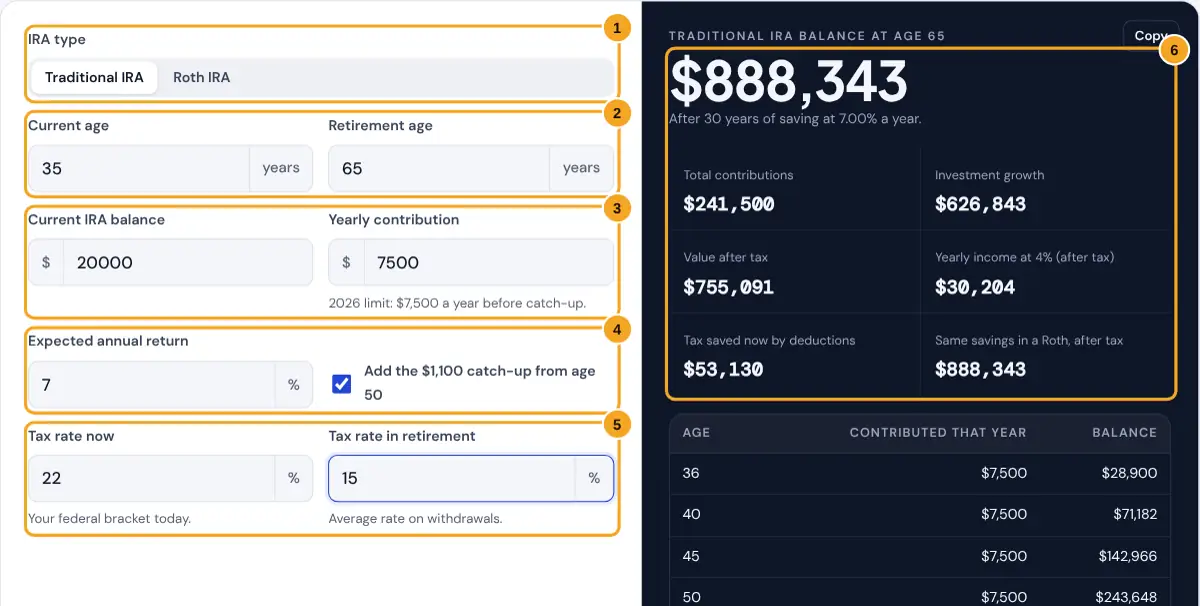
- Choose Traditional IRA or Roth IRA.
- Enter your current age and the age you plan to retire.
- Add your current IRA balance and how much you will put in each year.
- Set an expected annual return and leave the catch-up box ticked if you will add the extra $1,100 from age 50.
- Enter your tax rate now and your expected tax rate in retirement, then read the balance, after-tax value and table.
A return of 5% to 7% a year is a common planning assumption for a diversified stock and bond mix over long periods, but it is not guaranteed. Try a lower figure as well to see a cautious case. The calculator adds each contribution at the end of the year, so it slightly understates the result if you invest in January.
How Is IRA Growth Calculated?
Each year the balance earns the expected return and then the new contribution is added. Repeating that step for every year until retirement gives the final balance.
With a fixed contribution C for n years: FV = B × (1 + r)n + C × [ (1 + r)n − 1 ] ÷ r
Traditional after tax = FV × (1 − retirement tax rate) | Roth after tax = FV
Worked example. A 30-year-old with no balance puts $6,000 a year into a Roth IRA at 6% until 60:
- (1.06)30 = 5.7435.
- FV = $6,000 × (5.7435 − 1) ÷ 0.06 = $474,349.
- Contributions total $180,000, so growth adds $294,349.
- As a Roth, the full $474,349 is tax free. In a Traditional IRA taxed at 15% in retirement, it would be worth $403,197 after tax.
The same compounding drives any long-term saving, and the compound interest calculator shows it with monthly deposits if you contribute through the year.
What Are the 2026 IRA Contribution Limits?
For 2026 you can contribute up to $7,500 across all your IRAs, or $8,600 if you are 50 or older, as long as you have at least that much earned income. The IRS announced the higher figures in its 2026 contribution limit release; the limit is shared, so $4,000 to a Roth leaves $3,500 for a Traditional IRA.
| 2026 IRA rule | Single or head of household | Married filing jointly |
|---|---|---|
| Contribution limit | $7,500, plus $1,100 catch-up at 50+ | |
| Roth IRA phase-out (MAGI) | $153,000 to $168,000 | $242,000 to $252,000 |
| Traditional IRA deduction phase-out, covered by a workplace plan | $81,000 to $91,000 | $129,000 to $149,000 |
| Deduction phase-out, you are not covered but your spouse is | Not applicable | $242,000 to $252,000 |
If neither you nor your spouse has a workplace retirement plan, the full Traditional IRA contribution is deductible at any income. The IRS keeps the rules for earned income, spousal IRAs and excess contributions on its IRA contribution limits page.
Should You Choose a Traditional or Roth IRA?
Choose a Roth IRA if you expect your tax rate in retirement to be the same or higher than today, and a Traditional IRA if you expect it to be lower. A Traditional contribution saves tax now and is taxed on the way out; a Roth contribution is taxed now and qualified withdrawals after age 59½ (with the account open five years) are tax free.
| Feature | Traditional IRA | Roth IRA |
|---|---|---|
| Tax break | Deduction now, if eligible | Tax-free qualified withdrawals |
| Withdrawals in retirement | Taxed as ordinary income | Tax free |
| Required minimum distributions | Yes, from age 73 (75 if born in 1960 or later) | None for the original owner |
| Income limit to contribute | None (deduction may phase out) | Yes, see phase-out above |
| Early withdrawal | 10% penalty plus tax before 59½, with exceptions | Contributions can come out any time; earnings follow the rules |
Many young savers in the 10% or 12% bracket favor the Roth, while people in their peak earning years often take the Traditional deduction. If you also hold dividend stocks, keeping them in an IRA means the payouts are not taxed each year, which the dividend calculator shows by setting the tax rate to 0%. To turn the final balance into a paycheck, the retirement income calculator models withdrawals year by year.
Related Tools
- Retirement Income Calculator
- Compound Interest Calculator
- Dividend Calculator
- Investment Calculator
- Annuity Calculator
- Barista FIRE Calculator
Frequently asked questions
How much can I put in an IRA in 2026?
Up to $7,500 in total across Traditional and Roth IRAs, or $8,600 if you are 50 or older by the end of the year. You cannot contribute more than your earned income for the year.
How much will my IRA be worth at retirement?
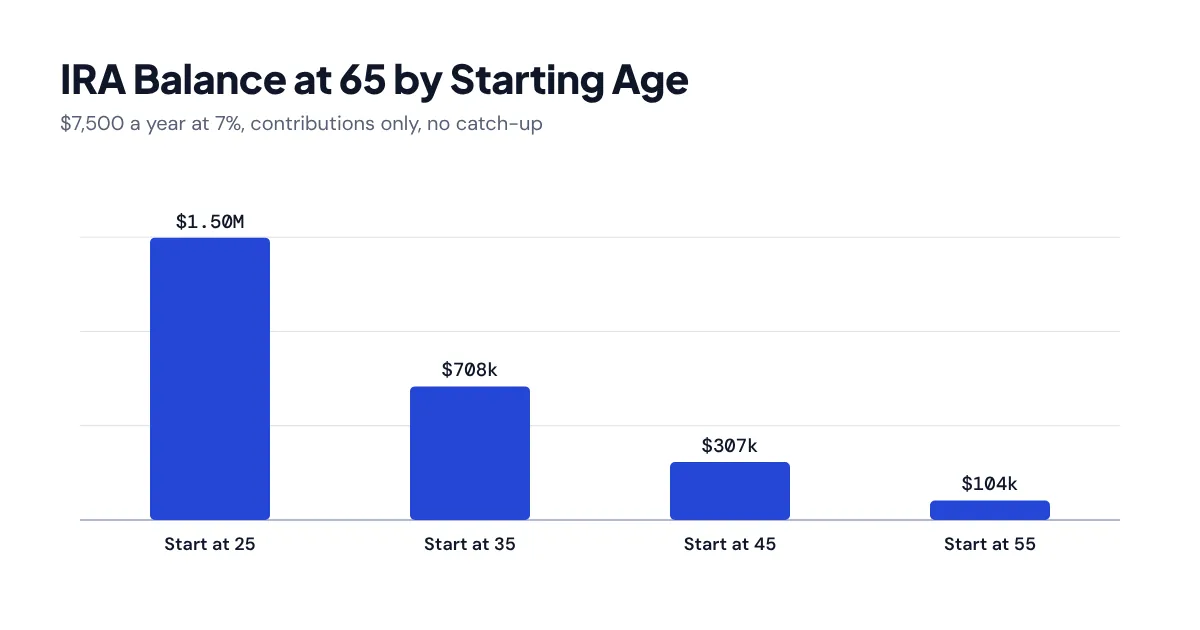
It depends on your contributions, years invested and return. For example, $7,500 a year for 30 years at 7% grows to about $708,000 from contributions alone. Enter your own figures above for a personal estimate.
Is a Roth or Traditional IRA better?
A Roth wins if your tax rate in retirement is equal to or higher than your rate today. A Traditional IRA wins if your rate will be lower. Many people split contributions between both to spread the risk.
Can I have both a Roth and a Traditional IRA?
Yes. You can hold both, but the $7,500 limit ($8,600 at 50+) applies to your total contributions across all IRAs for the year.
What happens if I withdraw early?
Withdrawals from a Traditional IRA before 59½ are usually taxed and face a 10% additional tax unless an exception applies, such as a first home purchase up to $10,000 or certain medical costs. Roth contributions, but not earnings, can be withdrawn at any time without tax.
What return should I use?
Many planners use 5% to 7% a year for a diversified portfolio over long periods. Run the calculator with a lower rate too, because returns vary from year to year and are never guaranteed.