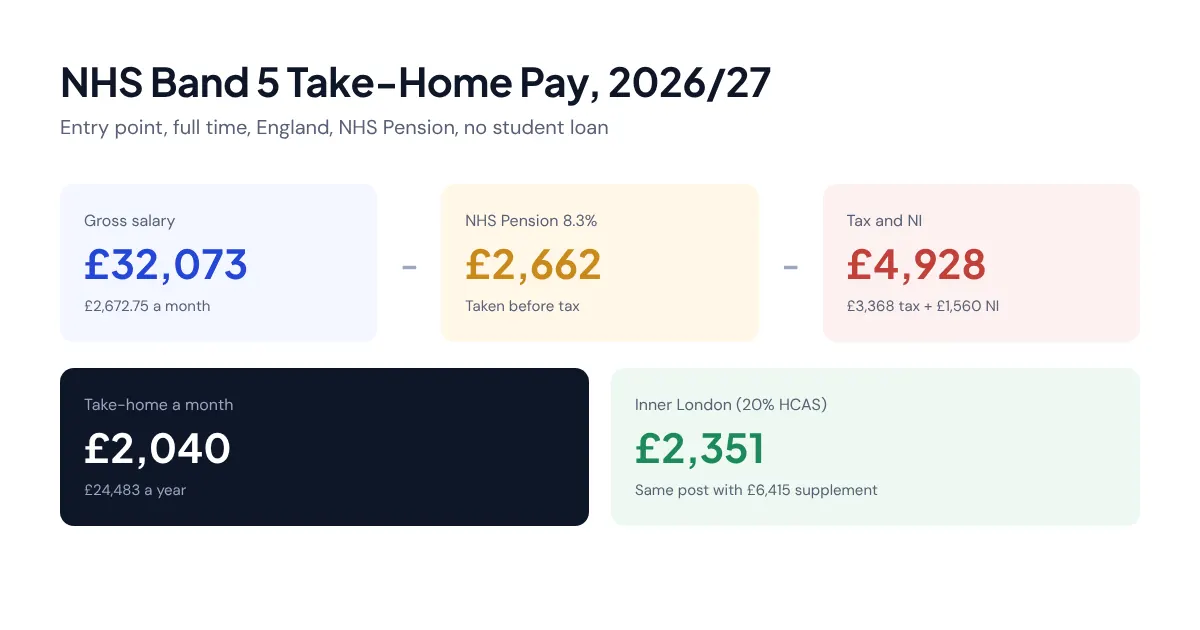
Quick answer: This NHS pay calculator turns your 2026/27 Agenda for Change band into take-home pay after Income Tax, National Insurance and NHS Pension. A full-time Band 5 nurse on the entry point earns £32,073, pays 8.3% into the pension and takes home about £2,040 a month in England.
Why Is Take-Home Pay Lower Than the Band Salary?
An NHS pay calculator shows what you actually receive each month from an Agenda for Change salary, after the deductions that appear on every NHS payslip. Job adverts quote the full-time annual figure for a band, but your pay depends on your pay point, your hours, where you work and whether you are in the pension scheme.
The calculator uses the 2026/27 pay scales for England, which include the 3.3% award that took effect on 1 April 2026, the high cost area supplement for London and the fringe, and the NHS Pension contribution tiers that apply from the same date. Unsocial hours, overtime and bank shifts are not included because they change from month to month. For extra shifts, the time and a half calculator works out enhanced hourly rates.
How Do You Work Out Your Monthly NHS Pay?
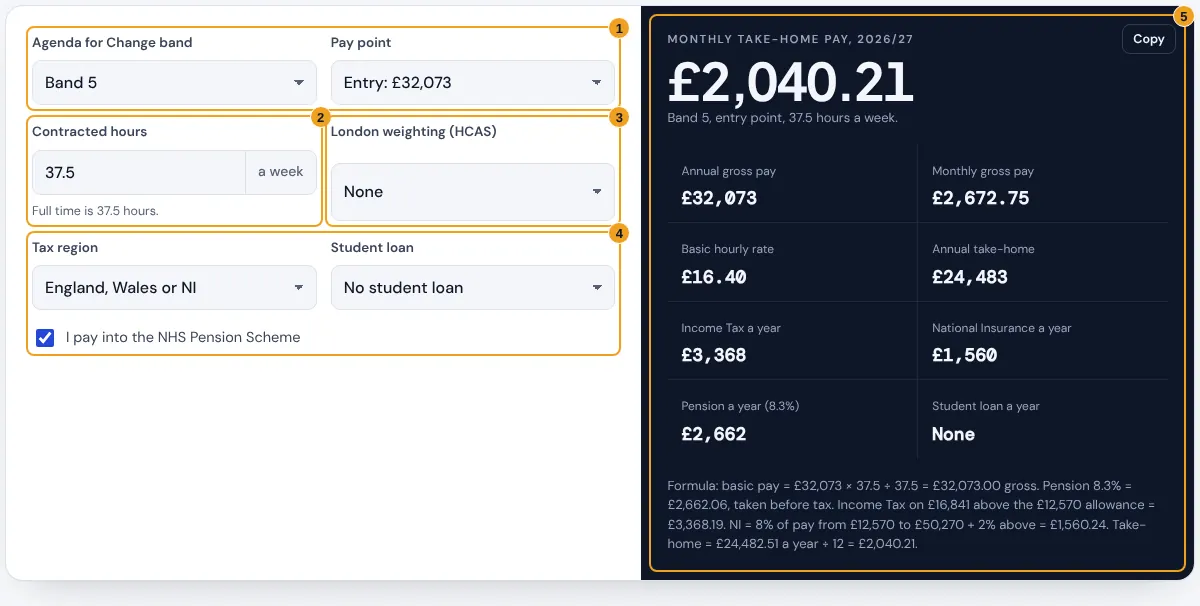
- Choose your Agenda for Change band and your pay point: entry, intermediate or top.
- Enter your contracted hours a week. Full time is 37.5 hours.
- Choose your high cost area supplement if you work in or around London.
- Set your tax region, any student loan and whether you pay into the NHS Pension.
- Read your monthly take-home pay and every deduction for the year.
Your pay point is on your contract or payslip. Staff move from entry to the next point after two years in most bands, and after three years for Band 4 and for the final step in Bands 5 to 9, as long as they meet the expected standards in their appraisal.
How Is NHS Take-Home Pay Calculated?
NHS take-home pay is your basic salary (pro rata for part-time hours) plus any high cost area supplement, minus pension contributions, Income Tax, National Insurance and any student loan.
Pension = gross pay × tier rate (5.2% to 12.5%)
Income Tax = 20% / 40% / 45% of (gross − pension − £12,570)
NI = 8% of gross from £12,570 to £50,270 + 2% above
Take-home = gross − pension − tax − NI − student loan
Worked example. A full-time Band 5 nurse in Manchester on the entry point, no student loan:
- Gross pay = £32,073 a year, or £2,672.75 a month.
- Pension at 8.3% = £2,662.06, because £32,073 falls in the £28,855 to £35,155 tier.
- Income Tax = 20% × (£32,073 − £2,662.06 − £12,570) = £3,368.19.
- National Insurance = 8% × (£32,073 − £12,570) = £1,560.24.
- Take-home = £24,482.51 a year, or £2,040.21 a month.
The pension rate is set by your actual pensionable pay, not the full-time equivalent, so part-time staff often pay a lower percentage. A Band 5 nurse working 22.5 hours earns £19,243.80, pays 6.5% and takes home about £1,365 a month. The NHS Business Services Authority publishes the tiers on its page about member contributions and pay.
The high cost area supplement is a percentage of basic pay with a minimum and maximum: 20% (£5,794 to £8,746) in inner London, 15% (£4,870 to £6,137) in outer London and 5% (£1,346 to £2,270) in the fringe zone. The same Band 5 nurse in inner London gets £6,414.60 on top and takes home about £2,351 a month.
What Are the NHS Pay Bands for 2026/27?
The 2026/27 Agenda for Change pay bands in England run from £25,272 for Band 2 to £129,783 at the top of Band 9, after a 3.3% rise for most staff. These figures come from the NHS Employers pay scales for 2026/27.
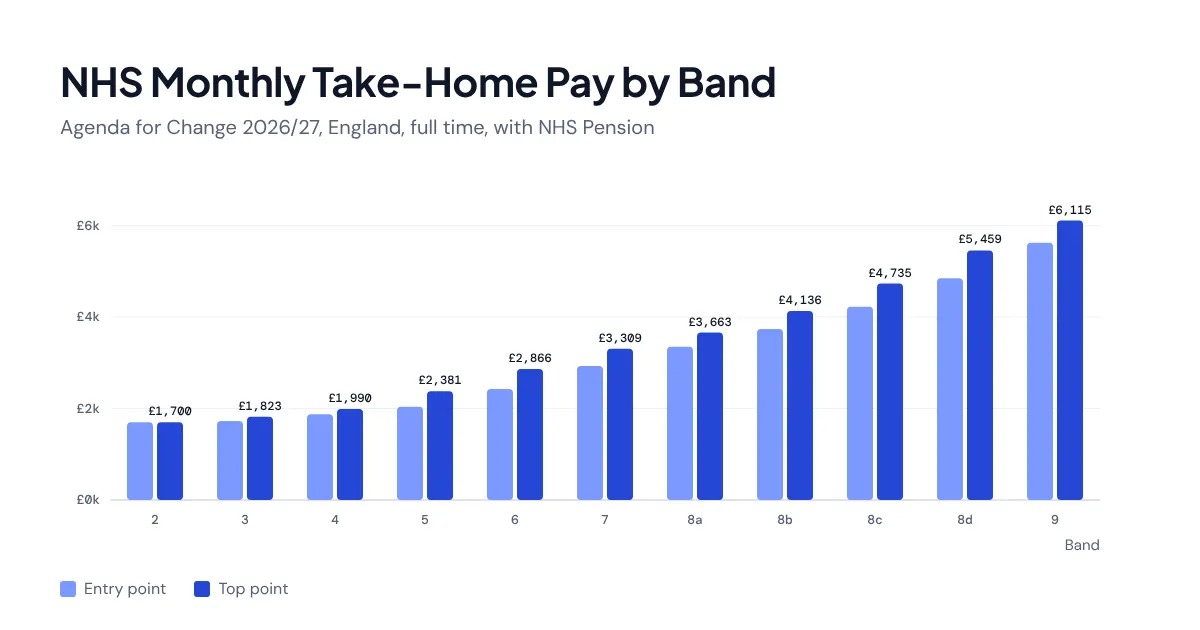
| Band | Entry salary | Top salary | Take-home a month (entry) | Take-home a month (top) |
|---|---|---|---|---|
| Band 2 | £25,272 | £25,272 | £1,700 | £1,700 |
| Band 3 | £25,760 | £27,476 | £1,727 | £1,823 |
| Band 4 | £28,392 | £31,157 | £1,874 | £1,990 |
| Band 5 | £32,073 | £39,043 | £2,040 | £2,381 |
| Band 6 | £39,959 | £48,117 | £2,430 | £2,866 |
| Band 7 | £49,387 | £56,515 | £2,934 | £3,309 |
| Band 8a | £57,528 | £64,750 | £3,353 | £3,663 |
| Band 8b | £66,582 | £77,368 | £3,742 | £4,136 |
| Band 8c | £79,504 | £91,609 | £4,226 | £4,735 |
| Band 8d | £94,356 | £108,814 | £4,851 | £5,459 |
| Band 9 | £112,782 | £129,783 | £5,626 | £6,115 |
Band 1 is closed to new staff and pays the same as Band 2. NHS Scotland, Wales and Northern Ireland set their own pay scales, so if you work there, use the tax region option for tax but check your local band figures. Newly qualified nurses repaying student loans can see their deduction in more detail with the student finance calculator.
Related Tools
- Self-Employed Tax Calculator
- Time and a Half Calculator
- Pay Raise Calculator
- Hourly to Salary Calculator
- Student Finance Calculator
- Savings Calculator
Frequently asked questions
How much is NHS Band 5 pay in 2026/27?
Band 5 runs from £32,073 at entry to £34,592 at the intermediate point and £39,043 at the top. Full time in England with pension, that is about £2,040 to £2,381 a month after deductions.
What was the NHS pay rise for 2026/27?
Agenda for Change staff in England received 3.3% from 1 April 2026. The new rates were paid on time this year, so there was no separate lump of back pay for most staff.
How much do I pay into the NHS Pension?
Between 5.2% and 12.5% of your actual pensionable pay, depending on which tier your pay falls into. The whole of your pay is charged at that one rate, and contributions are taken before Income Tax.
Is London weighting included in my pension?
Yes. The high cost area supplement counts as pensionable pay, so it is included when your contribution tier is worked out and in the pension you build up.
How is part-time NHS pay worked out?
Your full-time salary is multiplied by your contracted hours divided by 37.5. A Band 6 entry post at 30 hours pays £39,959 × 30 ÷ 37.5 = £31,967 a year.
Does this include unsocial hours pay?
No. Unsocial hours enhancements, overtime and bank shifts vary each month, so the result shows basic pay and HCAS only. Your actual take-home will be higher in months with enhancements.