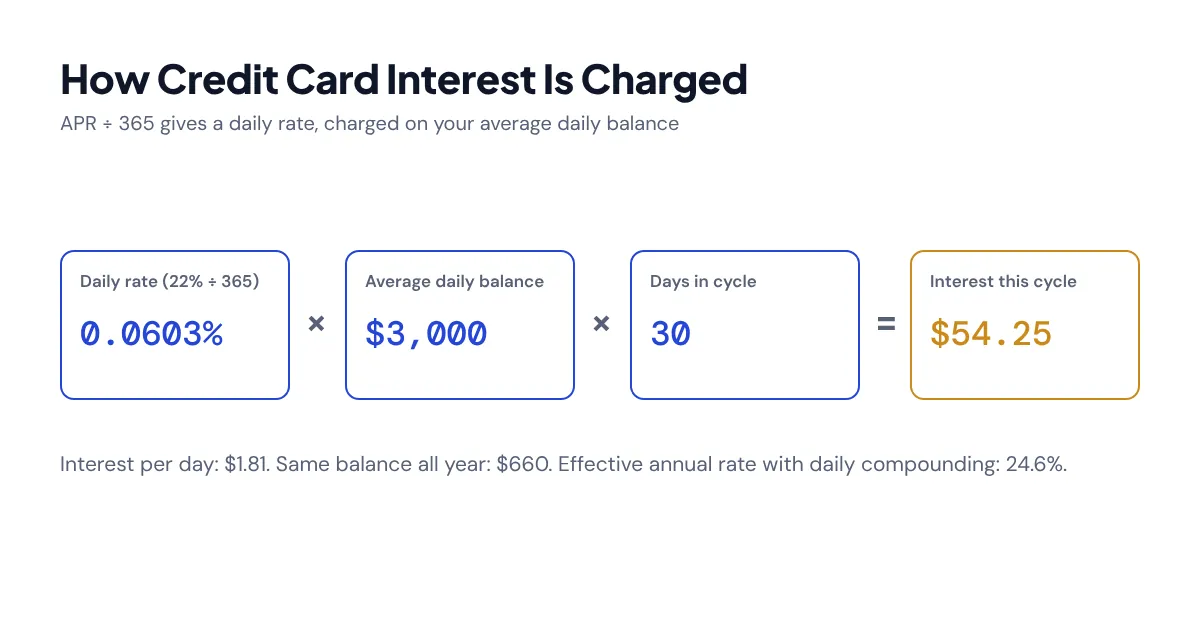
Quick answer: Credit card interest = average daily balance × (APR ÷ 365) × days in the billing cycle. A $3,000 balance at 22% APR over a 30-day cycle costs $3,000 × 0.0006027 × 30 = $54.25. This credit card interest calculator also handles purchases and payments made partway through the cycle.
What Does a Credit Card Charge Each Billing Cycle?
A credit card interest calculator shows how much interest your card issuer will charge for one billing cycle. You enter the balance, the APR and the number of days in the cycle, and it returns the interest in dollars, the daily periodic rate, the interest per day and what the same balance costs over a year.
Switch to the purchase and payment mode to copy what really happens on a statement: you spend on one day, pay on another, and the issuer averages the balance across every day of the cycle. That is the average daily balance method most US cards use, and it is why paying a week earlier lowers your interest even when the payment amount is the same.
How Do You Work Out One Month's Interest?

- Choose Stays the same for a quick estimate, or Add a purchase and a payment for a full billing cycle.
- Enter the balance at the start of the cycle and your purchase APR from the statement.
- Enter the number of days in the billing cycle, usually 28 to 31.
- In the second mode, add the purchase amount and day, and the payment amount and day.
- Read the interest for the cycle, the daily rate and the yearly cost, then press Copy.
Your statement lists the APR, the billing cycle dates and often the daily periodic rate as well. Some cards have separate APRs for purchases, balance transfers and cash advances, so use the rate that applies to the balance you are checking.
How Is Credit Card Interest Calculated?
Most US issuers divide the APR by 365 to get a daily periodic rate, apply it to the average daily balance and multiply by the days in the cycle. The Consumer Financial Protection Bureau explains this in its guide to how card companies calculate the interest you owe, and your cardholder agreement names the exact method.
Average daily balance = sum of each day's balance ÷ days in cycle
Interest = average daily balance × daily periodic rate × days in cycle
Worked example. You start a 30-day cycle owing $3,000 at 22% APR, buy $400 of goods on day 8 and pay $500 on day 20:
- Days 1 to 7: $3,000 × 7 = $21,000.
- Days 8 to 19: $3,400 × 12 = $40,800.
- Days 20 to 30: $2,900 × 11 = $31,900.
- Average daily balance = $93,700 ÷ 30 = $3,123.33.
- Interest = $3,123.33 × (0.22 ÷ 365) × 30 = $56.48.
Many issuers compound daily, adding each day's interest to the balance. Over a single cycle that adds only cents, but across a year it lifts a 22% APR to an effective rate of about 24.6%, which the calculator shows as the effective annual rate.
How Much Does a Balance Cost Each Month?
Each $1,000 you carry at 22% APR costs about $18 a month in interest. The average rate on accounts that were charged interest was 22.36% in the Federal Reserve's G.19 consumer credit release for August 2026, so the table uses rates around that level.
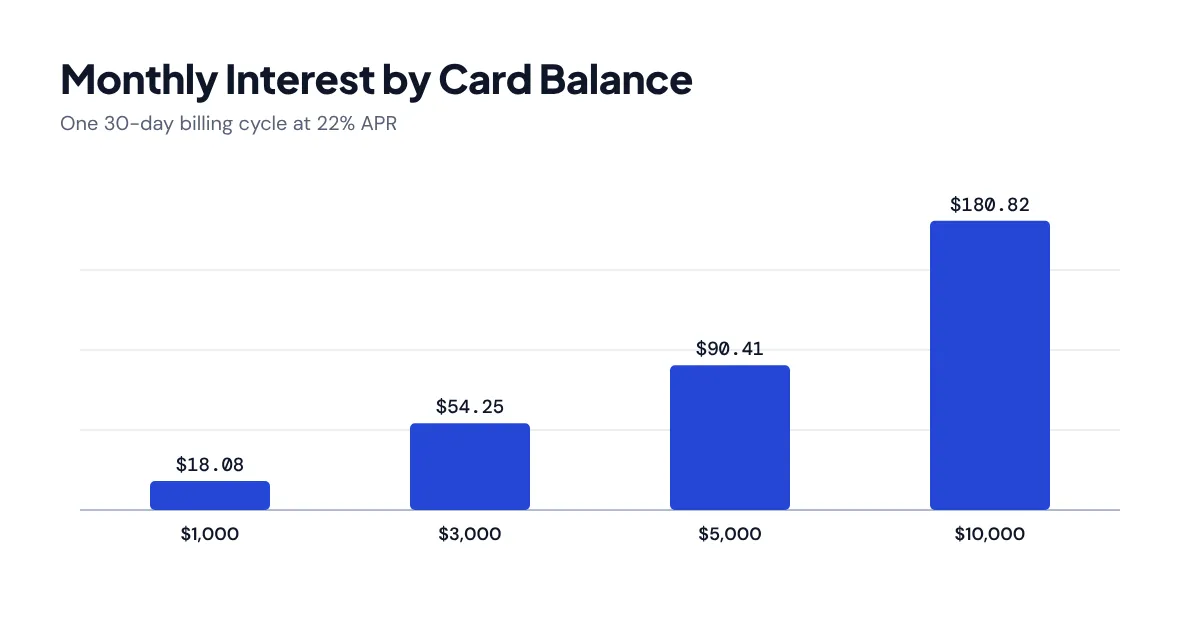
| Balance | 18% APR | 22% APR | 25% APR | 29.99% APR |
|---|---|---|---|---|
| $1,000 | $14.79 | $18.08 | $20.55 | $24.65 |
| $3,000 | $44.38 | $54.25 | $61.64 | $73.95 |
| $5,000 | $73.97 | $90.41 | $102.74 | $123.25 |
| $10,000 | $147.95 | $180.82 | $205.48 | $246.49 |
Figures are for a 30-day cycle with a steady balance. If you only pay the interest each month, the balance never falls, and $5,000 at 22% costs $1,100 a year. The credit card payoff calculator shows how long a fixed monthly payment takes to clear the debt and the total interest along the way.
How Can You Pay Less Credit Card Interest?
Pay the full statement balance by the due date and you keep the grace period, so new purchases cost no interest at all. Once you carry a balance, most cards charge interest on new purchases from the day you make them until the balance is cleared in full.
- Pay early in the cycle. Moving a $500 payment from day 20 to day 5 in the example above cuts the interest from $56.48 to $51.96.
- Pay more than the minimum. The credit card minimum payment calculator shows how minimums can stretch a balance over many years.
- Move the debt to a 0% balance transfer card, after checking the transfer fee, usually 3% to 5%.
- Clear high-APR debt before investing for income. Paying off a 22% card is a guaranteed 22% saving, far more than a typical 3% to 4% dividend yield.
Related Tools
- Credit Card Payoff Calculator
- Credit Card Minimum Payment Calculator
- APR Calculator
- Daily Interest Calculator
- Debt Payoff Calculator
- Debt to Income Ratio Calculator
Frequently asked questions
How do I calculate credit card interest per month?
Divide the APR by 365, multiply by your average daily balance, then multiply by the days in the billing cycle. At 22% APR, a $2,000 balance over 30 days costs about $36.16.
How much is 24% APR on $1,000?
About $19.73 for a 30-day cycle, or $240 over a year if the balance stays at $1,000 and you pay the interest each month. If the interest is left to compound daily, the yearly cost is about $271.
Is credit card interest charged daily or monthly?
It is worked out daily and billed monthly. The issuer applies the daily periodic rate to each day's balance and adds the total to your statement at the end of the cycle.
Do I pay interest if I pay the full balance?
No, not on purchases, as long as you pay the full statement balance by the due date every month. Cash advances usually start charging interest straight away, with no grace period.
Why is my interest charge different from the calculator?
Your card may use 360 days instead of 365, compound daily, have different APRs for different balances, or count the payment and purchase dates differently. Your cardholder agreement explains the exact method.