Quick answer: ROI is net profit divided by what you put in. A good ROI is one that beats a risk-free alternative, inflation and the cost of any borrowed money, measured as a yearly rate. For long-term investors that usually means a real return of a few per cent a year above inflation, with higher targets for riskier projects.
Return on investment is the most common way to judge whether money was well spent, and also one of the easiest to get wrong. A 40% return sounds excellent until you learn it took twelve years, or that fees and inflation ate half of it. This guide explains how to measure ROI properly, how to compare investments held for different lengths of time and what a good figure looks like for shares, property, a business loan or a degree. You can check every example in the ROI calculator as you read.
What Is ROI and How Do You Calculate It?
ROI measures how much you gained or lost relative to what you paid, as a percentage. The formula is short:
"Total returned" means everything the investment gave back: the sale price or current value plus any income along the way, such as dividends, rent or interest. "Total cost" means everything you paid in: the purchase price plus fees, commission, stamp duty and any money spent improving the asset.
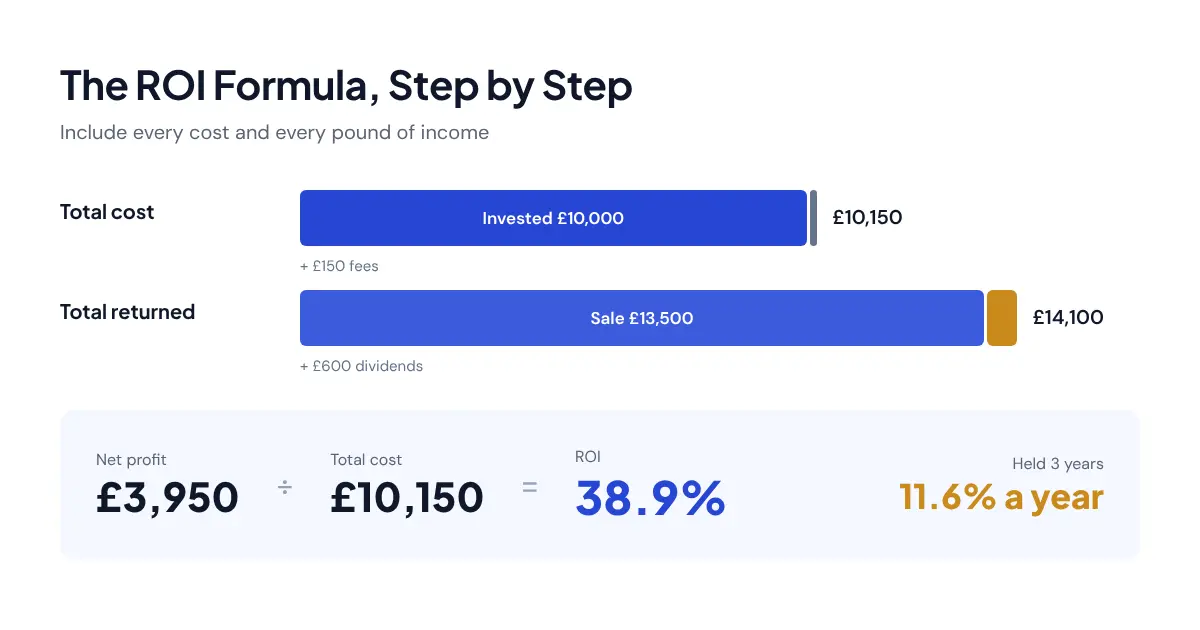
Here is a worked example. You buy shares for £10,000 and pay £150 in dealing charges. Three years later you sell them for £13,500, and you received £600 in dividends while you held them.
- Total cost = £10,000 + £150 = £10,150.
- Total returned = £13,500 + £600 = £14,100.
- Net profit = £14,100 − £10,150 = £3,950.
- ROI = £3,950 ÷ £10,150 = 38.9%.
Leave out the dividends and the ROI drops to 33.0%. Leave out the fees and it rises to 41.0%. Small items move the answer by several points, which is why a consistent method matters more than the formula itself.
Why Can Total ROI Be Misleading?
Total ROI ignores time, so it cannot tell a fast return from a slow one. A 38.9% gain over three years and a 38.9% gain over ten years look identical on paper, yet the first is far better: the money was free to work elsewhere for the other seven years.
The fix is to convert total ROI into an annualised ROI, the steady yearly rate that would produce the same result with compounding:
For the share example, (£14,100 ÷ £10,150)1/3 − 1 = 11.6% a year. The same 38.9% spread over ten years would be just 3.3% a year. The table shows how quickly a fixed total return shrinks when it takes longer to arrive.
| Total ROI | Over 1 year | Over 3 years | Over 5 years | Over 10 years |
|---|---|---|---|---|
| 20% | 20.0% a year | 6.3% a year | 3.7% a year | 1.8% a year |
| 50% | 50.0% a year | 14.5% a year | 8.4% a year | 4.1% a year |
| 100% | 100.0% a year | 26.0% a year | 14.9% a year | 7.2% a year |
Annualised ROI is the same idea as compound annual growth rate. Use it whenever you compare two investments held for different periods, or an investment with a savings rate quoted per year.
What Is a Good ROI?
A good ROI is one that beats your next best option for the same level of risk, after inflation and costs. There is no universal number, but three hurdles give a practical answer.
1. Beat the risk-free rate
The risk-free rate is what you could earn with almost no chance of loss: a savings account, a government bond or a Treasury savings bond. Central bank rates set the floor for these; in the UK, the Bank of England publishes its latest decision on interest rates and Bank Rate. In the US, a Series I bond bought between May and October 2026 earns 4.26% a year, which you can project with the savings bond calculator. If a risky investment annualises at 4%, it has paid you nothing for the risk.
2. Beat inflation
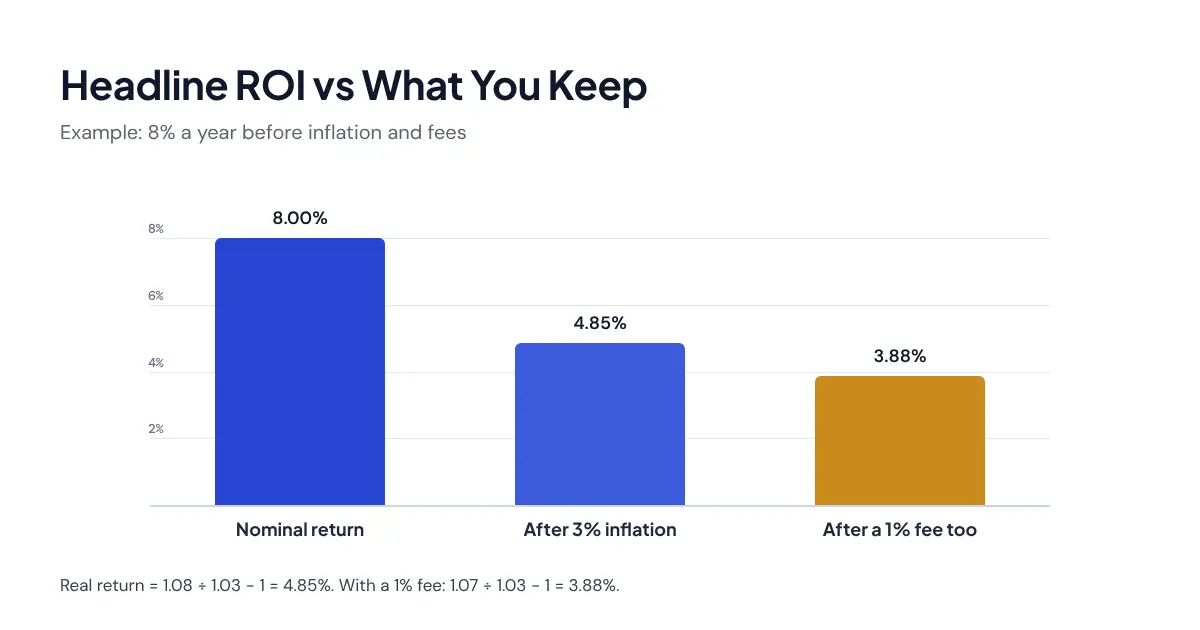
Inflation reduces what your profit can buy, so the return that matters is the real return:
An investment that grows 8% a year while prices rise 3% a year has a real return of 1.08 ÷ 1.03 − 1 = 4.85%, not 5%. Over decades that gap adds up.
3. Earn a premium for the risk you take
Riskier investments should promise more. Long-run studies of world stock markets put the average real return at roughly 5% a year over more than a century, with long stretches far below that. A single company, a start-up or a buy-to-let flat carries more risk than a global index fund, so most investors expect more from them. The US Securities and Exchange Commission's guide to asset allocation and risk tolerance explains how to match the return you aim for with the risk you can stand.
How Do You Measure ROI on Different Investments?
The formula stays the same, but what counts as cost and return changes with the type of investment.
- Shares and funds. Include dividends, platform fees and dealing charges. Compare the annualised ROI with a low-cost index fund over the same period.
- Property. Include the deposit, stamp duty, legal fees, repairs, letting fees and mortgage interest as costs, and rent plus any rise in value as return. Many landlords measure ROI on the cash they put in rather than the full price, which the rental property ROI calculator does for you.
- A business investment. If you borrow to fund a project, its ROI must beat the interest rate on the loan, or the lender earns more from your project than you do. A US business borrowing $250,000 through an SBA 7(a) loan at 10.5% pays about $3,449 a month, as the SBA loan calculator shows, so the new equipment or premises needs to add more than that in monthly profit.
- Education. A degree is an investment of time and money that pays back through higher earnings. In England, a student living away from home outside London can borrow up to £20,620 a year for fees and living costs in 2026/27, and the student finance calculator shows both what you can borrow and what you would repay from your salary. The ROI depends far more on the career it leads to than on the size of the loan, because repayments are linked to income.
- Marketing. Campaigns are usually judged by return on ad spend, revenue divided by ad cost, but true ROI also subtracts the cost of the goods sold.
What Mistakes Distort ROI?
Most bad ROI figures come from leaving something out rather than from bad maths. Watch for these:
- Ignoring fees and tax. A 1% yearly fee on a fund returning 7% removes about a seventh of your gain every year.
- Ignoring time. Comparing total ROI across different holding periods favours whatever you held longest.
- Counting paper gains as profit. An unrealised gain can disappear before you sell, so label it clearly.
- Leaving out your own time. A side business that returns 20% but takes ten hours a week may pay less per hour than a job.
- Looking only at winners. Judge a strategy by every investment it produced, including the ones you sold at a loss.
A sound habit is to write down the full cost and the holding period at the moment you invest. When you sell, the ROI and annualised ROI take seconds to work out, and you can compare them honestly with the hurdles above.
Frequently asked questions
Is a 10% ROI good?
A 10% ROI a year is strong for a diversified investment and well above a typical savings rate. A 10% total ROI over five years is only about 1.9% a year, which may not beat inflation, so always check the time period.
What is the difference between ROI and annualised ROI?
ROI is the total gain over the whole period. Annualised ROI turns it into an equivalent yearly rate with compounding, so investments held for different lengths of time can be compared fairly.
Should ROI include inflation?
Standard ROI does not, but you should check the real return as well. Divide 1 plus the ROI by 1 plus inflation and subtract 1 to see how much your buying power actually grew.
How do I calculate ROI on a property?
Add up everything you paid, including deposit, purchase costs and repairs, and everything you received, including rent and the current value or sale price. Subtract the cost from the return and divide by the cost. Mortgage interest and running costs reduce the return.
Can ROI be more than 100%?
Yes. An ROI above 100% means you more than doubled your money. Turning £1,000 into £2,500 is an ROI of 150%.