How to Use the Crossword Puzzle Maker
- Give your puzzle a title.
- Type one word per line as ANSWER: clue, using 2 to 40 words.
- Generate the crossword, or try another layout for a different grid.
- Print the puzzle or download a PNG, with or without the answer key.
- Check the numbered grid and the across and down clue lists.
Type a puzzle title and enter your words and clues one per line: the answer, a colon and the clue, for example ORBIT: The curved path of a planet around the Sun. It rebuilds instantly.
The crossword generator tries dozens of arrangements and keeps the one that places the most words in the smallest grid. Press Try another layout for a different arrangement of the same words whenever you like.
The header shows how many words were placed. The tool is completely free with no registration: tick Printable view for a clean worksheet, add the answer key for the teacher copy, then print or download.
How the Grid Is Built
The longest word goes in first, across the middle of the grid. Every other word is tested against each letter already placed, looking for a shared letter where it can cross at a right angle.
A position is allowed when shared letters match and the new word does not touch another word side by side. This keeps the puzzle readable, because every run of squares must be a real answer.
best layout = most words placed, then smallest area, then most crossings
Each layout gets a score that rewards crossings and penalizes wasted space and long, thin shapes. The winner places the most words first, then uses the smallest area. The result is compact and well interlocked.
Example: An Eight-Word Space Puzzle
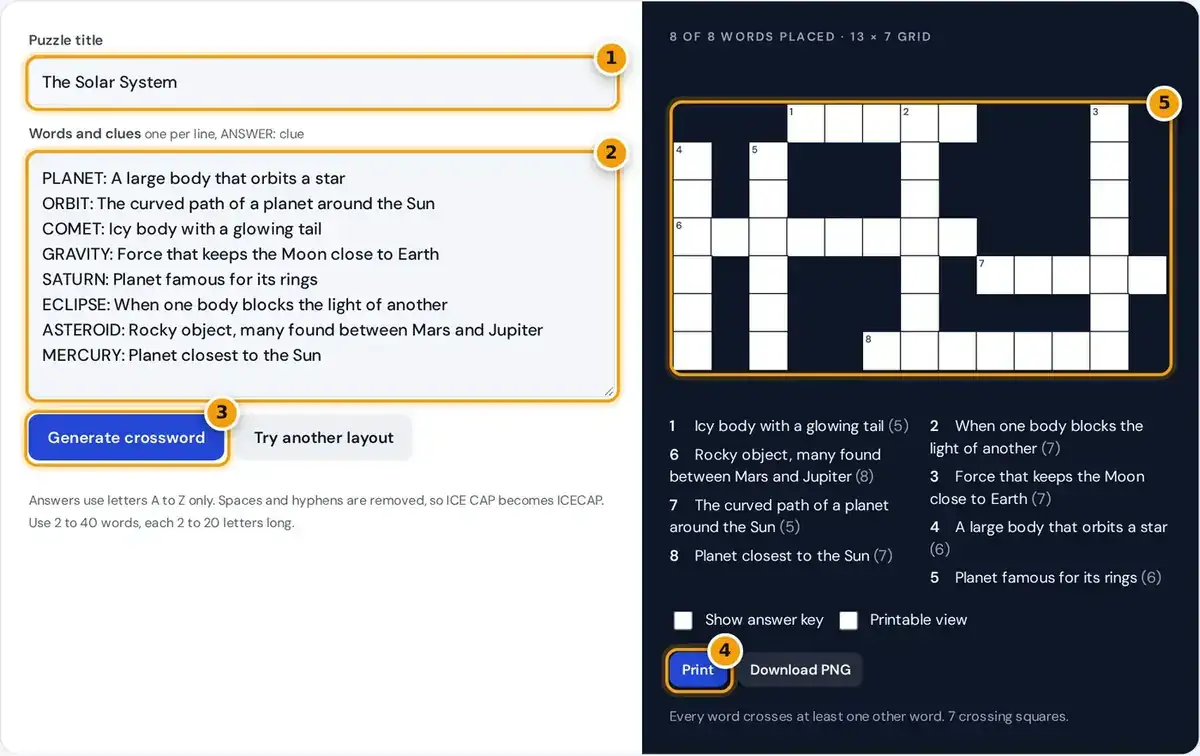
The sample puzzle has eight space words from 5 to 8 letters. ASTEROID goes first because it is the longest word, and it is placed across the middle row as the spine for everything else.
MERCURY can cross it at R or E, and GRAVITY can cross at the A, R, T or I. After 60 attempts, it keeps the layout that fits all eight words into the tightest rectangle.
Clues are numbered left to right and top to bottom, the standard crossword convention, and split into across and down clue lists. Each clue shows the answer length in brackets, which helps solvers check guesses.
Choosing Words and Writing Clues
- Use 8 to 20 words. Fewer leave few crossings, and more than 25 gets crowded on one page.
- Mix word lengths. Long words act as a spine, and short words fill the gaps.
- Favor common letters. Words with E, A, R, S and T cross easily, while JAZZ may not fit.
A good word list mixes long and short answers so the grid has a strong spine and many crossing points. Words packed with common letters interlock easily, while words with rare letters often stay unplaced.
Match the clue style to the difficulty you want. Plain definitions suit vocabulary review for older students, while fill-in-the-blank sentences suit younger learners, because the surrounding words give extra context that points toward the answer.
Keep each clue short and specific, with only one possible answer. Test the puzzle yourself before handing it out, since a clue that seems obvious to you can have two reasonable answers for a student.
Classroom Uses for a Crossword
Teachers use a crossword for end-of-unit vocabulary review, spelling practice and test revision. It works for any subject, from science terms and history dates to French vocabulary, math language and book characters in English class.
Crosswords also make good tasks for early finishers, homework that recaps the week, and cover lessons, because students can work independently. The National Reading Panel report highlights repeated exposure to new words as especially important.
The crossword format itself has a long and popular history. The Library of Congress credits Arthur Wynne with the earliest crossword, a puzzle called Word-Cross printed in the New York World on December 21, 1913.
Printing, Answer Keys and Sharing
Tick Printable view to hide the editor and turn the puzzle white. The Print button then sends only the numbered grid and clue lists to the printer, so each student worksheet stays clean and uncluttered.
Tick Show answer key to fill in every letter and list each answer beside its clue. Print that version separately for the teacher, and untick it again before printing the student copies for your class.
The PNG download works well for slides, learning platforms and school newsletters. Because the image is generated in your browser, you can post it straight away without an account, a watermark or any upload step.
Limits and Troubleshooting
Answers use the letters A to Z. Accents, digits and punctuation are removed, and duplicate answers are merged. Each answer must be 2 to 20 letters, and a puzzle can hold up to 40 words.
Unplaced words are listed under the grid. A word needs a letter in common with the grid and a free spot. An impossible list, where words share no letters, cannot fully interlock in any layout.
Phrases work because spaces are removed, so ICE CAP becomes ICECAP. The layout is compact but not symmetric like a newspaper crossword, and everything runs in your browser, so your word list is never uploaded.
Frequently asked questions
How do I make a crossword puzzle for free?
Type your answers and clues, one per line in the form ANSWER: clue. The grid, numbering and clue lists are generated instantly, and you can print them or download a PNG without creating an account.
Why was one of my words not placed?
A word needs at least one letter in common with the grid and a spot where it does not touch other words side by side. Add words that share its letters, or press Try another layout.
Can I print an answer key?
Yes. Tick Show answer key to fill in the letters and list the answers beside each clue, then print or download the PNG. Untick it again before printing the student copies.
Can I use phrases with spaces?
Yes. Spaces and hyphens are removed, so ICE CAP becomes ICECAP. Mention in the clue that the answer is two words so students are not confused by the letter count.
How many words can a crossword have?
You can use from 2 up to 40 words, each 2 to 20 letters long. Between 8 and 20 words usually gives the best balance of crossings, grid size and readability on a printed page.
How are crossword clues numbered?
Squares that start an answer are numbered left to right and top to bottom. A square can start both an across and a down answer, so the two clues share that number.