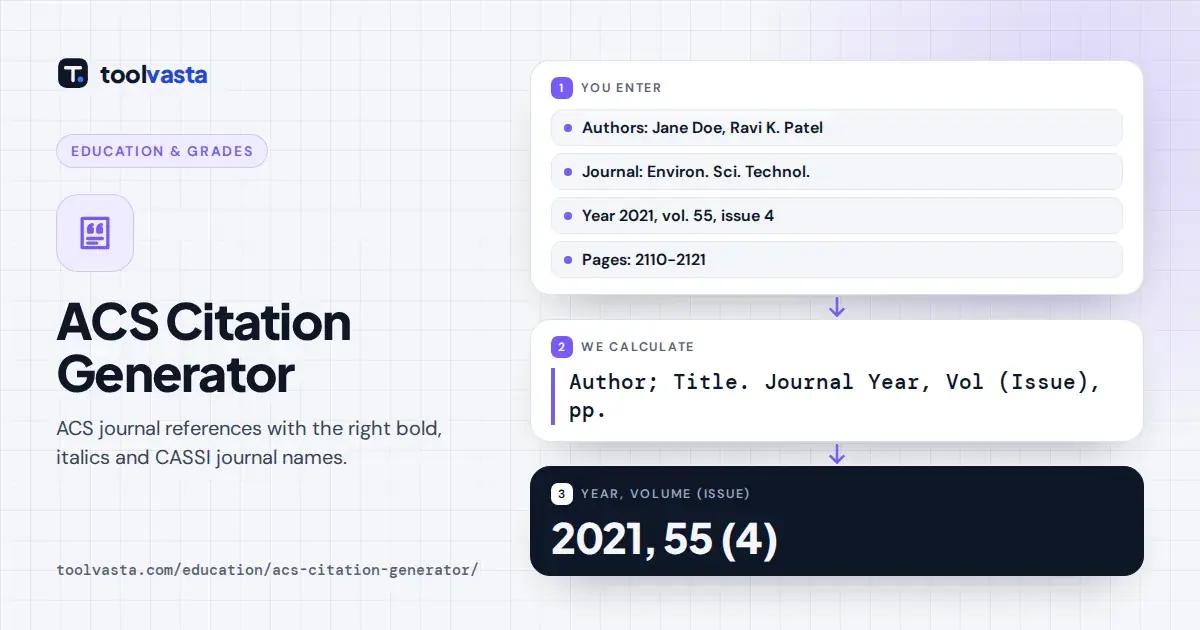
How to Use the ACS Citation Generator
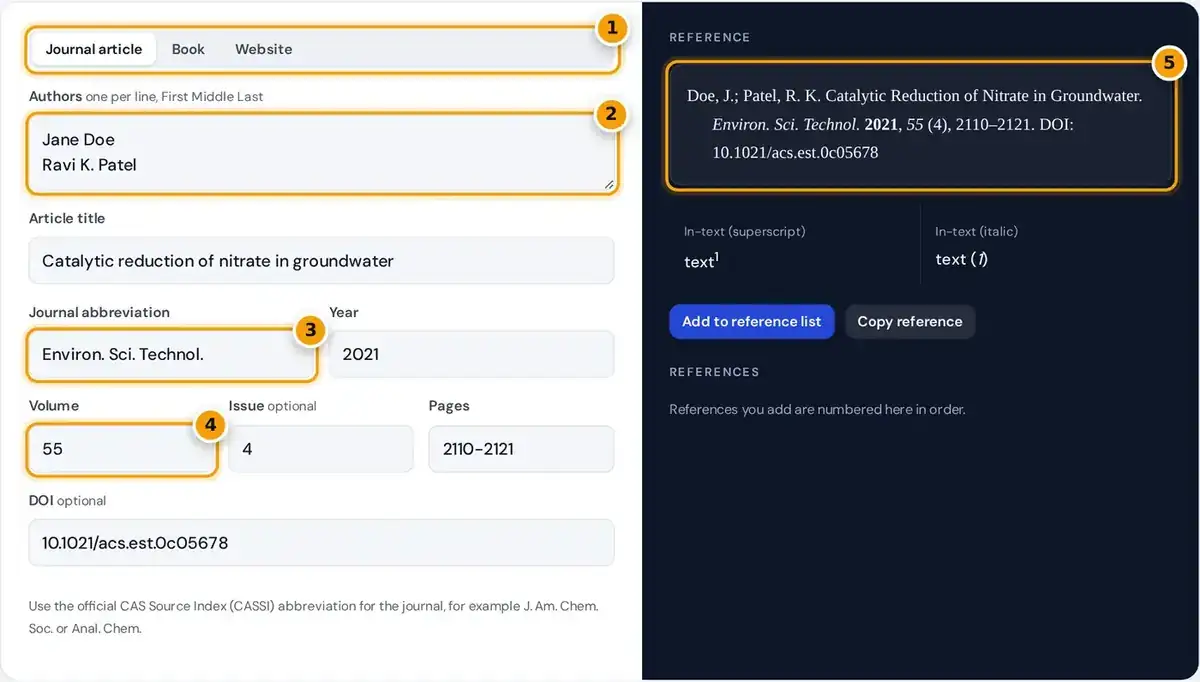
- Choose journal article, book or website.
- Enter each author on its own line as First Middle Last. Initials are added automatically.
- Use the CASSI journal abbreviation, such as J. Am. Chem. Soc.
- Add volume, issue, pages and the DOI if you have one.
- Copy the ACS reference and add it to your numbered reference list.
Pick the source type first: journal article, book or website. Then type each author on a separate line as first name, middle initial and last name, followed by the title and the remaining publication details.
The acs citation generator formats the full reference instantly as you type. It inverts names, applies title case and adds the bold year and italic volume, then shows the matching superscript and italic in-text numbers.
Press add to reference list in the order you cite each source. The list numbers itself to match your text, and copy reference list places the whole numbered list on your clipboard, ready to paste.
ACS Reference Formats
Each source type has its own reference format. Journal articles are the most common in chemistry, and they pack a lot of information into one line using punctuation, bold and italic type rather than labels.
Book: Author, A. B. Book Title, Edition ed.; Publisher: City, Year.
Website: Author, A. B. Title of Page. Website Name. URL (accessed YYYY-MM-DD).
- Doe, J.; Patel, R. K. Catalytic Reduction of Nitrate in Groundwater. Environ. Sci. Technol. 2021, 55 (4), 2110–2121. DOI: 10.1021/acs.est.0c05678
- Lee, M. S. Principles of Analytical Chemistry, 3rd ed.; Harbour Press: Toronto, 2019.
- Periodic Table of Elements. Sample Chemistry Portal. https://www.example.org/periodic-table (accessed 2026-09-30).
A journal reference ends with the bold year, the italic volume, the optional issue in parentheses and the page range. The DOI goes last, which lets readers find the exact article even if links change.
Books put the title in italics, followed by the edition, the publisher and city, and the year. Website references end with the URL and the date you accessed the page, written with the year first.
In-Text Citations in ACS Style
ACS allows three in-text citation systems. Most journals use a superscript number placed after the punctuation, like this.1 Other journals use an italic number in parentheses, written as (1), placed inside the sentence itself.
The third option is author-date, such as (Doe and Patel, 2021). With two authors, join the surnames with and. With three or more, give the first surname followed by et al. inside the same parentheses.
With numbered systems, the reference list follows citation order, not the alphabet. A source that is cited again later keeps the same number, and the result panel shows which number the current source will receive.
Formatting Details
Authors appear as surname, then initials with periods, separated by semicolons. The generator lists every author you enter. For very long author lists, current ACS guidance suggests listing the first ten names, then et al.
Where possible, use the official journal abbreviation from the CAS Source Index (CASSI), for example J. Am. Chem. Soc. or Anal. Chem. Some courses and journals now also accept full journal titles instead of abbreviations.
The year appears in bold and the volume in italics, while the issue in parentheses is optional. Page ranges use an en dash, and a book edition is written as an ordinal like 3rd ed.
Worked Example
Suppose your chemistry lab report cites a 2021 article by Jane Doe and Ravi K. Patel in Environmental Science & Technology, volume 55, issue 4, on pages 2110 to 2121, with a DOI that starts 10.1021.
Enter both authors on separate lines, the title, the abbreviation Environ. Sci. Technol., the year, volume, issue, page range and DOI. The generator turns each name into surname and initials, joined by a single semicolon.
It converts the title to title case, sets 2021 in bold and 55 in italics, and replaces the hyphen in the page range with an en dash. As the first source, it becomes superscript 1.
Missing Information and Multiple Citations
If a page has no author, many guides list the publishing organization instead, and if there is none, start with the title. This generator starts with the title when you leave the author box empty.
When a source has no publication date, some instructors ask for n.d., meaning no date. Websites always need an access date, which the generator fills with today's date and lets you change it if needed.
To cite multiple citations at one point in the text, separate the numbers with commas, as in (10, 12), and use an en dash for a range of three or more, as in (13–15).
Check Your Target Journal
This generator follows the reference patterns of the American Chemical Society. Individual ACS journals and each instructor may still differ, for example on article titles, how DOIs are shown or how access dates should appear.
Before submitting, always check the author guidelines for the journal or course you are writing for. The official rules come from the ACS Guide to Scholarly Communication, which replaced the older printed ACS Style Guide.
Many university libraries also publish helpful free summaries, such as the Concordia University ACS citation style guide. These guides are especially useful for chemistry students checking unusual sources like patents, theses, datasets or government reports.
Frequently asked questions
What is ACS citation style?
It is the referencing style of the American Chemical Society, used in chemistry papers and lab reports. It usually uses numbered in-text citations and a reference list in the order sources are first cited.
How do I cite a journal article in ACS style?
List authors as surname and initials separated by semicolons, then the article title, the abbreviated journal name in italics, the year in bold, the volume in italics, the pages and the DOI.
Where do I find the journal abbreviation?
Use the CAS Source Index, known as CASSI. For example, Journal of the American Chemical Society is abbreviated J. Am. Chem. Soc., and Analytical Chemistry is abbreviated Anal. Chem.
Is the ACS reference list alphabetical?
Not when you use numbered citations. Sources are listed in the order they are first cited in the text. Only the author-date system may use an alphabetical list, depending on the journal.
Which in-text citation formats does ACS allow?
ACS allows superscript numbers, italic numbers in parentheses and the author-date system. Use one system consistently throughout a paper, and follow your journal or instructor if they require a particular one.
Do I include the issue number?
It is optional in ACS style. If you have it, include it in parentheses after the italic volume number, for example 55 (4), followed by a comma and the page range.