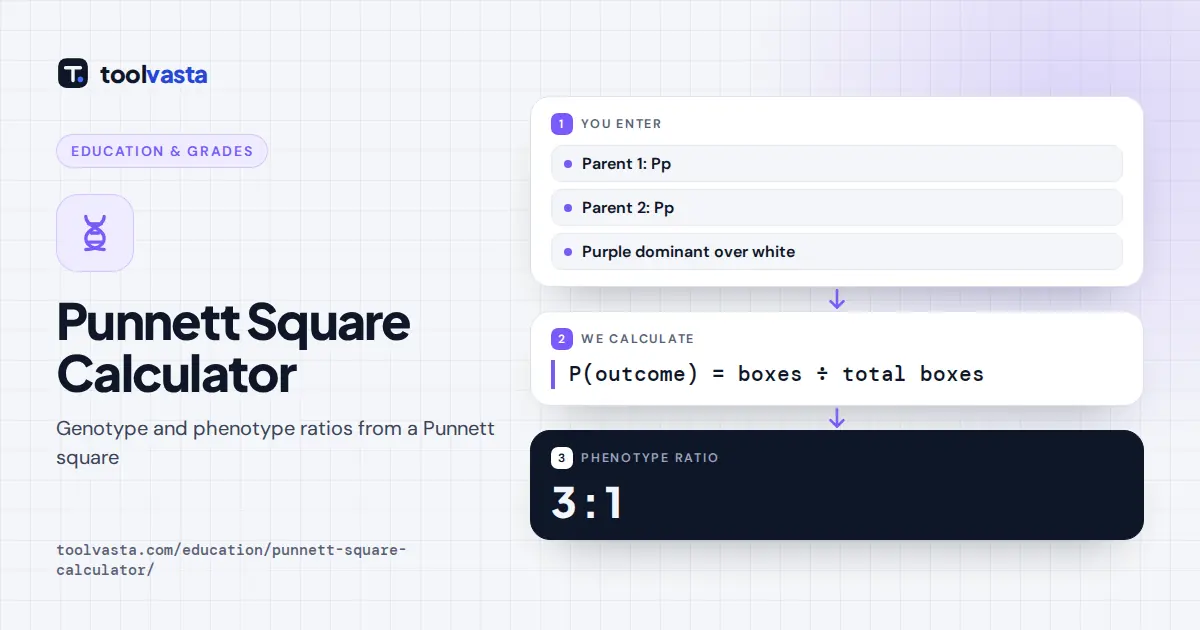
How to Use the Punnett Square Calculator
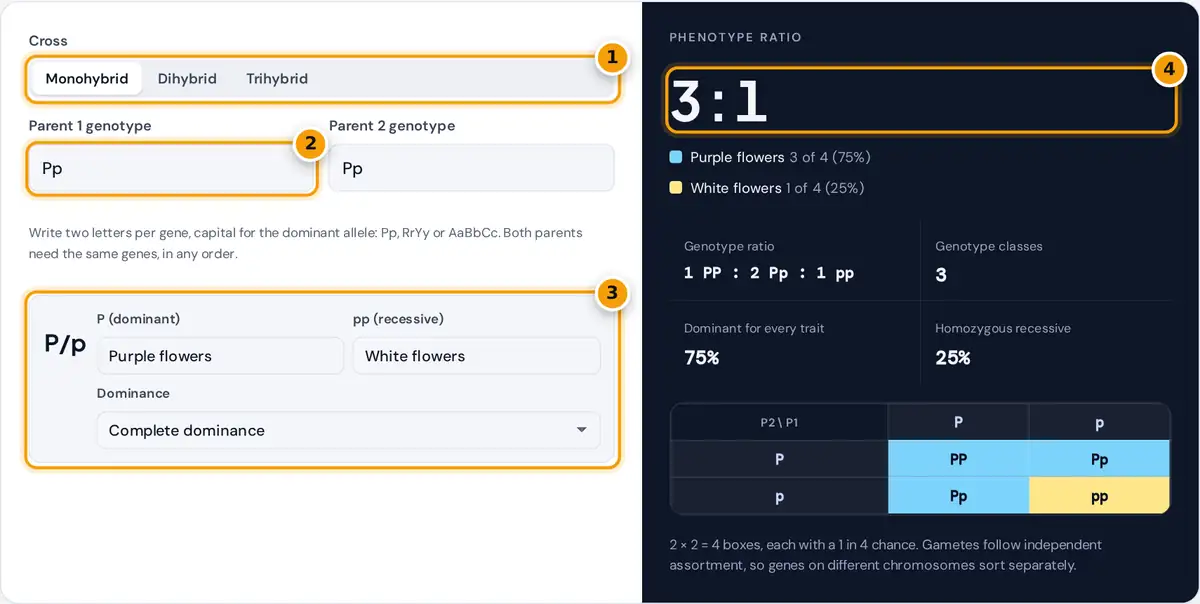
- Load a monohybrid, dihybrid or trihybrid example.
- Type both parent genotypes, two letters per gene.
- Name the traits and set complete or incomplete dominance.
- Read the phenotype ratio, genotype ratio and the square.
Type the genotype of each parent, using two letters for every gene and a capital letter for the dominant allele, for example Pp for a pea plant that carries one purple allele and one white allele. Press Monohybrid, Dihybrid or Trihybrid to load a classic example. The result panel shows the phenotype ratio, the genotype ratio, the share of offspring that show every dominant trait, the share that are homozygous recessive, and a color-coded Punnett square. Rename the traits in the cards below the genotypes, and switch any gene to incomplete dominance to see a third, blended phenotype.
How a Punnett Square Works
Each parent passes one allele of every gene to each offspring. Mendel's law of segregation says the two alleles of a gene separate into different gametes, and the law of independent assortment says genes on different chromosomes sort independently. The calculator lists every gamete a parent can make, puts one parent's gametes across the top and the other's down the side, and fills each box by combining the alleles. Every box is equally likely.
probability of an outcome = boxes with that outcome ÷ total boxes
ratio = counts divided by their greatest common divisor
Worked Example
For Pp × Pp, each parent makes P and p gametes, so the square has 2 × 2 = 4 boxes: PP, Pp, Pp and pp. The genotype ratio is 1 PP : 2 Pp : 1 pp. With purple dominant, three boxes are purple and one is white, a 3 : 1 phenotype ratio, or 75% purple. For the dihybrid RrYy × RrYy, each parent makes RY, Ry, rY and ry, giving 16 boxes. Nine show both dominant traits (round and yellow), three are round and green, three are wrinkled and yellow, and one is wrinkled and green: 9 : 3 : 3 : 1, so 9 ÷ 16 = 56.25% are round and yellow and 1 ÷ 16 = 6.25% are homozygous recessive.
Common Crosses and Their Ratios
| Cross | Phenotype ratio | Genotype ratio |
|---|---|---|
| Aa × Aa | 3 : 1 | 1 AA : 2 Aa : 1 aa |
| Aa × aa (test cross) | 1 : 1 | 1 Aa : 1 aa |
| AA × aa | 1 (all dominant) | 1 Aa |
| Aa × Aa, incomplete dominance | 1 : 2 : 1 | 1 AA : 2 Aa : 1 aa |
| AaBb × AaBb | 9 : 3 : 3 : 1 | 9 genotypes, 1 : 2 : 2 : 1 : 4 : 1 : 2 : 2 : 1 |
| AaBb × aabb (test cross) | 1 : 1 : 1 : 1 | 1 AaBb : 1 Aabb : 1 aaBb : 1 aabb |
| AaBbCc × AaBbCc | 27 : 9 : 9 : 9 : 3 : 3 : 3 : 1 | 27 genotypes in 64 boxes |
Complete and Incomplete Dominance
With complete dominance, one dominant allele is enough to show the trait, so Pp looks the same as PP. With incomplete dominance the heterozygote shows a blend, such as the pink snapdragons that come from crossing red and white plants. With codominance both alleles show at once, such as AB blood type. For ratio purposes, incomplete dominance and codominance behave the same way: the heterozygote is its own phenotype, so the monohybrid ratio becomes 1 : 2 : 1 instead of 3 : 1.
Mendel's Pea Plants
The default examples come from Gregor Mendel's experiments with garden peas in the 1850s and 1860s. He crossed plants that differed in clear traits, such as purple or white flowers, round or wrinkled seeds and yellow or green seeds, and counted thousands of offspring. In one experiment he counted 5,474 round seeds and 1,850 wrinkled seeds, a ratio of about 2.96 to 1, very close to the 3 : 1 that the Punnett square predicts. His results became the foundation of modern genetics.
Assumptions and Limits
- Genes are assumed to assort independently, which holds for genes on different chromosomes or far apart on one chromosome. Linked genes produce different ratios.
- Sex-linked traits, multiple alleles such as the ABO blood group, epistasis and polygenic traits need extra rules that a basic Punnett square does not cover.
- Ratios are probabilities. Real families and small samples often differ from them by chance, just as Mendel's counts were close to, but not exactly, 3 : 1.
Frequently asked questions
How do you do a Punnett square?
List the gametes each parent can make, put one parent's gametes across the top and the other's down the side, and combine the alleles in each box. Count the boxes for each genotype and phenotype to get the ratios.
What is the ratio of a dihybrid cross?
A cross between two parents heterozygous for two independent genes, such as RrYy × RrYy, gives a 9 : 3 : 3 : 1 phenotype ratio when both genes show complete dominance. The genotype ratio has nine classes.
What is the difference between genotype and phenotype?
The genotype is the pair of alleles an organism carries, such as Pp. The phenotype is the trait you can observe, such as purple flowers. Different genotypes, like PP and Pp, can share one phenotype.
How does incomplete dominance change the ratio?
The heterozygote shows its own blended phenotype, so a monohybrid cross gives 1 : 2 : 1 instead of 3 : 1. Switch a gene to incomplete dominance in the trait card and name the blended phenotype, such as pink flowers.
Can I calculate a trihybrid cross?
Yes. Enter three genes for each parent, such as RrYyTt, or press Trihybrid. The calculator draws the 8 by 8 square with 64 boxes and returns the 27 : 9 : 9 : 9 : 3 : 3 : 3 : 1 phenotype ratio.
Does the calculator handle sex-linked or blood type genes?
Not directly. It assumes two alleles per gene on autosomes that assort independently. Sex-linked traits, the three-allele ABO blood group and linked genes need different methods and give different ratios.