How to Use the GPA Calculator
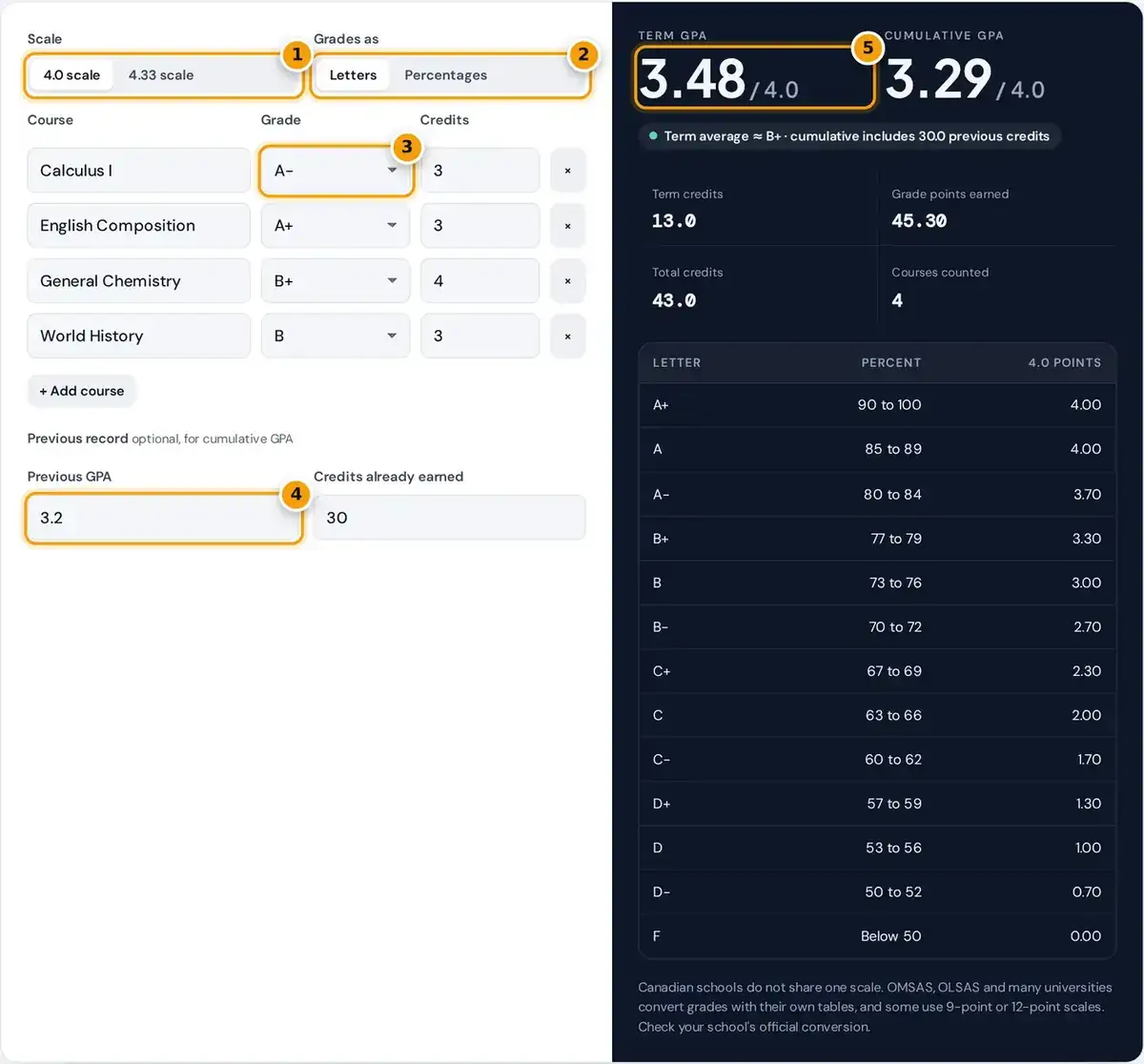
- Pick the 4.0 or 4.33 grade point scale your school uses.
- Choose whether to enter letter grades or percentages.
- Select each course's grade and enter its credits.
- Optional: add your previous GPA and credits earned for a cumulative GPA.
- Read your term GPA, with the cumulative GPA shown beside it.
Pick the 4.0 or 4.33 scale, then choose Letters if your transcript shows letter grades, or Percentages to enter marks such as 82%. Each row holds one course name, its grade and its credit value.
Press Add course for more rows, or remove a row with its cross button. The GPA calculator updates as you type and shows your term GPA, term credits, grade points earned and the courses counted.
To get a cumulative GPA, fill in your previous GPA and the credits already earned. Leave those boxes empty if you only want this term, and the conversion table in the result panel stays visible.
The GPA Formula and Quality Points
A grade point average is weighted by credits. Convert each grade to grade points, multiply by the course credits or credit hours, add the results, then divide the sum by the total credits you attempted.
The product of grade points and credits is often called quality points. A 4-credit course therefore moves your GPA more than a 3-credit one, even when both courses earn exactly the same final letter grade.
The formula below also covers cumulative GPA. Multiply the previous GPA by its credits to rebuild the earlier quality points, add this term, and divide by all credits combined to get the new overall figure.
cumulative GPA = (term points + previous GPA × previous credits) ÷ (term credits + previous credits)
Worked Example on the 4.0 Scale
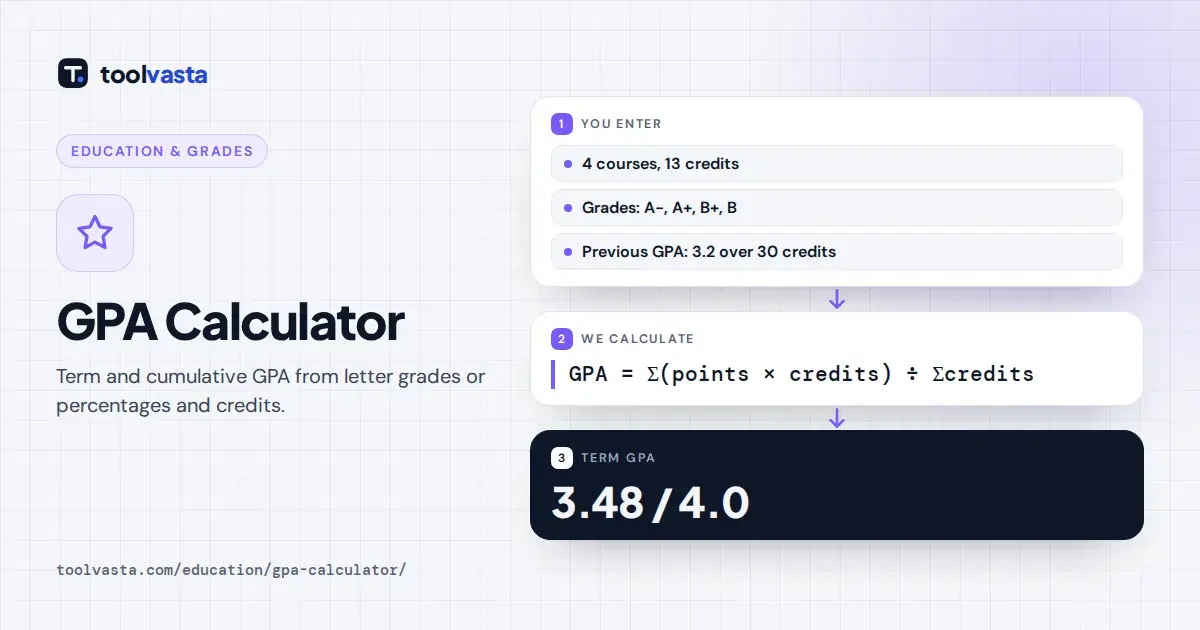
This worked example uses four courses. Calculus I earns an A- over 3 credits, English Composition an A+ over 3 credits, General Chemistry a B+ over 4 credits, and World History a B over 3.
The quality points total 45.3 over 13 credits, so the term or semester GPA is 45.3 divided by 13, or 3.48. Results are rounded to two decimals, which is how most transcripts report a GPA.
With a previous GPA of 3.2 over 30 credits, the cumulative GPA is 45.3 plus 96, divided by 43, which gives 3.29. On the 4.33 scale the same grades give 46.32 points and 3.56 instead.
| Course | Grade | Credits | Points (4.0 scale) |
|---|---|---|---|
| Calculus I | A- | 3 | 11.1 |
| English Composition | A+ | 3 | 12.0 |
| General Chemistry | B+ | 4 | 13.2 |
| World History | B | 3 | 9.0 |
| Total | 13 | 45.3 |
4.0 and 4.33 Grade Point Scales
On the 4.0 scale an A+ and an A are both worth 4.0, the approach listed in the University of Toronto grading scales and at many other Ontario universities. Students cannot finish above 4.0 there.
The 4.33 scale values an A+ at 4.33, so a top GPA can pass 4.0. Several Canadian and US schools use it, and its plus and minus steps are thirds, such as 3.67 and 3.33.
The percentage ranges in the table are a common Ontario conversion, with an A+ from 90 to 100 and a pass from 50. Your own school may draw the lines differently, so check the calendar.
| Letter | Percent | 4.0 scale | 4.33 scale |
|---|---|---|---|
| A+ | 90 to 100 | 4.0 | 4.33 |
| A | 85 to 89 | 4.0 | 4.00 |
| A- | 80 to 84 | 3.7 | 3.67 |
| B+ | 77 to 79 | 3.3 | 3.33 |
| B | 73 to 76 | 3.0 | 3.00 |
| B- | 70 to 72 | 2.7 | 2.67 |
| C+ | 67 to 69 | 2.3 | 2.33 |
| C | 63 to 66 | 2.0 | 2.00 |
| C- | 60 to 62 | 1.7 | 1.67 |
| D+ | 57 to 59 | 1.3 | 1.33 |
| D | 53 to 56 | 1.0 | 1.00 |
| D- | 50 to 52 | 0.7 | 0.67 |
| F | Below 50 | 0.0 | 0.00 |
Canadian GPA Differences and Conversions
Because each province runs education, there is no single Canadian GPA. York University uses a 9-point scale and McMaster University uses a 12-point scale, so comparing students across schools needs an official grade conversion table.
For medical school, OMSAS converts applicants' grades to its own 4.0 scale using the OMSAS undergraduate grade conversion table. OLSAS does the same for law school, so each service's result can differ from this estimate.
Use this calculator for a quick estimate, then confirm with your registrar or the application service. When a form asks for your GPA, report the figure on your transcript unless the instructions clearly say otherwise.
What Counts Toward Your GPA
Pass/fail courses usually carry no grade points, so leave them out. A withdrawal before the deadline normally has no effect either, although some schools record a late withdrawal as a failing grade in the GPA.
Repeated courses follow school policy: the new grade may replace the old one, or both may be averaged together. Transfer credits often count toward your degree but not toward the GPA at your new school.
Some high schools add a weighted GPA bonus for honors or advanced courses. This calculator does not apply those bonuses, because university and college GPAs are almost always calculated on credits alone, without extra weighting.
- Pass/fail courses and withdrawals: usually left out.
- Repeated courses: may replace or be averaged with the earlier grade.
- Transfer credits: often count toward the degree but not the GPA.
- High school weighted GPA bonuses: not applied here.
What Is a Good GPA and How to Raise It
A good GPA depends on your goal. Scholarships, the dean's list, graduate programs and professional schools each publish their own minimums, so check the exact requirement rather than relying on a general rule of thumb.
To raise your GPA more quickly, focus on high-credit courses, since they carry the most weight. Moving one 4-credit course from a B to an A- adds 2.8 quality points on the standard 4.0 scale.
Use the calculator to test scenarios before the term ends. Enter the grades you expect, then change one course at a time to see which single improvement lifts your term and cumulative GPA the most.
Frequently asked questions
How do I calculate my GPA?
Multiply each course's grade points by its credits, add them up and divide by the total credits. A 3-credit A- worth 3.7 and a 4-credit B worth 3.0 give 23.1 divided by 7, or 3.30.
How do I calculate cumulative GPA?
Multiply your previous GPA by your previous credits, add this term's grade points, then divide by the combined credits. The calculator does this automatically when you fill in the previous record boxes.
What is the difference between a 4.0 and a 4.33 scale?
On a 4.0 scale an A+ and an A are both worth 4.0. On a 4.33 scale an A+ is worth 4.33, so strong students can finish with a GPA above 4.0.
What GPA is 80 percent?
On the common Ontario conversion used here, 80% is an A-, worth 3.7 on the 4.0 scale or 3.67 on the 4.33 scale. Other schools may convert percentages with slightly different ranges.
Does OMSAS use this scale?
OMSAS uses its own conversion table for each university, so your OMSAS GPA can differ from this estimate. Check the official OMSAS table for your school before you apply to medical school.
Do pass/fail courses affect my GPA?
Usually not. Pass/fail courses carry no grade points, so they are left out of the GPA calculation. A failing grade in a graded course does count, as zero points over its full credits.