Your high school GPA is the average of the grade points you earn in every class, weighted by how many credits each class carries. Most US schools report two versions: an unweighted GPA on a plain 4.0 scale, and a weighted GPA that adds a bonus for Honors, AP, IB and dual enrollment classes. You can check your own numbers in seconds with the high school GPA calculator, but knowing how the arithmetic works helps you plan your schedule, read your transcript and talk to colleges with confidence.
This guide walks through both calculations step by step, shows a full worked example, and explains which number colleges actually look at.
How Are Letter Grades Turned into Grade Points?
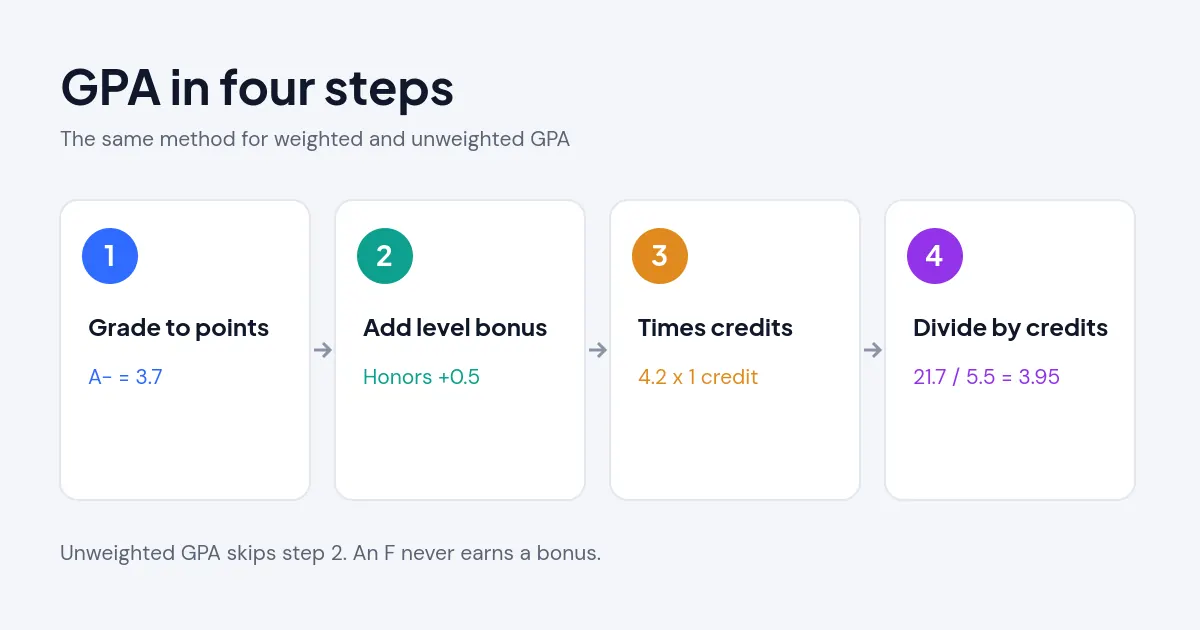
Every letter grade is first converted to a number of grade points on the 4.0 scale. An A is worth 4.0, a B 3.0, a C 2.0, a D 1.0 and an F zero. Plus and minus grades sit in between: an A- is 3.7, a B+ 3.3, a B- 2.7, and so on in steps of roughly a third of a point.
| Letter | Points | Letter | Points |
|---|---|---|---|
| A / A+ | 4.0 | C+ | 2.3 |
| A- | 3.7 | C | 2.0 |
| B+ | 3.3 | C- | 1.7 |
| B | 3.0 | D+ | 1.3 |
| B- | 2.7 | D | 1.0 |
| F | 0.0 | D- | 0.7 |
A few schools give an A+ 4.3 points rather than 4.0, and some skip minus grades entirely. Your student handbook or school profile lists the exact scale. If your teachers record percentages, the school first maps them to letters; the common College Board mapping puts 93 to 96 at an A and 90 to 92 at an A-, while some districts use a straight 10 point scale where 90 and above is an A.
How Do You Calculate an Unweighted GPA?
An unweighted GPA is the credit-weighted average of your grade points, with every class treated the same regardless of difficulty. The steps are:
The three steps
- Convert each final grade to grade points using the table above.
- Multiply the grade points by the credits for that class. A full-year class is usually 1 credit and a semester class 0.5.
- Add up all the results and divide by the total number of credits.
Credits matter more than many students expect. A half-credit elective counts only half as much as a full-year core class, so an A in a semester of PE cannot fully cancel out a C in a year of chemistry. If every class has the same credit value, the GPA is simply the plain average of the grade points, the same result you would get from the average calculator.
How Does a Weighted GPA Work?
A weighted GPA adds a bonus to the grade points of harder classes before averaging, so students are not penalized for taking on a tougher schedule. The most common system adds 0.5 points for Honors classes and 1.0 point for AP, IB and dual enrollment classes. Under that system an A in AP Calculus is worth 5.0, a B in Honors English 3.5 and a B in regular Spanish 3.0.
Rules that vary by school
The idea is the same everywhere, but the details are set locally. Watch for these differences on your own transcript:
- Some schools give no bonus to grades of D or F, and almost none weight an F.
- A few use a 0.5 bonus for AP as well as Honors, or a 1.0 bonus for both.
- Some cap the weighted scale at 5.0, while others allow higher values when an A+ is worth 4.3.
- Many only weight core academic classes, so electives always use the regular scale.
Because the bonus is added before dividing by credits, one AP class does not raise your GPA by a full point. It raises it by the bonus divided by your total credits, which is why a schedule with several AP classes moves the weighted figure much more than a single one.
What Does a Full Worked Example Look Like?
Take a 10th grader with six classes in one semester. Five are full-credit and one, PE, is a half credit.
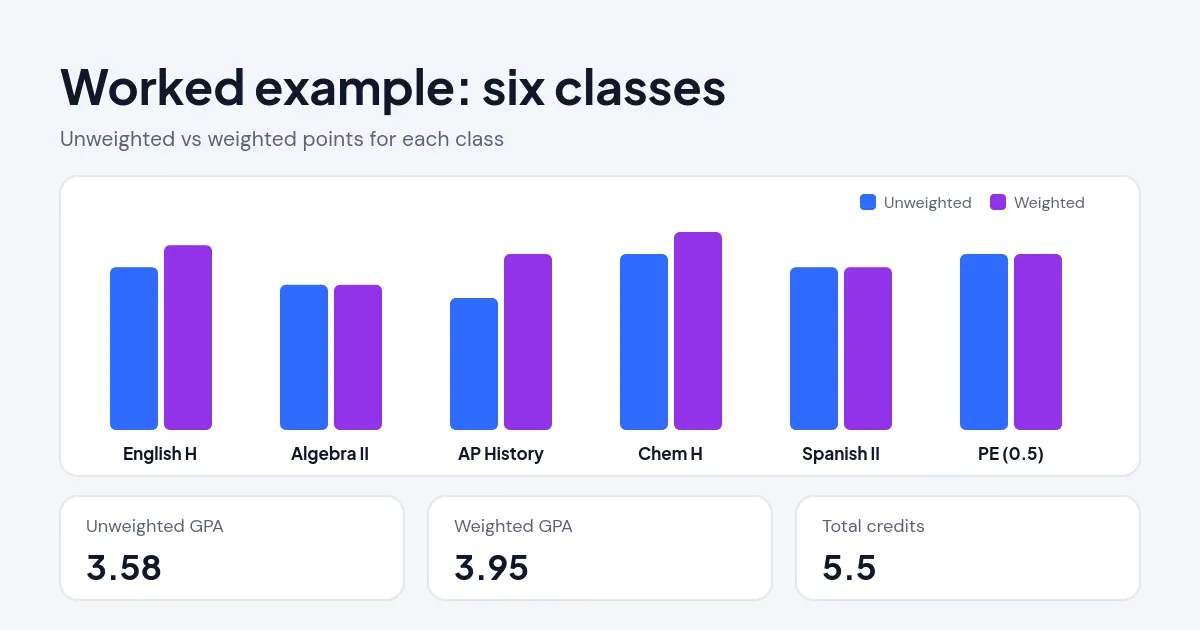
| Class | Grade | Level | Credits | Unweighted points | Weighted points |
|---|---|---|---|---|---|
| English 10 | A- | Honors | 1 | 3.7 | 4.2 |
| Algebra II | B+ | Regular | 1 | 3.3 | 3.3 |
| World History | B | AP | 1 | 3.0 | 4.0 |
| Chemistry | A | Honors | 1 | 4.0 | 4.5 |
| Spanish II | A- | Regular | 1 | 3.7 | 3.7 |
| Physical Education | A | Regular | 0.5 | 4.0 | 4.0 |
The unweighted total is 3.7 + 3.3 + 3.0 + 4.0 + 3.7 + (4.0 × 0.5) = 19.7 points over 5.5 credits, so the unweighted GPA is 19.7 ÷ 5.5 = 3.58. For the weighted figure, the three bonuses add 0.5 + 1.0 + 0.5 = 2.0 points, giving 21.7 ÷ 5.5 = 3.95.
Adding the new semester to your cumulative GPA
Your cumulative GPA blends every semester so far, again weighted by credits. Suppose the same student already had a 3.40 unweighted GPA over 12 credits. The new cumulative figure is (3.40 × 12 + 19.7) ÷ (12 + 5.5) = 60.5 ÷ 17.5 = 3.46. Notice that a strong semester only nudges a cumulative GPA upward once you have many credits behind you, which is why freshman and sophomore grades matter so much.
Which GPA Do Colleges Look At?
Colleges see whatever your school reports on the transcript, together with a school profile that explains the grading scale and how many advanced classes are offered. On the Common App you enter your GPA exactly as the school reports it and say whether it is weighted. Many admissions offices then recalculate their own figure, often an unweighted GPA using only core academic classes from 10th and 11th grade, so they can compare students from thousands of different schools on the same footing.
That means both numbers matter. Your unweighted GPA shows how well you did in the classes you took. Your weighted GPA, and the list of courses behind it, shows how hard those classes were. The College Board's BigFuture guide to the 4.0 scale is a good reference for converting your own grades, and federal data from the NCES High School Transcript Study shows that the average graduate's GPA has risen to just above 3.0 as students take more advanced courses.
Grades are only part of the academic picture. Test scores, where submitted, give colleges a common yardstick, and the SAT score calculator turns your section scores into a total and a national percentile so you can see how the two fit together.
How Can You Raise Your High School GPA?
The math points to a few practical moves. First, protect your full-credit core classes, because they carry the most weight. Second, add advanced classes where you can realistically earn a B or better: a B in an AP class (4.0 weighted) is worth more than an A- in a regular class (3.7) on the weighted scale, but a D in an AP class hurts both numbers. Third, act early. With few credits on the books, every grade moves the average a lot; by senior year the cumulative GPA is hard to shift.
The same accuracy habits that help in class help with your grade tracking. Science teachers often grade labs partly on how close your result is to the accepted value, and the percent error calculator shows that gap as a percentage so you can fix a method before the final report is due. When a class grade is on the line, the final grade calculator tells you the exam score you need.
Frequently asked questions
Is a weighted or unweighted GPA more important?
Both matter. Colleges use the unweighted GPA to compare raw performance and the weighted GPA, plus your course list, to judge the difficulty of your schedule.
What is the highest possible high school GPA?
On an unweighted scale it is 4.0, or 4.3 where an A+ earns extra. On the usual weighted scale it is 5.0, reached only with straight A grades in AP or IB classes.
Do 9th grade grades count toward GPA?
Yes, at most schools your cumulative GPA includes every semester from 9th grade onward. Some colleges recalculate using only 10th to 12th grade.
Does a pass or fail class affect GPA?
Usually not. Pass or fail classes earn credits toward graduation but are left out of the GPA calculation, although a failing grade may still appear on the transcript.
How much does one AP class raise my GPA?
It adds the 1.0 bonus divided by your total credits. With 6 credits in a semester, one AP class lifts that semester's weighted GPA by about 0.17.