How to Use the Old English Font Generator
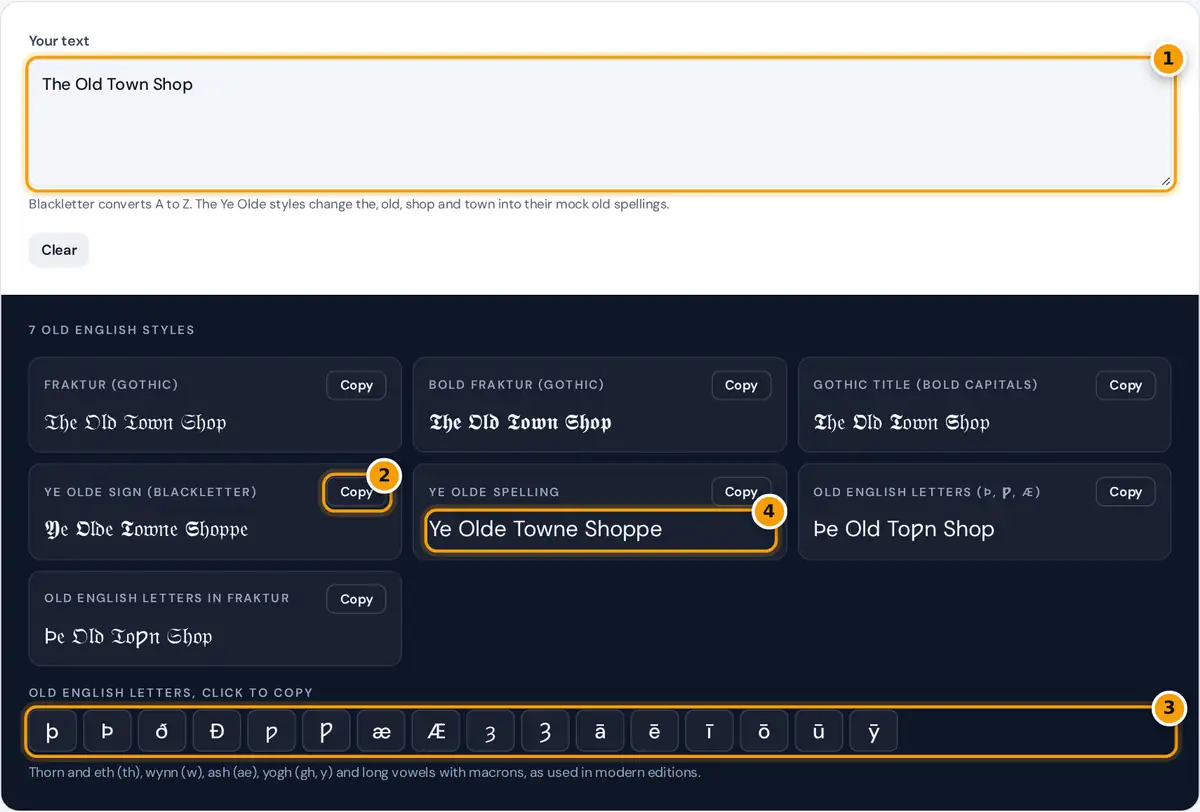
- Type a name, motto, sign or tattoo idea.
- Copy the Ye Olde sign, a blackletter weight or the Old English letters style.
- Click þ, ð, ƿ, æ or ȝ to copy a single Old English letter.
- Paste the result into your sign, label, post or design.
Type a name, a motto, a shop sign or a tattoo idea. Seven styles update as you type. The first three are blackletter, the lettering most people call an Old English font. The two Ye Olde styles rewrite a few words in mock old spelling for signs and labels. The last two use real letters from the Old English language, such as thorn and wynn. Press Copy on a style, or click a single letter in the strip below to copy it.
Two Meanings of Old English
"Old English" can mean a lettering style or a language. The lettering is blackletter: dense, angular gothic letters used in medieval manuscripts and early printing, and later on newspaper mastheads, diplomas and tattoos. The language is the English spoken in England from about the 5th century to the 12th century, the language of Beowulf, written with a Latin alphabet plus extra letters. This generator covers both.
| Letter | Name | Sound and use |
|---|---|---|
| þ Þ | Thorn | th, as in thin and this |
| ð Ð | Eth | th, used interchangeably with thorn |
| ƿ Ƿ | Wynn | w, later replaced by w |
| æ Æ | Ash | the a in cat |
| ȝ Ȝ | Yogh | Middle English sounds later spelled gh and y |
How the Styles Are Built
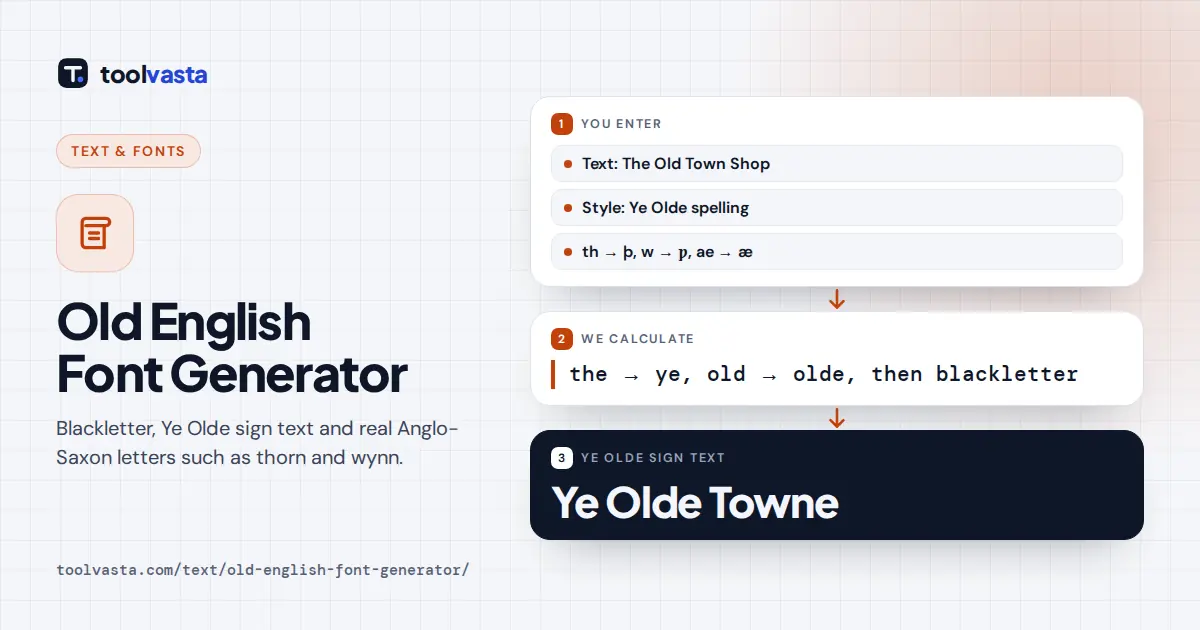
Blackletter styles replace each letter with a fraktur character from the Mathematical Alphanumeric Symbols block. The Old English letter styles change th to thorn, w to wynn and ae to ash, keeping capitals, and the fraktur version then converts the remaining letters.
th → þ (U+00FE), w → ƿ (U+01BF), ae → æ (U+00E6)
Worked Example
"The Old Town Shop" in Ye Olde spelling becomes "Ye Olde Towne Shoppe". In the sign style each word starts with a bold fraktur capital: Y is the 25th letter, so it is U+1D56C + 24 = U+1D584 (𝖄), giving 𝖄𝔢 𝕺𝔩𝔡𝔢 𝕿𝔬𝔴𝔫𝔢 𝕾𝔥𝔬𝔭𝔭𝔢. With Old English letters the original text reads Þe Old Toƿn Shop, because Th becomes capital thorn and w becomes wynn.
Why "Ye Olde" Means "The Old"
The "Ye" in "Ye Olde" was never pronounced "yee". Late medieval scribes wrote thorn in a way that looked like a y, and early printers, who often lacked a thorn in their type, used a y in its place. So "þe", meaning "the", was printed "ye". The extra e on olde and the double letters in shoppe are later inventions that make a word look old.
Where Blackletter Appears Today
Blackletter never fully disappeared. Many newspapers still print their name in it on the front page, universities use it on diplomas and seals, breweries and barbers use it on signs and labels, and it is a staple of heavy metal album covers, streetwear and lettering tattoos. In each case it signals tradition, authority or a dark, dramatic mood. That is why a short word in blackletter, such as a surname, a city or a motto, can carry a strong identity on its own.
Blackletter for Tattoos, Logos and Signs
- Use the title style for names and words in capitals: whole words in blackletter capitals are very hard to read.
- Bold fraktur has a complete alphabet with no exceptions, so it looks the most even for tattoo and logo drafts.
- For a final tattoo or print design, ask the artist to set the text in a real blackletter font. Unicode text is ideal for previews and for places without font choices.
Limits
The Old English letter styles are a playful approximation, not a translation into the Old English language, and the Ye Olde rules only change four common words. Unicode has no fraktur digits, so numbers stay plain. Screen readers announce these characters by name, so keep key information in normal text as well.
Frequently asked questions
What is the Old English font called?
The lettering usually called Old English is blackletter, also known as gothic script. Fraktur and Textura are two of its best known styles. This generator uses Unicode fraktur characters to create the look.
How do I type the letter thorn?
Click þ or Þ in the Old English letters strip to copy it. On Windows you can also hold Alt and type 0254 for the small thorn or 0222 for the capital on the number pad.
Is "Ye Olde" real Old English?
No. It is early modern printing with a mock old spelling. Ye stands for the, because printers used a y in place of thorn, and the extra letters in olde and shoppe were added much later for effect.
Can I use this text for a tattoo?
It is a good way to preview wording and letter shapes. For the tattoo itself, give your artist the plain words and ask them to draw them in a real blackletter font at the right size.
Does this translate into the Old English language?
No. It swaps th, w and ae for the letters thorn, wynn and ash, which gives an Old English look. Real Old English has different words and grammar, so use a scholarly dictionary for actual translations.
Why do some blackletter letters look different?
Five fraktur capitals, C, H, I, R and Z, were encoded earlier in the Letterlike Symbols block, so some fonts draw them with a different weight. The bold fraktur style avoids this.