How to Use the Hacked Text Generator
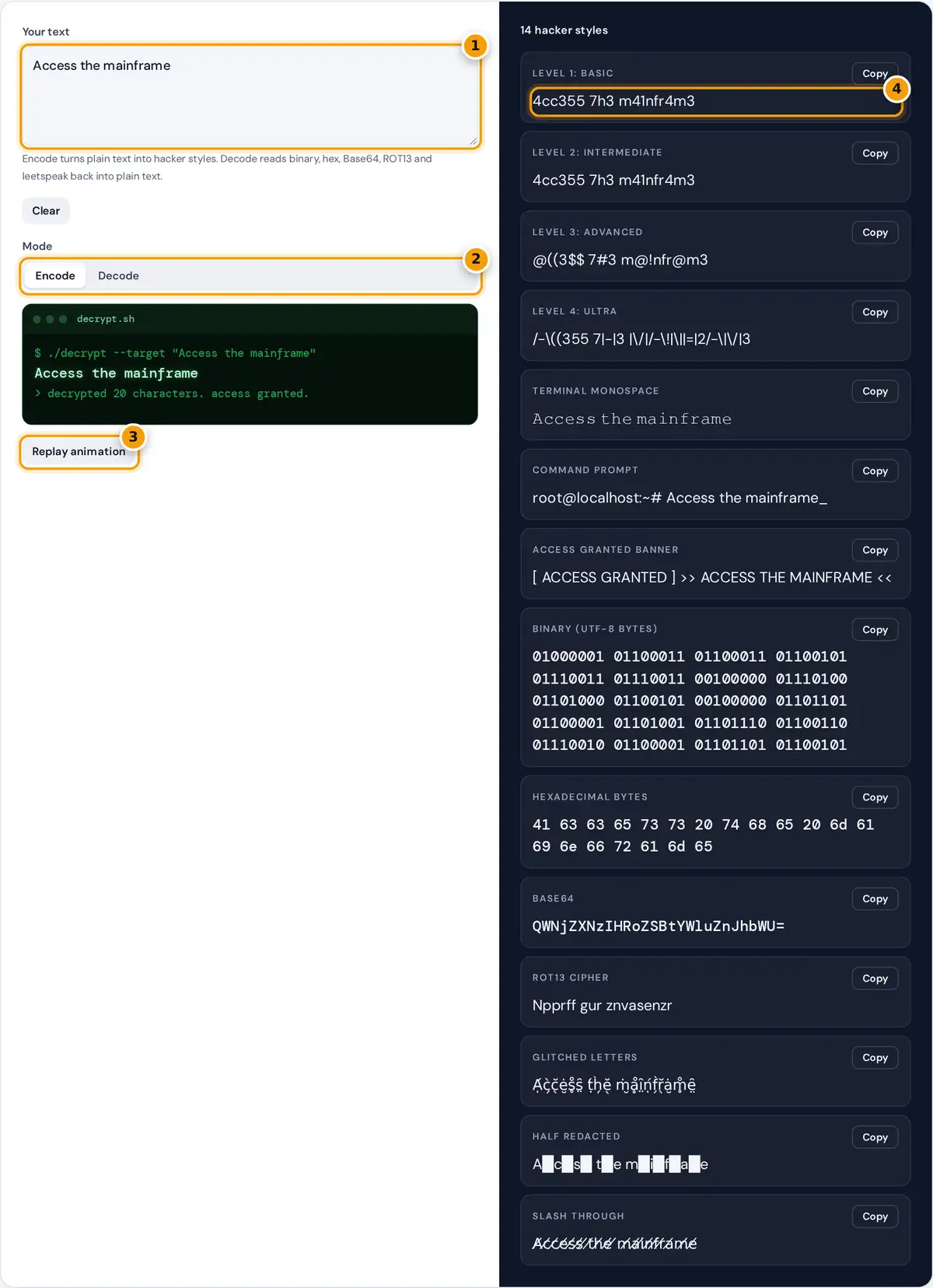
- Type your message, or paste hacker text to decode.
- Choose Encode for hacker styles or Decode to read binary, hex, Base64, ROT13 and leet.
- Replay the green terminal decrypt animation with your words.
- Copy any hacker style, from leetspeak to binary and glitch text.
Type a message into the box. Fourteen hacker styles update as you type, from four levels of leetspeak to binary, hexadecimal, Base64, ROT13, glitched letters and a command prompt line. The green terminal on the left replays a "decrypt" effect with your words each time you press Replay animation. Press Copy on any card to use the style in a chat, a bio, a game name or a puzzle.
Switch the mode to Decode to go the other way. Paste binary, hex, Base64, ROT13 or leetspeak and the tool shows what each decoder makes of it, with a clear message when the input is not valid for that format.
How Each Hacker Style Works
Some styles are only visual, and some are real encodings that a computer can reverse. Leetspeak swaps letters for look-alike digits and symbols. Binary and hexadecimal show the actual UTF-8 bytes that store your text, so they always decode back exactly. Base64 packs those bytes into 64 safe characters, which is how email attachments travel. ROT13 is a classic substitution cipher that moves each letter 13 places along the alphabet, so applying it twice gives the original back.
hex: each byte as two hexadecimal digits, e.g. A = 41
ROT13: letter → (position + 13) mod 26
Worked Example
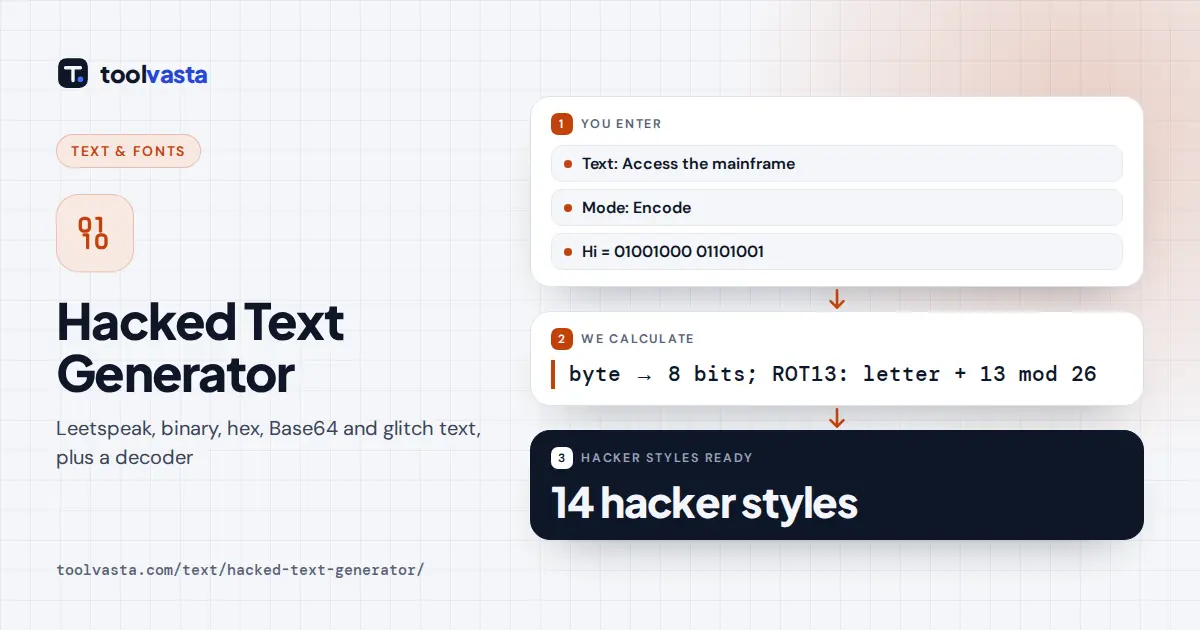
Take the word "Hi". H has the code 72, which is 64 + 8, so its byte in binary is 01001000 and in hex 48. The small i is 105 = 64 + 32 + 8 + 1, written 01101001 or 69. The binary style therefore shows 01001000 01101001, hex shows 48 69, and Base64 shows SGk=. In ROT13, H is the 8th letter and moves to the 21st, U, while i moves to v, giving Uv. The default message "Access the mainframe" becomes 4cc355 7h3 m41nfr4m3 in level 1 leetspeak and @((3$$ 7#3 m@!nfr@m3 in level 3.
Hacker Styles Compared
| Style | "Hi" becomes | Reversible? |
|---|---|---|
| Leetspeak level 3 | #! | Mostly, by guessing |
| Binary | 01001000 01101001 | Yes, exactly |
| Hexadecimal | 48 69 | Yes, exactly |
| Base64 | SGk= | Yes, exactly |
| ROT13 | Uv | Yes, apply it again |
| Glitched letters | Ḥ́ì̗ | Visually only |
These Styles Are Not Encryption
None of these styles protects a secret. Binary, hex and Base64 are encodings, so anyone can reverse them with a tool like the decoder above. ROT13 has only one possible key and has been used for decades to hide spoilers, not to secure data. If you need to keep a message private, use a well-reviewed encrypted messaging app or a password manager rather than a text style.
Fun Ways to Use Hacked Text
- Escape rooms and puzzles: hide a clue in binary or ROT13 and let players decode it.
- Classroom coding lessons: show how letters become bytes and how hexadecimal shortens binary.
- Gaming names and bios: leetspeak levels 1 and 2 stay readable while looking technical.
- Video intros: record the terminal animation for a quick "access granted" effect.
Where Hacker Text Comes From
Leetspeak grew out of 1980s bulletin board systems, where users swapped letters for digits to look like insiders and to slip past simple word filters. Green monospace text on black recalls the phosphor screens of early computer terminals. Binary and hexadecimal are the everyday notation of programmers, and ROT13 became the usual way to hide spoilers and punchlines on Usenet newsgroups. Together they form the look that films, games and memes use to say "hacker".
Limits
Binary, hex and Base64 can be long: every ASCII letter becomes 8 bits, and accented letters or emoji take 2 to 4 bytes each. Glitched letters use combining marks, which some apps strip or stack differently. The leetspeak decoder makes its best guess, so ambiguous symbols such as 1 for i or l may need a quick human fix. Everything runs locally in your browser.
Frequently asked questions
What is hacked text?
Hacked text is ordinary text restyled to look like it came from a computer terminal or a hacker movie. Common forms are leetspeak, binary, hexadecimal, Base64 and glitched characters, often shown in green monospace letters.
How do I decode binary or Base64 text?
Switch the mode to Decode and paste the text. The tool tries binary, hexadecimal, Base64, ROT13 and leetspeak at once and shows the plain result for each format that fits, or a note when the input is not valid.
Is hacked text the same as encryption?
No. Binary, hex and Base64 are public encodings, and ROT13 has a single fixed key, so anyone can reverse them in seconds. They are fine for games and puzzles but never for passwords or private messages.
What does 1337 mean?
1337 is leet written in leetspeak, where 1 stands for l, 3 for e and 7 for t. The term comes from elite and began in early online communities, where swapping letters for digits became a playful insider style.
Why is the binary version so long?
Each character is stored as at least one byte, and each byte is written as eight 0s and 1s plus a space. Letters with accents and emoji take two to four bytes, so binary is many times longer than the original.
Can I use hacked text in Discord or games?
Yes. Leetspeak, ROT13, binary and Base64 are plain characters that paste anywhere. Glitched letters use combining marks, which some name fields reject, so test them in a chat or bio before using them as a display name.