How to Use the Chinese Font Generator
- Type the English words you want in Chinese-style letters.
- Check the real meaning of every character the look-alike style used.
- Copy the look-alike letters, or pick numerals, punctuation or vertical text.
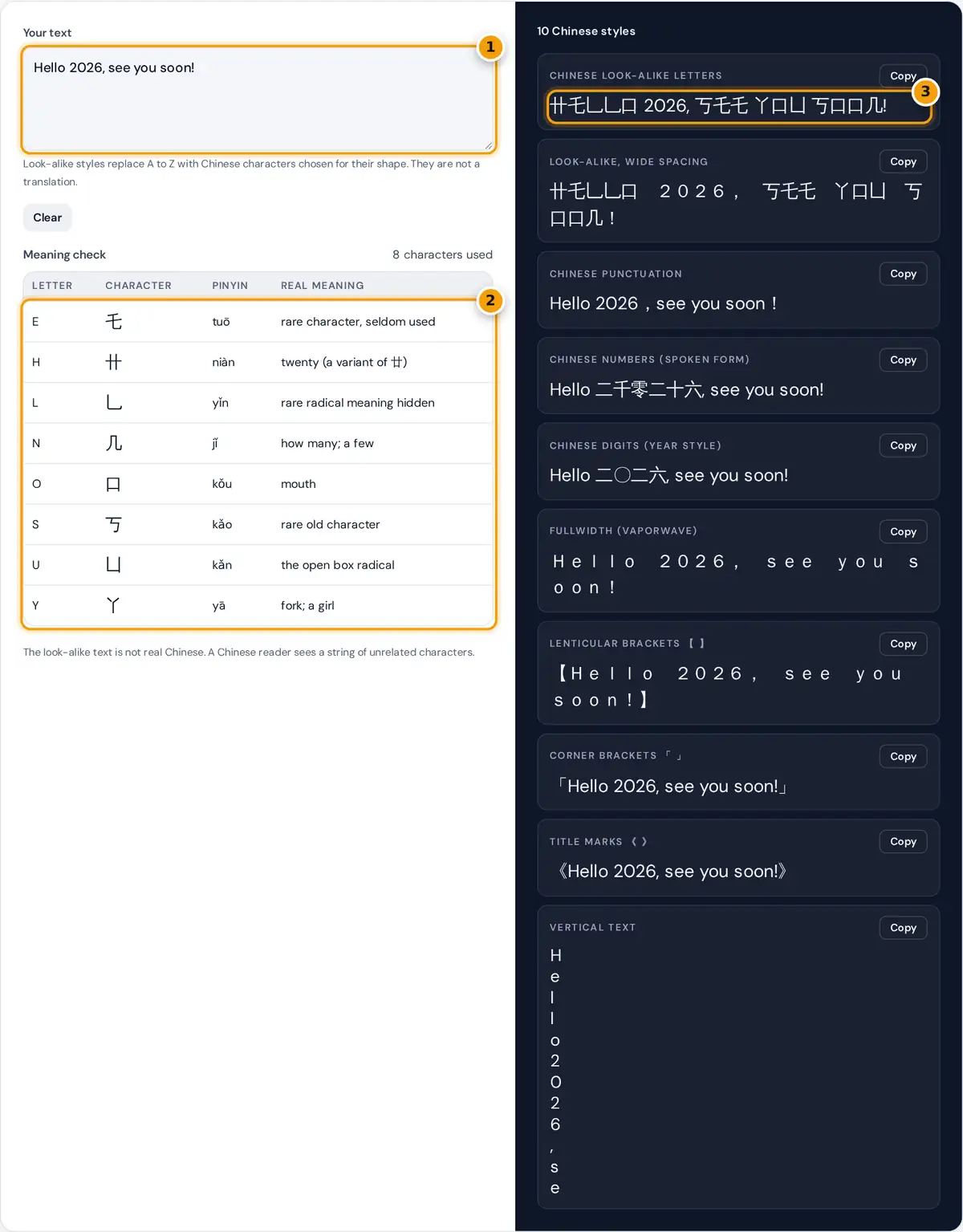
Type a name or a short phrase. Ten styles update as you type: Chinese-style look-alike letters, Chinese numbers, full-width punctuation, CJK brackets and vertical text. Under the box, the Meaning check table lists every character the look-alike style used, with its pinyin and its real meaning, so you know what a Chinese reader will see. Press Copy on the card you want.
Look-Alike Letters Are Not Chinese
The popular "Chinese font" is a set of real Chinese characters picked only because their shape resembles a Latin letter. 卄 looks like H but means twenty, 口 looks like O but means mouth, and 尸 looks like P but is the corpse radical. Strung together, they spell nothing in Chinese. That is fine for a playful username or a poster, but it is not a translation, and a Chinese speaker will read it as random characters. The meaning table is there so you can avoid surprises, such as a name full of corpses. For a real Chinese name or phrase, ask a fluent speaker.
spoken numbers: digit + unit (十 10, 百 100, 千 1,000, 万 10,000), with 零 for skipped places
Worked Example
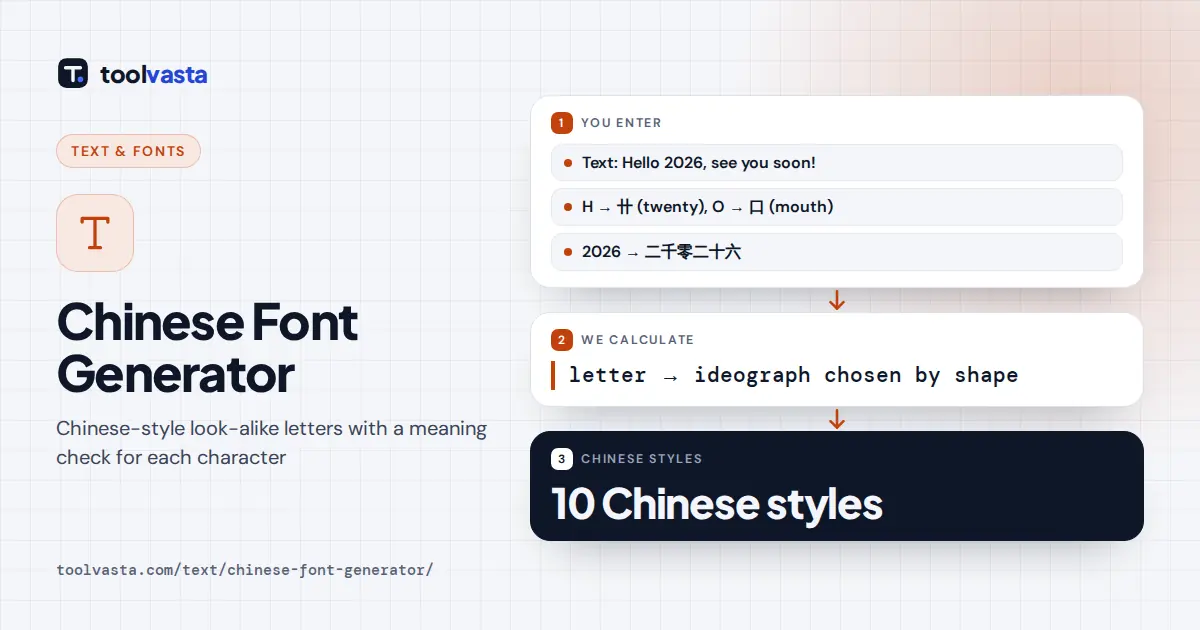
"Hello" becomes 卄乇乚乚口: H → 卄, e → 乇, l → 乚 twice and o → 口. The number 2026 has 2 thousands, no hundreds, 2 tens and 6 ones, so the spoken form is 二千 + 零 for the empty hundreds place + 二十六 = 二千零二十六. In everyday speech many people say 两千 (liǎng qiān) for 2,000, and both forms are understood. Written as a year, each digit is read on its own: 二〇二六. The default sentence with Chinese punctuation becomes Hello 2026,see you soon!, where the comma and exclamation mark take their full-width forms and the space after the comma disappears, as Chinese typesetting expects.
Chinese Numbers Reference
| Number | Chinese | How it is built |
|---|---|---|
| 10 | 十 | One ten, the leading one is dropped |
| 15 | 十五 | Ten plus five |
| 101 | 一百零一 | One hundred, 零 for the empty tens, one |
| 110 | 一百一十 | One hundred one ten |
| 10,005 | 一万零五 | One 万 (ten thousand), 零, five |
| 100,000 | 十万 | Ten 万, because Chinese groups by four digits |
The spoken form is used for numbers up to eight digits. Longer numbers, and numbers that start with zero such as codes, are written digit by digit with 〇.
Full-Width Text, Brackets and Vertical Text
Chinese, Japanese and Korean text is set on a square grid, so keyboards in those languages type full-width Latin letters, digits and punctuation that fill a whole square. The full-width style uses those real characters. 【 】 lenticular brackets are common in Chinese headlines and video titles, 「 」 corner brackets work as quotation marks in traditional Chinese, and 《 》 marks the title of a book, film or song. Vertical text puts one character on each line, the traditional direction for Chinese writing on scrolls and signs.
Thinking of a Real Chinese Name?
A real Chinese name is chosen for both sound and meaning, with the family name first and one or two given-name characters after it. Transliterated names pick characters whose pronunciation is close to the original, then avoid characters with unlucky or odd meanings. That takes knowledge of tones and connotations that no letter swap can provide. If you want a Chinese name for a tattoo, a business card or a gift, ask a native speaker or a professional translator, and double-check the characters before printing anything permanent.
Tips and Limits
- Use look-alike letters for short decorative text, not for messages to Chinese speakers.
- Check the meaning table before using a look-alike name in public.
- Q has no good look-alike ideograph, so it uses the full-width Q instead of an unrelated character.
- Screen readers read each ideograph by its Chinese sound, which makes look-alike text confusing to listen to.
- Everything runs in your browser and nothing is uploaded.
Frequently asked questions
Is the Chinese font generator a translator?
No. The look-alike style swaps English letters for Chinese characters that resemble them in shape, so the result is meaningless in Chinese. For a real translation or a Chinese name, ask a fluent speaker or use a dictionary.
What do the Chinese look-alike letters mean?
Each one is a real character with its own meaning. 卄 means twenty, 口 means mouth, 山 means mountain and 尸 is the corpse radical. The meaning check table under the box lists every character your text uses.
How do you write 2026 in Chinese?
As a number it is 二千零二十六, often said as 两千零二十六. As a year it is read digit by digit, 二〇二六年, with 年 meaning year. The tool shows both the spoken and the digit forms.
What are full-width characters?
They are versions of Latin letters, digits and punctuation that take up a full square, like Chinese characters. Chinese and Japanese keyboards type them, and they give text the wide look used in many Asian titles.
Can I use Chinese-style letters in my username?
Most usernames accept only basic letters, numbers, periods and underscores, so ideographs are rejected there. Display names, bios, captions and game nicknames usually accept them, but check the meanings first.
Why is P shown as a warning in the meaning table?
Because the look-alike for P is 尸, the corpse radical. It is harmless as decoration, but a Chinese reader will notice it, so think twice before putting it in a name or a gift message.