How to Use the Crop Factor Calculator
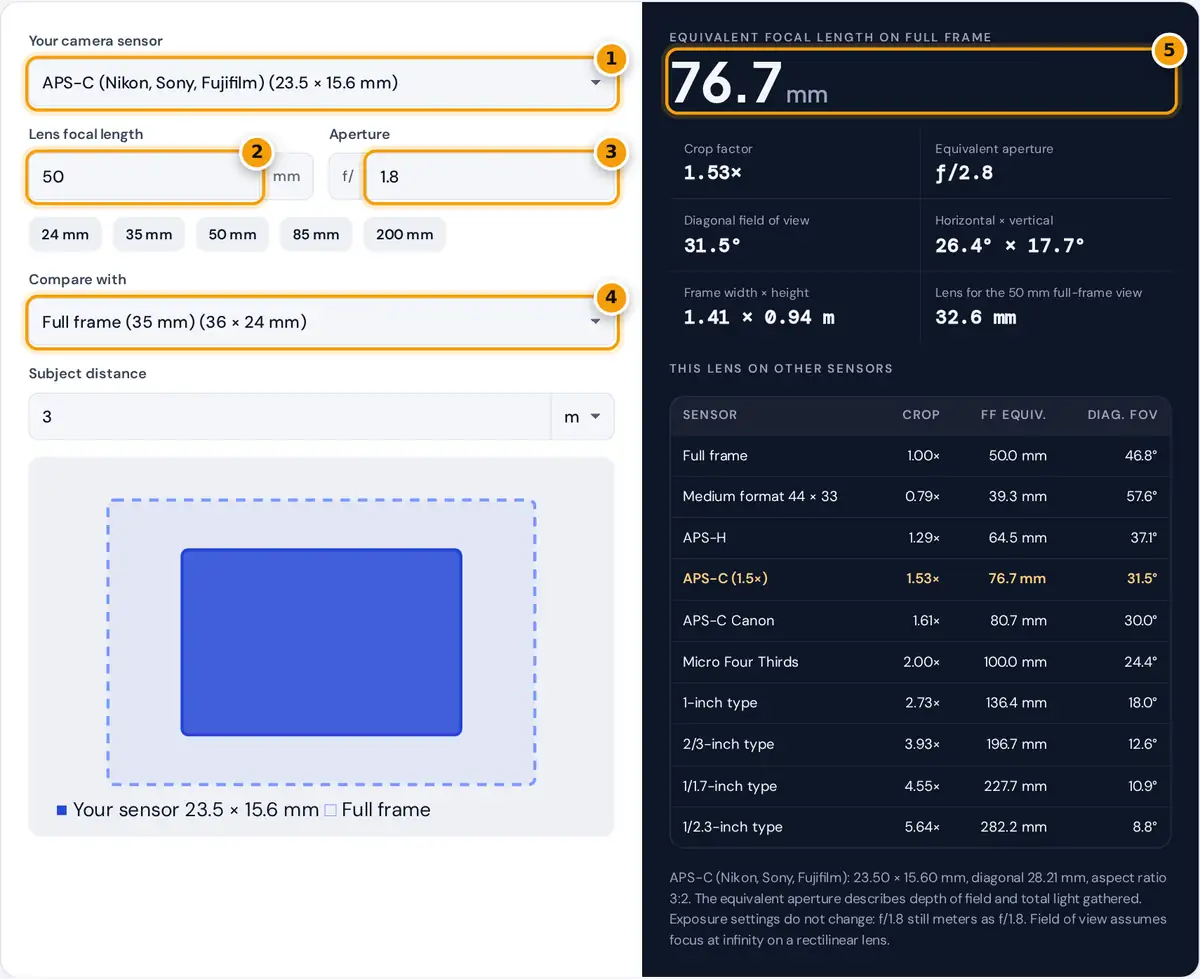
- Choose your camera sensor, or Custom size to enter width and height.
- Enter the focal length printed on your lens.
- Enter the aperture to get the equivalent depth of field f-number.
- Pick the sensor to compare with, usually full frame.
- Read the equivalent focal length, crop factor and field of view.
- Choose your camera's sensor from the list. Pick Custom size and enter the width and height in millimeters if your camera is not listed. The exact size is in the camera manual or the maker's specification page.
- Enter the focal length printed on the lens, and the aperture you plan to use. The quick buttons fill common focal lengths.
- Leave Compare with on Full frame to get the usual 35 mm equivalent, or pick another sensor to compare two systems directly, for example APS-C against Micro Four Thirds.
- Enter a subject distance to see how wide and tall the scene in the frame will be.
The big number is the focal length that gives the same field of view on the comparison sensor. The table shows what the same lens does on every common sensor size.
Crop Factor Formulas
Crop factor compares the diagonal of a sensor with the 43.27 mm diagonal of a full-frame 36 × 24 mm sensor. Field of view comes from simple lens geometry:
crop factor = 43.27 mm ÷ sensor diagonal
equivalent focal length = focal length × crop factor
equivalent aperture = f-number × crop factor
field of view = 2 × arctan(sensor dimension ÷ (2 × focal length))
frame width at distance = distance × sensor width ÷ focal length
Worked Example
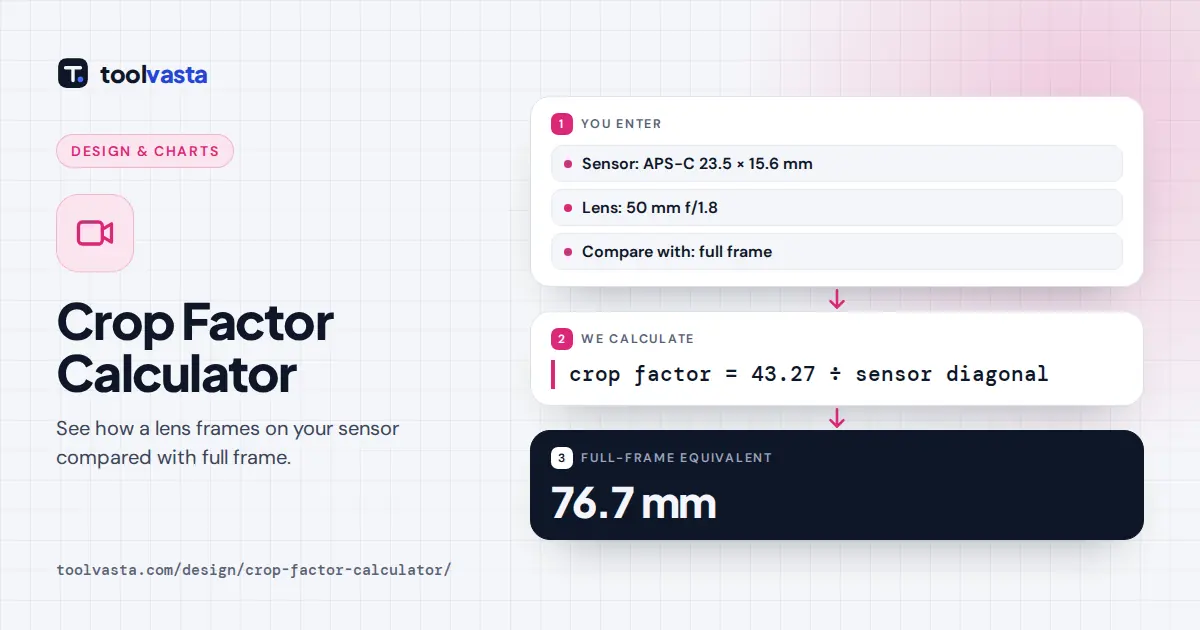
A Sony, Nikon or Fujifilm APS-C sensor measures 23.5 × 15.6 mm. Its diagonal is √(23.5² + 15.6²) = 28.21 mm, so the crop factor is 43.27 ÷ 28.21 = 1.53. A 50 mm f/1.8 lens therefore frames like a 76.7 mm lens on full frame, with the depth of field of about f/2.8. The diagonal field of view is 2 × arctan(28.21 ÷ 100) = 31.5°, the horizontal view is 26.4° and the vertical view is 17.7°. At 3 m the frame covers 3 × 23.5 ÷ 50 = 1.41 m by 0.94 m. To get the look of a 50 mm full-frame lens on this camera, use about 32.6 mm.
Common Sensor Sizes and Crop Factors
| Sensor | Size (mm) | Crop factor | 50 mm equals |
|---|---|---|---|
| Medium format | 44 × 33 | 0.79 | 39.3 mm |
| Full frame | 36 × 24 | 1.00 | 50 mm |
| APS-H | 27.9 × 18.6 | 1.29 | 64.5 mm |
| APS-C (Nikon, Sony, Fujifilm) | 23.5 × 15.6 | 1.53 | 76.7 mm |
| APS-C (Canon) | 22.3 × 14.9 | 1.61 | 80.7 mm |
| Micro Four Thirds | 17.3 × 13.0 | 2.00 | 100 mm |
| 1-inch type | 13.2 × 8.8 | 2.73 | 136.4 mm |
| 1/2.3-inch type | 6.17 × 4.55 | 5.64 | 282.2 mm |
Makers round these figures, so you will see 1.5× and 1.6× for APS-C and 2× for Micro Four Thirds. Exact sizes vary slightly between models. Type sizes such as 1-inch come from old video tube names and do not measure one inch.
What Equivalent Aperture Means
A smaller sensor needs a shorter lens for the same view, and a shorter lens at the same f-number gives more depth of field. Multiplying the f-number by the crop factor tells you which full-frame aperture would give a similar background blur and total light on the sensor. It does not change exposure. An f/1.8 lens lets in light per area like any f/1.8 lens, so shutter speed and ISO stay the same.
Limits and Assumptions
- The diagonal is used because sensors have different shapes. A 4:3 Micro Four Thirds frame is relatively taller than a 3:2 full-frame one, so horizontal views differ a little from what the factor suggests.
- Field of view assumes focus at infinity and a normal rectilinear lens. Close focusing narrows the view slightly, and fisheye lenses follow different geometry.
- Some cameras crop further in video modes or with electronic stabilization. Multiply by that extra crop as well.
Frequently asked questions
What is crop factor?
Crop factor is the ratio of a full-frame sensor's 43.27 mm diagonal to your sensor's diagonal. It tells you how much narrower your view is than a full-frame camera with the same lens.
What is a 50mm lens on APS-C equivalent to?
On a Sony, Nikon or Fujifilm APS-C camera with a 1.53 crop factor, a 50 mm lens frames like a 76.7 mm lens on full frame. On Canon APS-C, with a 1.61 factor, it is about 80.7 mm.
Does crop factor change the aperture?
It does not change exposure, so f/1.8 is still f/1.8 for shutter speed and ISO. Depth of field and total light gathered match a full-frame lens at the f-number times the crop factor.
What is the crop factor of Micro Four Thirds?
Micro Four Thirds sensors measure about 17.3 by 13 mm, which gives a crop factor of 2.00. A 25 mm lens frames like a 50 mm lens on full frame.
How do I calculate field of view?
Field of view equals two times the arctangent of the sensor dimension divided by twice the focal length. Use the width for horizontal view, the height for vertical view and the diagonal for diagonal view.
Does a crop sensor make my lens longer?
No. The focal length is a property of the lens and does not change. The smaller sensor records only the middle of the image, so the result looks like a longer lens on full frame.