How to Use the Time Dilation Calculator
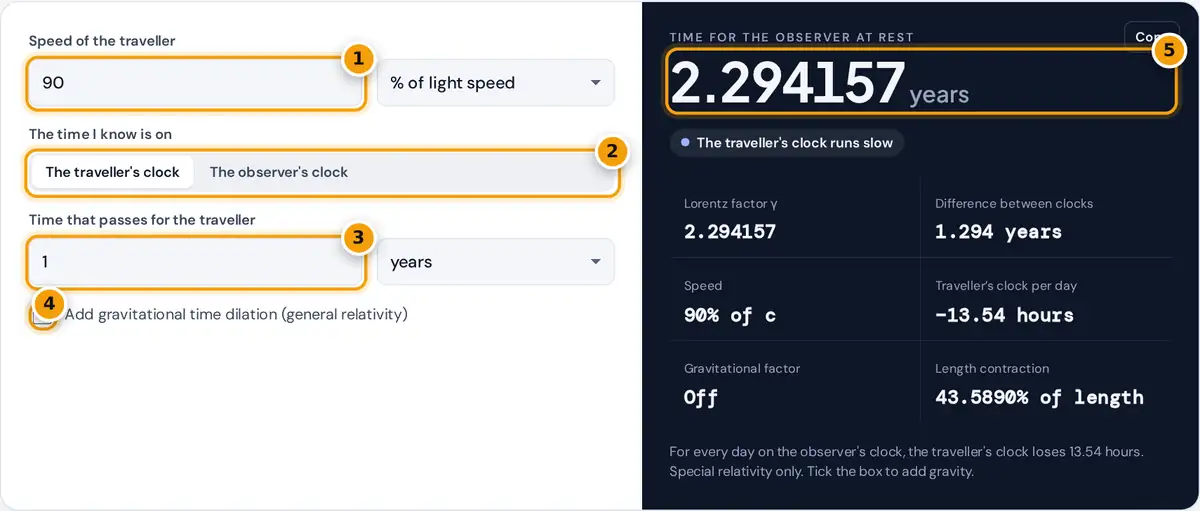
- Enter the traveller's speed and choose a unit, such as percent of light speed or km/h.
- Choose whether the time you know is on the traveller's clock or the observer's clock.
- Enter that time and its unit.
- Tick to add gravitational time dilation near a planet, star or neutron star.
- Read the time on the other clock, the Lorentz factor and the drift per day.
Enter how fast the traveller moves. You can type a percentage of the speed of light, a fraction of c (often written β), or an everyday speed in km/s, m/s, km/h or mph. Then choose which clock you know: the traveller’s own clock, called proper time, or the clock of an observer at rest. Enter that time and pick its unit. The result shows the time on the other clock, the Lorentz factor γ and how much the clocks drift apart each day.
To include gravity, tick the box, choose a body such as Earth, the Sun or a neutron star, and enter how far the traveller is from its center. Leave the observer’s distance blank to compare with a clock far away, or enter it to compare two clocks at different heights, for example a satellite and a ground station.
Time Dilation Formulas
In special relativity, a moving clock ticks slowly compared with clocks at rest. The slowdown depends only on speed, through the Lorentz factor:
observer time t = γ × traveller time τ
gravity: τ = t × √(1 − 2GM ÷ (r c²))
Here c is the speed of light, exactly 299,792,458 m/s by the definition of the meter. The gravitational formula comes from the Schwarzschild solution of general relativity for a clock at rest at distance r from the center of a mass M, compared with a clock far away. When both effects apply, the calculator multiplies the two rate factors, which is exact for a non-rotating body when the speed is measured by a local observer at rest at that distance. To avoid rounding errors at everyday speeds, the code works with logarithms, so tiny effects such as nanoseconds per day stay accurate.
Worked Examples
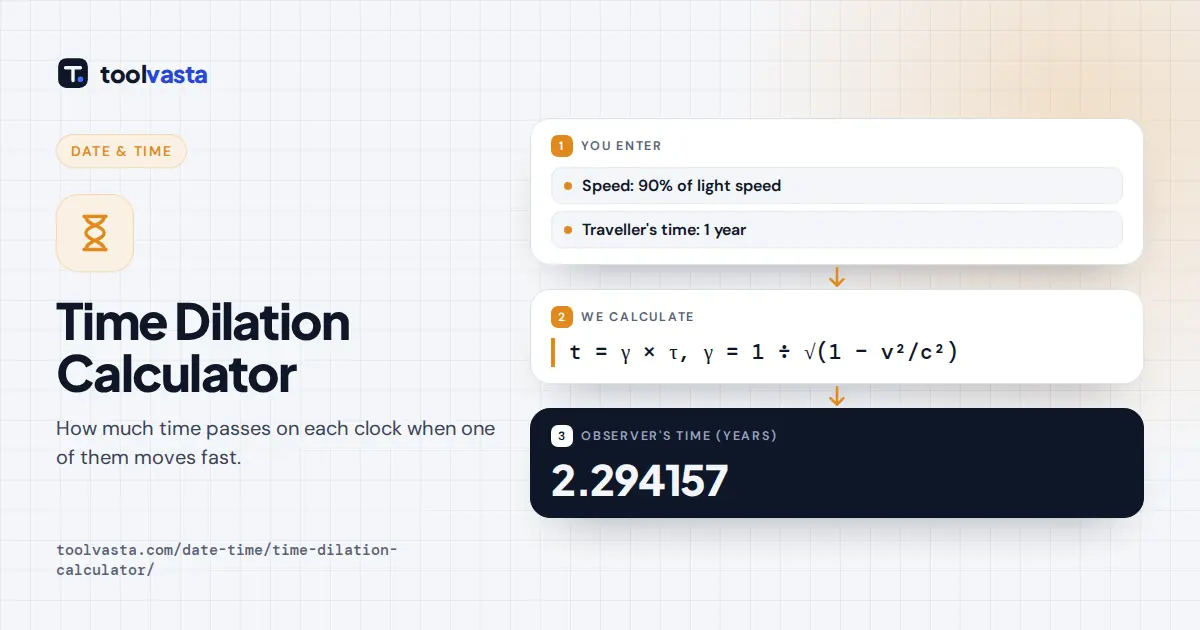
Fast spaceship. At 90% of light speed, γ = 1 ÷ √(1 − 0.81) = 1 ÷ √0.19 = 2.294157. One year on the ship’s clock equals 2.294157 years on Earth, so the crew ages about 1.29 years less than the people they left behind.
GPS satellites. A GPS satellite moves at about 3.874 km/s. Speed alone makes its clock lose about 7.21 microseconds per day. It also sits 26,560 km from Earth’s center, where gravity is weaker than on the ground at 6,371 km, which makes it gain about 45.7 microseconds a day. The net effect is a gain of about 38.5 microseconds per day, which GPS engineers correct for. Enter these numbers with gravity switched on and Earth’s observer distance set to 6,371 km to reproduce it. We checked every example with an independent Python script.
Lorentz Factor at Common Speeds
| Speed | γ | 1 traveller year equals |
|---|---|---|
| Airliner, 900 km/h | 1 + 3.5 × 10⁻¹³ | 1 year + 11 μs |
| 10% of c | 1.005038 | 1.005 years |
| 50% of c | 1.154701 | 1.155 years |
| 90% of c | 2.294157 | 2.294 years |
| 99% of c | 7.088812 | 7.089 years |
| 99.9% of c | 22.36627 | 22.37 years |
The Twin Paradox
If one twin flies to a distant star at high speed and returns, that twin comes home younger. The situation is not symmetric because the travelling twin turns around and changes frame, while the twin on Earth does not. Experiments have confirmed time dilation many times, from fast-moving muons created in the upper atmosphere that survive long enough to reach the ground, to atomic clocks flown on airliners and the daily corrections built into satellite navigation.
Limits and Tips
- The speed must be below the speed of light. Massive objects can approach c but never reach it.
- The gravity model assumes a spherical, non-rotating body and a clock at rest at that distance. Near rapidly spinning objects the Kerr solution applies instead.
- The neutron star preset uses a typical mass of 1.4 Sun masses and a 12 km radius for illustration. Real neutron stars vary.
- Acceleration itself does not slow clocks in this model. Only speed and gravitational potential matter.
Frequently asked questions
What is the time dilation formula?
For speed, observer time equals the Lorentz factor times the traveller's time, where the factor is 1 divided by the square root of 1 minus v squared over c squared. Gravity adds the factor square root of 1 minus 2GM over rc squared.
How much does time slow down at 99% of the speed of light?
The Lorentz factor is about 7.09, so one year for the traveller equals about 7.09 years for an observer at rest. At 99.9% of light speed the factor rises to about 22.4.
Does time dilation happen at everyday speeds?
Yes, but it is tiny. A passenger on a 900 km/h flight ages about 11 microseconds less per year from speed alone. Atomic clocks can measure effects this small, and experiments have confirmed them.
Why do GPS satellites need relativity corrections?
Their speed makes their clocks lose about 7 microseconds per day, while weaker gravity in orbit makes them gain about 46. The net gain of about 38 microseconds a day would cause kilometres of position error if ignored.
What is the Lorentz factor?
It is the number, written gamma, that tells you how much time stretches and lengths shrink at a given speed. It equals 1 at rest, about 1.155 at half the speed of light and grows without limit as speed approaches c.
Does gravity slow down time?
Yes. A clock deeper in a gravitational field runs slower than one higher up. A clock on Earth's surface loses about 22 milliseconds per year compared with a distant clock, and the effect is far stronger near neutron stars and black holes.