How to Use the Lunar Age Calculator
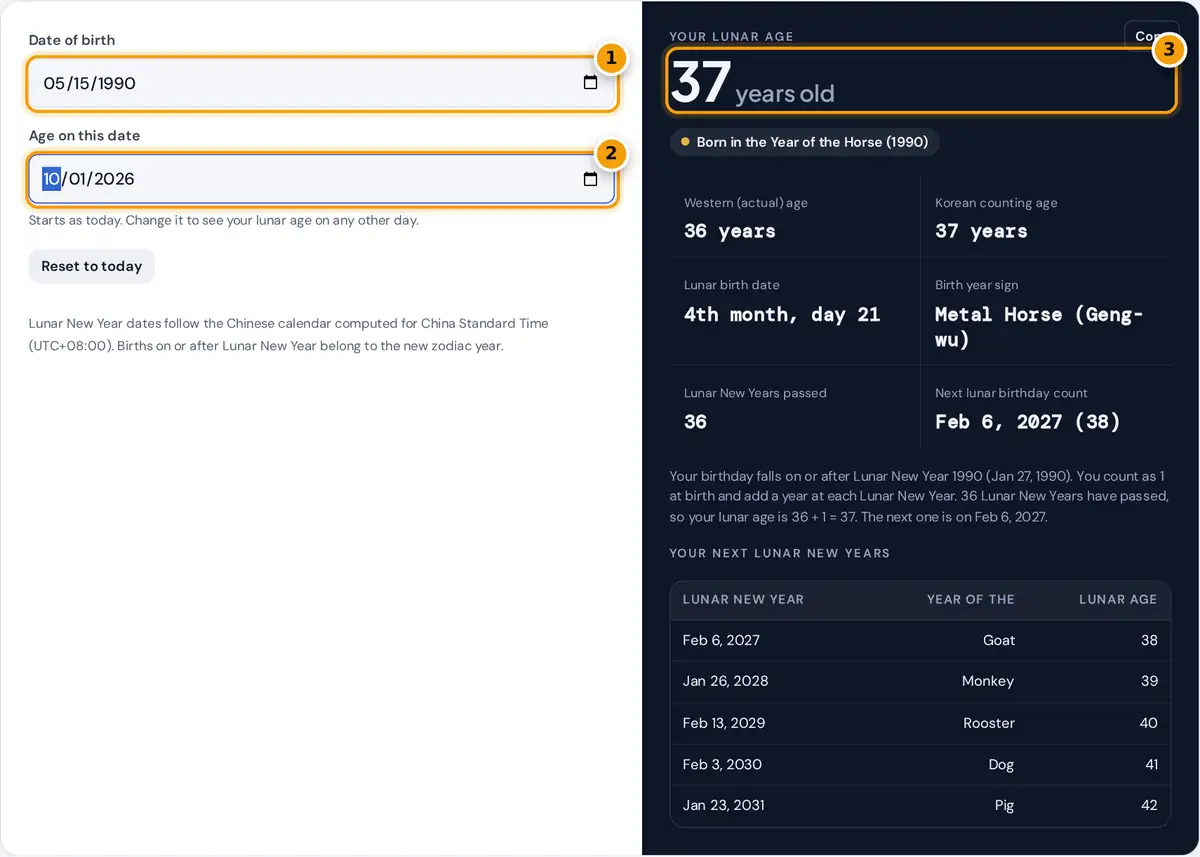
- Enter your date of birth from your passport or birth certificate.
- Keep today or pick another date to see your lunar age on that day.
- Read your lunar age, zodiac year, lunar birth date and when your lunar age goes up next.
Enter your date of birth from your birth certificate or passport, which use the Western (Gregorian) calendar. The second date starts as today, so the result shows your lunar age right now. Change it to any other day to see what your lunar age was or will be then, for example on a wedding date or at a family celebration.
The result panel shows your lunar age, the zodiac year you belong to, your Western age for comparison, your Korean counting age, your birth date in the Chinese calendar and the next Lunar New Year, when your lunar age goes up by one. The table lists the next five Lunar New Years and the age you reach on each.
What Lunar Age Means in Traditional Chinese Reckoning
Lunar age, called xusui (nominal or virtual age) in Chinese, is the way age was traditionally counted in China and in other places that used the Chinese calendar. Two rules make it different from the age on your passport:
- You are 1 at birth. Age counts the calendar years you have lived in, starting with the year you were born in, rather than the full years completed. There is no year zero.
- Everyone gets a year older at Lunar New Year. Age goes up on the first day of the first month of the Chinese calendar, not on your birthday.
Because of these rules, your lunar age is usually one year more than your Western age, and two years more between Lunar New Year and your birthday. A baby born the day before Lunar New Year turns 2 the very next day.
Chinese year changes on Lunar New Year, not on January 1
Worked Example
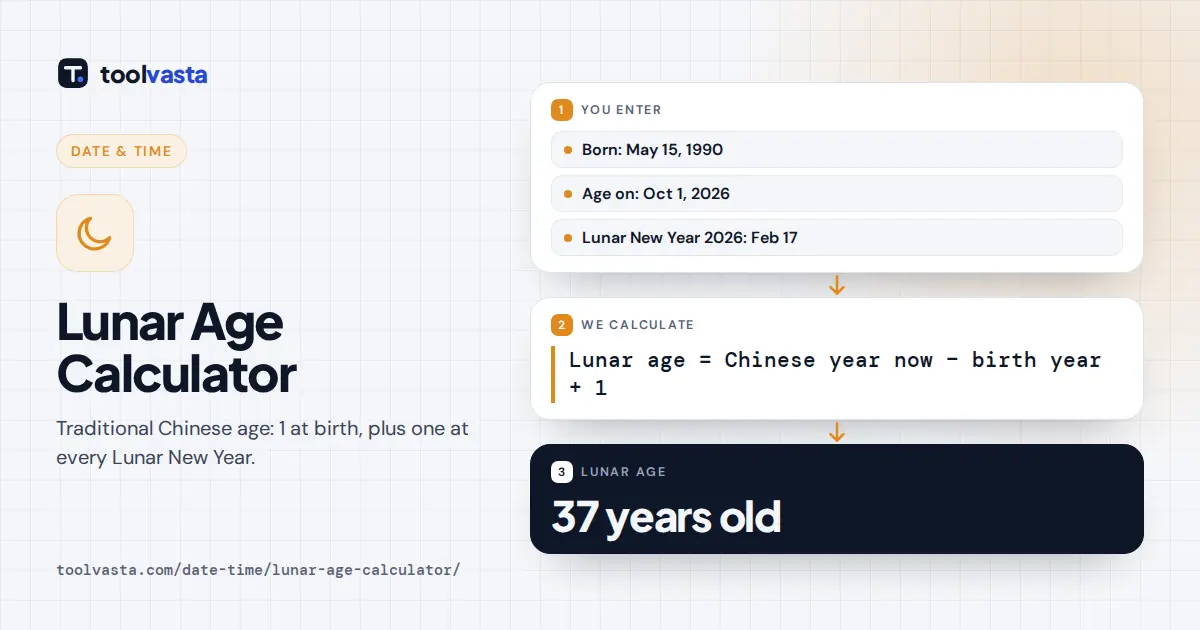
Take a birth on May 15, 1990. Lunar New Year 1990 fell on January 27, so the birth belongs to Chinese year 1990, the Year of the Horse (Metal Horse, geng-wu). In the Chinese calendar the birthday is the 21st day of the 4th month.
On October 1, 2026 the latest Lunar New Year was February 17, 2026, so the current Chinese year is 2026. The lunar age is (2026 − 1990) + 1 = 37, while the Western age is 36. The next increase comes on February 6, 2027, when the lunar age becomes 38. We generated the calendar table from astronomical new moons and solar terms and checked Lunar New Year dates such as January 29, 2025 and February 17, 2026 against published calendars.
Born before Lunar New Year
Someone born on January 20, 1990 arrived before Lunar New Year 1990, so they belong to Chinese year 1989, the Year of the Snake. On October 1, 2026 their lunar age is (2026 − 1989) + 1 = 38, two years more than their Western age of 36.
| Birth date | Age on | Western age | Lunar age |
|---|---|---|---|
| May 15, 1990 | Oct 1, 2026 | 36 | 37 |
| Jan 20, 1990 | Oct 1, 2026 | 36 | 38 |
| Feb 4, 2000 | Feb 16, 2026 | 26 | 27 |
| Feb 4, 2000 | Feb 17, 2026 | 26 | 28 |
| Feb 9, 2024 | Feb 10, 2024 | 0 | 2 |
Lunar Age, Korean Age and Western Age
Korea traditionally used a similar system, but in modern practice the extra year was usually added on January 1 rather than at Lunar New Year. That is the Korean counting age shown in the results. South Korea adopted international age for most legal and administrative purposes in June 2023, although the traditional count is still heard in daily life. In mainland China, Taiwan, Hong Kong and among overseas Chinese families, nominal age appears mostly in traditional settings such as birthday celebrations for elders, temple rites and fortune telling.
How the Chinese Calendar Sets Lunar New Year
The Chinese calendar is lunisolar. Each month starts on the day of a new moon, and the month containing the winter solstice is always the 11th month. Lunar New Year is the start of the 1st month, which lands between January 21 and February 20. When a year has 13 new moons between winter solstices, a leap month is added, which is why some lunar birth dates show a leap month. This calculator uses dates calculated for China Standard Time, the official reference for the Chinese calendar, from 1900 to 2101.
Tips and Limits
- Lunar age is cultural, not legal. Use your Western age on forms, contracts and medical records.
- Families in other regions may count differently, for example adding the year on January 1 or on the lunar birthday. Ask an elder which custom your family follows.
- The zodiac animal for January and early February birthdays depends on the exact Lunar New Year date, so check the badge rather than the Western year.
- The Vietnamese calendar is computed for UTC+07:00, so Tet occasionally falls on a different day from Chinese New Year. Use Vietnamese calendar dates if your family follows Tet.
Frequently asked questions
How is lunar age calculated?
Count the Chinese calendar years you have lived in, including your birth year. Subtract your Chinese birth year from the current Chinese year and add one. The Chinese year changes at Lunar New Year, not on January 1.
Why is my Chinese age one or two years older than my real age?
You count as 1 at birth, which adds one year. Between Lunar New Year and your birthday you also gain a year before your Western birthday arrives, which adds a second year.
When does my lunar age increase?
On Lunar New Year, the first day of the first month of the Chinese calendar. It falls between January 21 and February 20. Everyone's lunar age goes up on that same day, whatever their birthday.
What is my Chinese zodiac animal if I was born in January or February?
It depends on whether you were born before or after that year's Lunar New Year. Births before it belong to the previous year's animal. The calculator checks the exact date for you.
Is lunar age the same as Korean age?
They follow the same idea of counting 1 at birth. Korean counting age usually adds a year on January 1, while Chinese lunar age adds it at Lunar New Year, so they differ for part of the year.
Can I use my lunar age on official documents?
No. Passports, school forms and medical records use your actual age from your birth date. Lunar age is a traditional count used in cultural and family settings, such as birthday celebrations and temple rites.