How to Use the Corrected Age Calculator
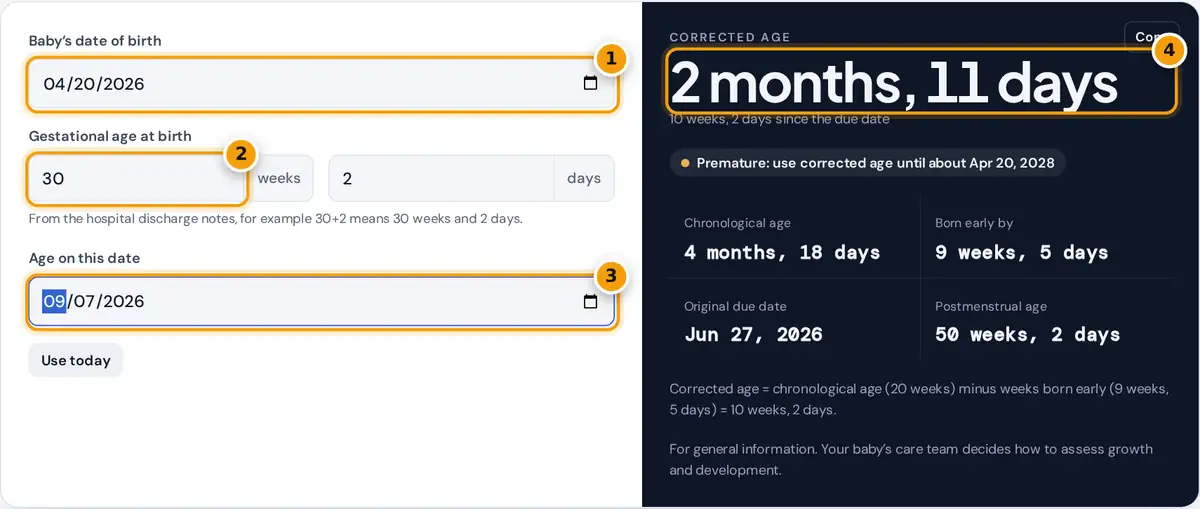
- Enter your baby's date of birth.
- Enter the gestational age at birth in weeks and days, for example 30 and 2.
- Pick the date for the age, such as today or a check-up.
- Read the corrected age, plus chronological age, due date and postmenstrual age.
Enter your baby’s date of birth and the gestational age at birth in weeks and days. Hospitals often write this as 30+2, meaning 30 weeks and 2 days. The age date starts as today, but you can change it to the date of a check-up or a developmental assessment. The result shows the corrected age in months and days and in weeks, the chronological age, how early the baby arrived, the original due date and the postmenstrual age.
If the age date falls before the due date, the calculator says the baby is not yet due and shows the postmenstrual age instead, because that is how neonatal units usually describe very young premature babies.
Corrected Age Formula
A full-term pregnancy is counted as 40 weeks, or 280 days, from the first day of the last menstrual period. Corrected age, also called adjusted age, subtracts the weeks a baby was born early from their age since birth. That is the same as counting from the original due date.
corrected age = chronological age − weeks early
postmenstrual age = gestational age at birth + chronological age
Worked Example
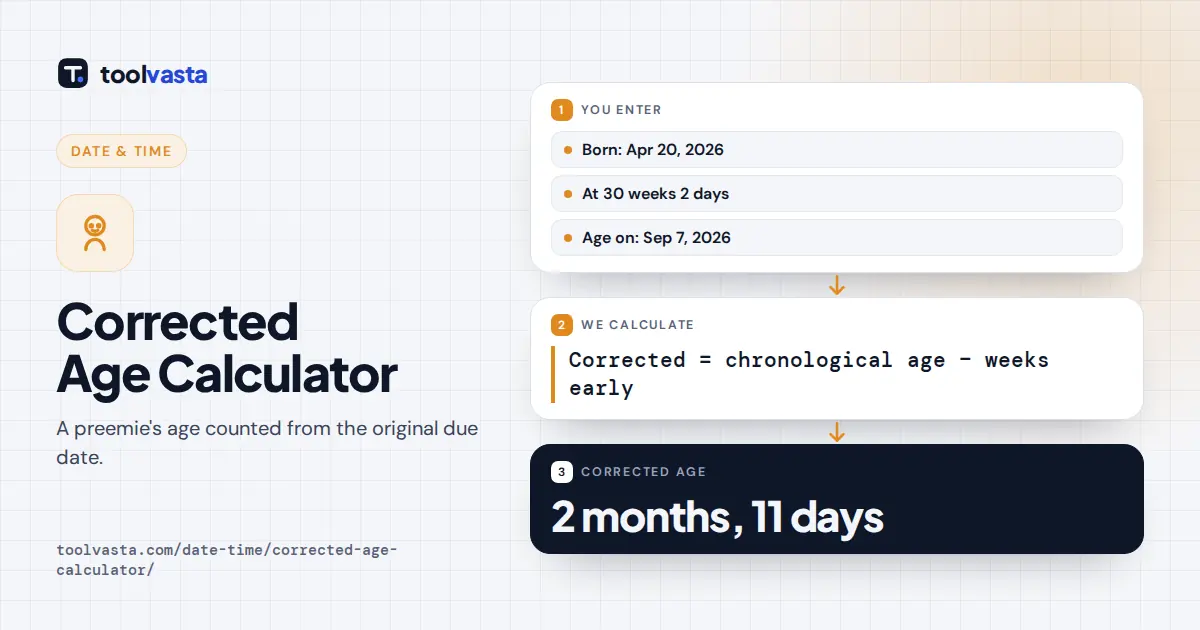
A baby is born on April 20, 2026 at 30 weeks and 2 days, which is 212 days of gestation. That is 280 − 212 = 68 days, or 9 weeks and 5 days, early, so the original due date was June 27, 2026.
On September 7, 2026 the baby is 140 days old: 20 weeks, or 4 months and 18 days. Subtracting the 68 days gives a corrected age of 72 days, which is 10 weeks and 2 days, or 2 months and 11 days counted from the due date. Their postmenstrual age is 212 + 140 = 352 days, or 50 weeks and 2 days. We checked these figures with a separate date script.
| Age date | Chronological age | Corrected age |
|---|---|---|
| May 20, 2026 | 1 month | Not yet due (34 weeks, 4 days PMA) |
| Jun 27, 2026 | 2 months, 7 days | 0 days |
| Sep 7, 2026 | 4 months, 18 days | 2 months, 11 days |
| Apr 20, 2027 | 1 year | 9 months, 24 days |
Why Corrected Age Matters
A baby born 10 weeks early has had 10 fewer weeks to develop before birth. Judging them by their birthday would make them look behind when they are growing on track for their real stage of development. Health professionals therefore use corrected age to plot growth charts and to check milestones such as smiling, sitting, crawling and first words. Parents can use it to set fair expectations and to compare with milestone guides.
Use chronological age for vaccinations. Immunization schedules for premature babies normally follow the actual birth date, not the corrected age, unless your care team advises otherwise.
How Long to Use Corrected Age
Most premature babies catch up with children born at term during the first two to three years. Corrected age is commonly used until about the second birthday, and some clinics continue a little longer for babies born very early. Babies born at 37 weeks or later are full term or early term, and corrections of a few days rarely matter, so the calculator notes when no correction is needed.
| Gestational age at birth | Usual description |
|---|---|
| Less than 28 weeks | Extremely preterm |
| 28 to 31 weeks | Very preterm |
| 32 to 36 weeks | Moderate to late preterm |
| 37 weeks and later | Term |
Tips
- Use the gestational age written by the hospital. It is based on early ultrasound dating and is more reliable than counting from memory.
- Write down the corrected age before appointments so you can compare progress with the right milestones.
- Every baby develops at their own pace. Bring any concern to your doctor, public health nurse or follow-up clinic, whatever the calculator says.
Frequently asked questions
How do you calculate corrected age for a premature baby?
Subtract the number of weeks the baby was born early from their age since birth. A baby born at 32 weeks is 8 weeks early, so at 20 weeks old their corrected age is 12 weeks.
What is the difference between corrected age and chronological age?
Chronological age counts from the birth date. Corrected age, or adjusted age, counts from the original due date, so it removes the weeks the baby was born early and matches their stage of development.
Until what age should you use corrected age?
It is commonly used until about two years old, when most premature babies have caught up. Some clinics continue a little longer for babies born very early. Follow your care team's advice.
What is postmenstrual age?
It is the gestational age at birth plus the time since birth. Neonatal units use it before and around the due date. A baby born at 30 weeks who is 4 weeks old has a postmenstrual age of 34 weeks.
Should vaccines follow corrected age?
Usually not. Premature babies normally receive routine vaccines by their chronological age, counted from the real birth date. Your doctor or public health nurse will confirm the schedule for your baby.
Do I need corrected age if my baby was born at 38 weeks?
Generally no. Babies born at 37 weeks or later are considered term, and a correction of one or two weeks makes little difference to milestones or growth charts.