How to Use the Lead Time Calculator
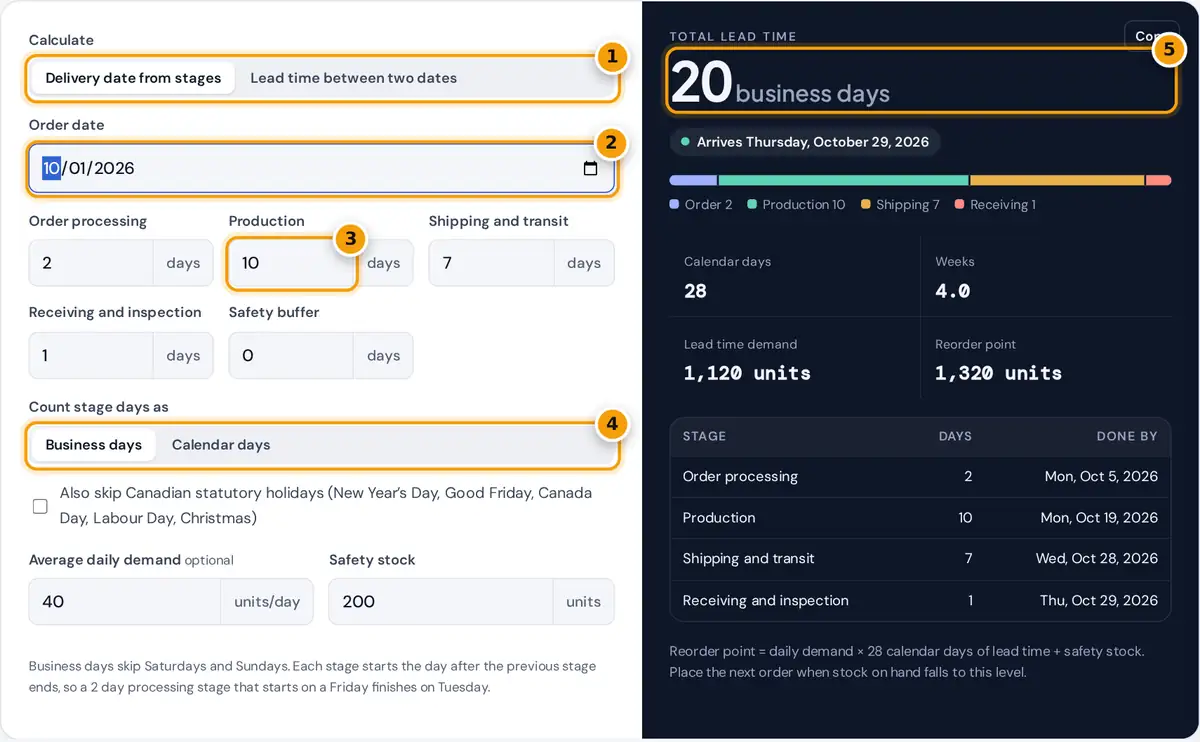
- Choose to plan a delivery date or measure the lead time between two dates.
- Enter the date you place the order.
- Enter the days for each stage: processing, production, shipping, receiving and any buffer.
- Count stage days as business days or calendar days.
- Read the total lead time, arrival date, stage dates and reorder point.
Choose Delivery date from stages to plan an order. Enter the order date, then the number of days each stage takes: order processing by the supplier, production or manufacturing, shipping and transit, and receiving and inspection at your end. Add a safety buffer if the supplier is often late. Pick business days if your supplier quotes working days, or calendar days if they quote elapsed days. Tick the holiday box to skip Canadian statutory holidays as well as weekends.
The result shows the total lead time, the expected arrival date, the date each stage should finish and the number of calendar days the whole process spans. If you enter your average daily demand and safety stock, the calculator also gives the reorder point.
Choose Lead time between two dates to measure a past order. Enter when it was placed and when it arrived to get calendar days, business days and weeks, which is useful for tracking supplier performance.
Lead Time and Reorder Point Formulas
delivery date = order date + lead time (skipping weekends and holidays for business days)
reorder point = daily demand × lead time in days + safety stock
Lead time is the time from placing an order to having the goods ready to use. In manufacturing, the same idea applies to production lead time, and in software teams to the time from request to delivery. The reorder point tells you when to buy again: the stock you will sell while waiting for the next delivery, plus a safety stock that covers delays and demand spikes.
Worked Example
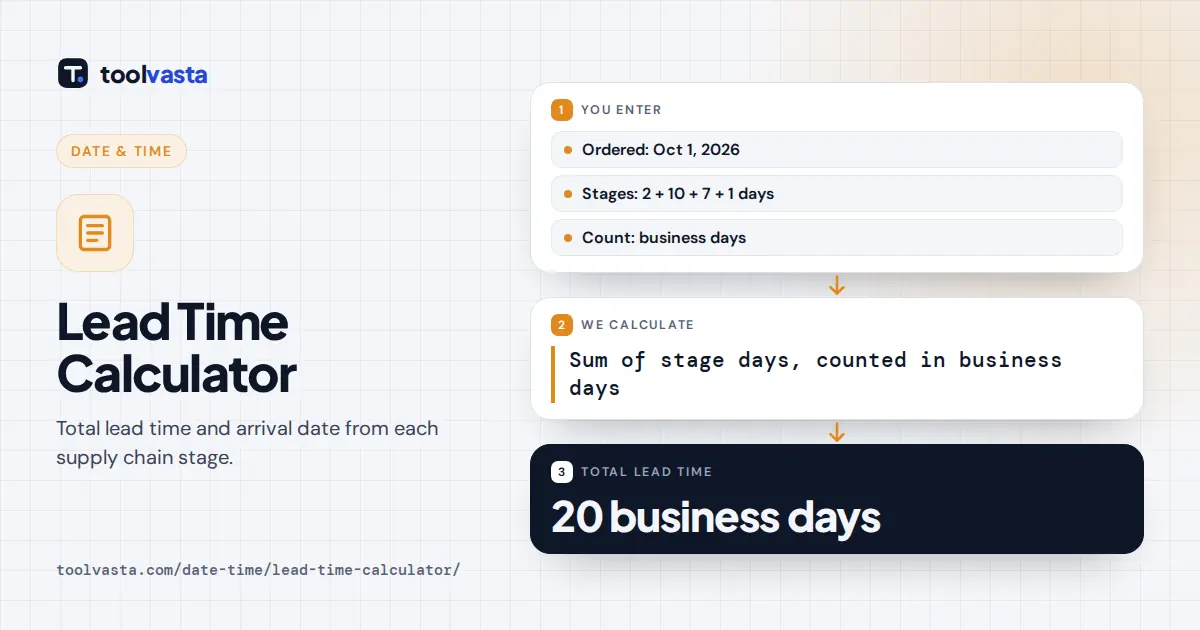
An order placed on Thursday, October 1, 2026 needs 2 business days of processing, 10 of production, 7 of transit and 1 for receiving, a total of 20 business days.
| Stage | Business days | Done by |
|---|---|---|
| Order processing | 2 | Mon, Oct 5, 2026 |
| Production | 10 | Mon, Oct 19, 2026 |
| Shipping and transit | 7 | Wed, Oct 28, 2026 |
| Receiving and inspection | 1 | Thu, Oct 29, 2026 |
The goods arrive on Thursday, October 29, which is 28 calendar days after ordering. With demand of 40 units a day, you sell 40 × 28 = 1,120 units while you wait. Adding 200 units of safety stock gives a reorder point of 1,320 units. If the same order were placed on Friday, December 18, 2026 with holidays skipped, Christmas Day and New Year’s Day push arrival from January 15 to Tuesday, January 19, 2027.
Types of Lead Time
| Term | What it covers |
|---|---|
| Supplier or procurement lead time | From your purchase order to receiving the goods |
| Production lead time | From starting production to finished goods |
| Customer lead time | From a customer’s order to delivery to them |
| Cumulative lead time | The longest chain of all stages, from raw materials to delivery |
Tips for Shorter, More Reliable Lead Times
- Track actual lead times with the measuring mode. Plan with your typical figure and size the safety buffer from the spread between fast and slow orders.
- Ask suppliers whether their quote is in business or calendar days. A quote of 15 days can mean three weeks or two.
- Check holidays at both ends. Factories abroad close for their own holidays, such as Lunar New Year, which this calculator does not include. Add those days to the buffer.
- Customs clearance often adds 1 to 5 days to international shipments. Put it in the transit stage.
Limits
The calculator assumes stages run one after another. If production starts while paperwork is still being processed, shorten the stages to match. Holiday skipping covers the five statutory holidays observed across Canada, moved to the next weekday when they fall on a weekend. Provincial holidays such as Family Day or Victoria Day are not skipped, so add them to the buffer if your supplier closes for them.
Frequently asked questions
How do you calculate lead time?
Add the time for each stage between placing an order and receiving it: order processing, production, shipping and receiving. Add a buffer for delays. The calculator then counts forward from the order date to give the delivery date.
What is the formula for reorder point?
Reorder point equals average daily demand multiplied by lead time in days, plus safety stock. With 40 units a day, a 28 day lead time and 200 units of safety stock, you reorder at 1,320 units.
Should lead time be in business days or calendar days?
Use whatever your supplier quotes. Factories often quote working days, while couriers quote calendar or business days depending on the service. The calculator handles both and shows the calendar span either way.
What is a good lead time?
There is no single good figure. It depends on the product, distance and production method. A reliable lead time with little variation is often more valuable than a short but unpredictable one.
Does lead time include shipping?
Yes. Total or procurement lead time runs from the moment you order until the goods are received and ready to use, so it includes shipping, customs and inspection as well as production.
How do I measure my supplier's actual lead time?
Switch to the two dates mode and enter when you placed the order and when it arrived. Record each order and compare the results to find the average and the slowest cases.