How to Use the Cow Gestation Calculator
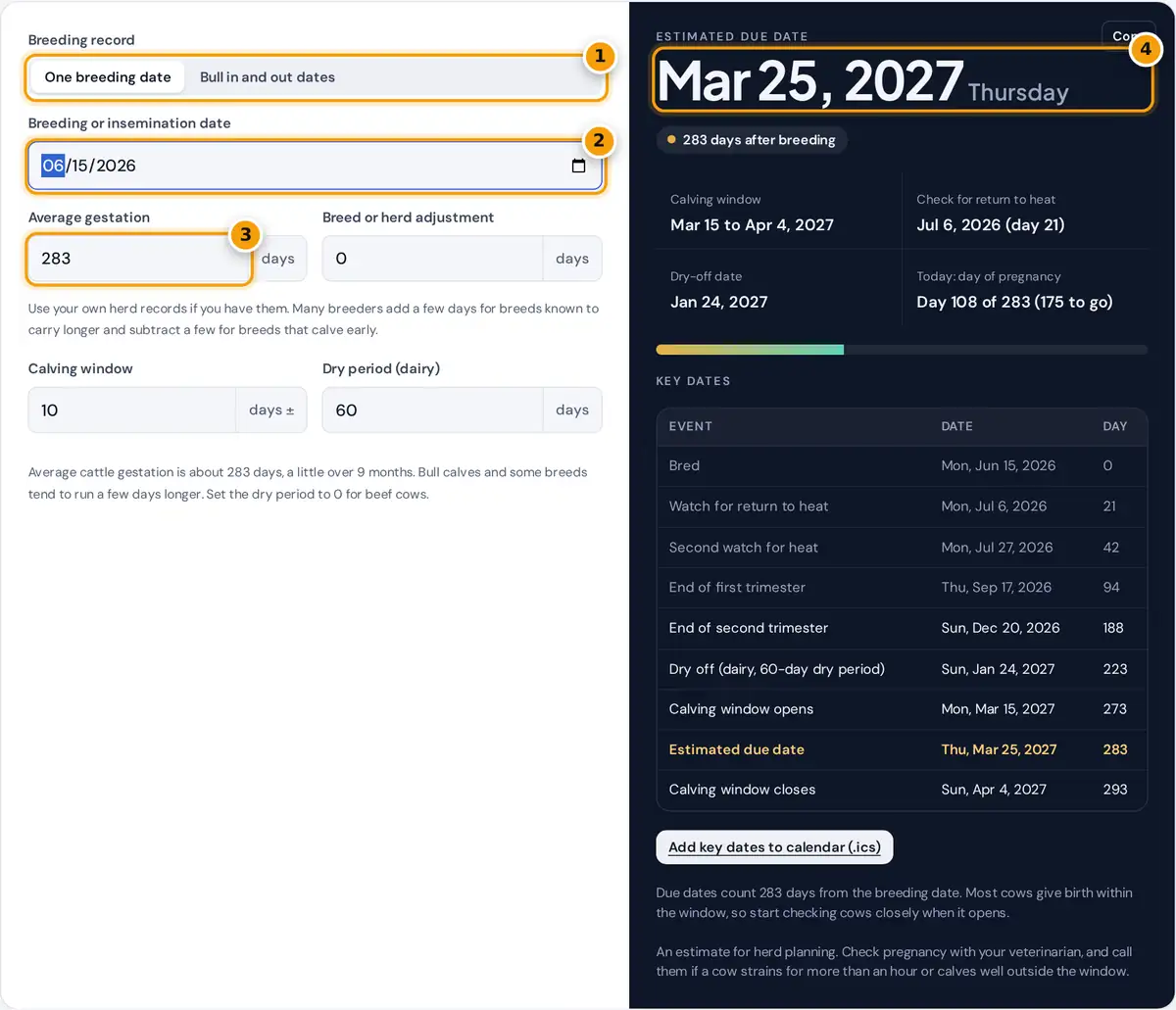
- Choose one breeding date, or bull in and out dates for a group.
- Enter the breeding or AI date.
- Keep 283 days or enter your herd average, and add a breed adjustment if needed.
- Read the calving date, window, heat checks and dry-off date.
For artificial insemination (AI) or a single observed mating, keep One breeding date selected and enter the date. For natural service with a bull in the pasture, choose Bull in and out dates and enter the day the bull went in and the day he came out. The calculator then shows the full calving period for the group.
The average gestation starts at 283 days. Replace it with your own herd average if you keep records, or use the adjustment box to add or subtract a few days for your breed. The calving window sets how many days either side of the due date you want to watch closely, and the dry period sets the dry-off date for dairy cows. Set it to 0 for beef cows.
The result shows the estimated calving date, the calving window, the days to check for a return to heat, the dry-off date and how far along the cow is today. The key dates table lists every milestone, and the calendar button saves the upcoming dates as an .ics file for your phone or computer.
How the Calving Date Is Calculated
Cattle carry a calf for about 283 days on average, a little over nine months. The calculator adds that number of days to the breeding date. With a bull in and out, the earliest calves come from cows bred on the first day and the last from cows bred on the last day.
calving window = due date ± window days
return to heat check = breeding date + 21 days (and + 42 days)
dry-off date = due date − dry period
The heat checks use the 21-day average length of the cow's estrous cycle. A cow that did not conceive usually shows heat again about three weeks after breeding, so watching on those days helps you catch open cows early. Trimesters are thirds of the gestation length.
Worked Example
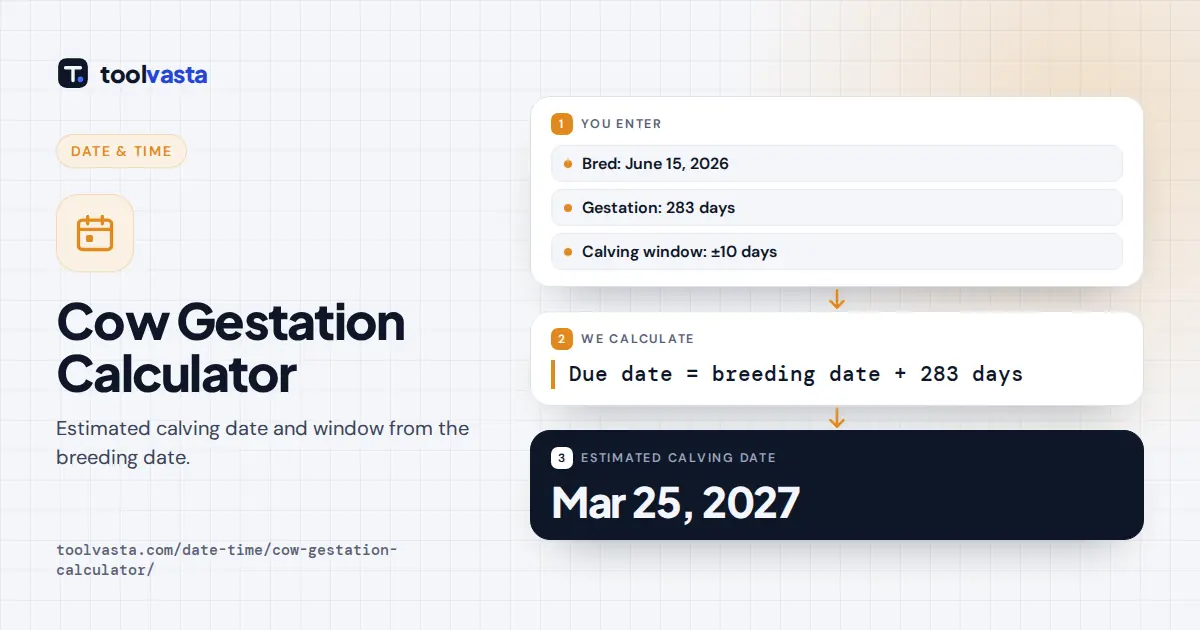
A cow is inseminated on June 15, 2026. Adding 283 days gives Thursday, March 25, 2027. With a 10-day window, watch her closely from March 15 to April 4, 2027. Check for a return to heat on July 6 and July 27, 2026. For a dairy cow with a 60-day dry period, dry-off falls on January 24, 2027.
For a group, a bull put in on June 1, 2026 and taken out on August 10, 2026 is with the cows for 71 days, about 3.4 heat cycles. The first calves are due March 11, 2027 and the last May 20, 2027. Cows that conceived in the first cycle (bred June 1 to June 21) should calve by March 31, 2027. We checked all of these dates with a separate script.
| Breeding date | Due date (283 days) | Due with +5 days |
|---|---|---|
| Jun 15, 2026 | Mar 25, 2027 | Mar 30, 2027 |
| Jun 1, 2026 | Mar 11, 2027 | Mar 16, 2027 |
| Aug 10, 2026 | May 20, 2027 | May 25, 2027 |
What Changes Gestation Length
283 days is an average, and individual cows vary by a week or more. The main known factors are:
- Breed. Breeds differ by several days. Zebu-type (Bos indicus) and some continental beef breeds tend to carry longer, while many dairy breeds are a little shorter. Your breed association or herd records give the best figure.
- Calf sex. Bull calves are usually carried a day or two longer than heifer calves.
- Twins. Twin pregnancies tend to end earlier than single ones.
- Sire. Many AI sires list a gestation length in their proofs. Use it in the adjustment box.
Tips and Limits
- Confirm pregnancy with your veterinarian by ultrasound, palpation or a blood test before you plan around a due date.
- Keep records of actual calving dates. After a season or two, your own average is the best number to enter.
- Prepare the calving area and supplies before the window opens, and know the signs of a difficult birth.
- A dry period that is too short can affect the next lactation, so follow the plan you agree with your vet or nutritionist.
Frequently asked questions
How long is a cow pregnant?
About 283 days on average, which is a little over nine months. Most cows calve within about 10 days either side of that, and breed, calf sex and twins can shift the date.
How do I calculate a calving date?
Add 283 days to the date the cow was bred or inseminated. For June 15, 2026 that gives March 25, 2027. Enter a different average or an adjustment if your breed or herd runs longer or shorter.
How do I work out calving dates with a bull in the herd?
Enter the dates the bull went in and came out. The first calves are due 283 days after the in date and the last 283 days after the out date, so the gap equals the breeding period.
When should a cow come back into heat if she is not pregnant?
About 21 days after breeding, the average length of the estrous cycle, with a normal range of about 18 to 24 days. Watching around days 21 and 42 helps catch open cows.
When should I dry off a dairy cow?
A common plan is about 60 days before the expected calving date, so the dry-off date is the due date minus your dry period. Ask your veterinarian or nutritionist what suits your herd.
Do heifers and cows have the same gestation length?
They are very similar. Differences between breeds, sires and calf sex matter more than the dam's age, so use your own records when you have them and adjust the average if needed.