How to Use the Doubling Time Calculator
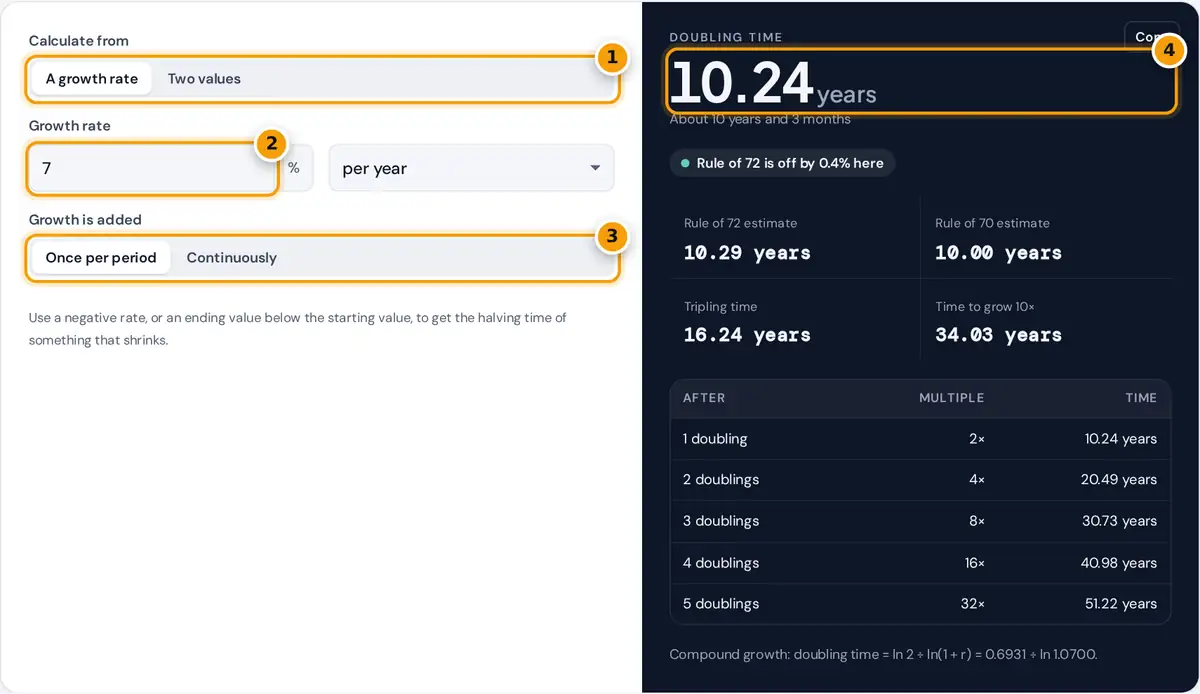
- Choose to start from a growth rate or from two measured values.
- Enter the growth rate in percent and pick the period.
- Choose growth added once per period or continuously.
- Read the exact doubling time with the Rule of 72 and 70 estimates.
Pick A growth rate if you know the percentage growth per period, such as 7% a year for an investment, 2% a month for a subscriber base or 25% an hour for a bacterial culture. Choose whether growth is added once per period, like annual compound interest, or continuously, like the smooth growth used in many biology and physics models. The result shows the exact doubling time, the Rule of 72 and Rule of 70 estimates, the tripling time and the time to grow tenfold.
Pick Two values if you have measurements instead, for example a population of 1,000 that reached 2,500 after 6 years. The calculator finds the growth rate per period and the doubling time from them. If the ending value is smaller, or the rate is negative, it gives the halving time instead.
Doubling Time Formulas
continuous growth: T = ln 2 ÷ r
from two values: T = t × ln 2 ÷ ln(end ÷ start)
Rule of 72: T ≈ 72 ÷ rate in %
Here r is the growth rate per period as a decimal (7% is 0.07) and ln is the natural logarithm. The answer is in the same period as the rate: a monthly rate gives a doubling time in months. Tripling time uses ln 3 instead of ln 2, and tenfold growth uses ln 10.
Worked Examples
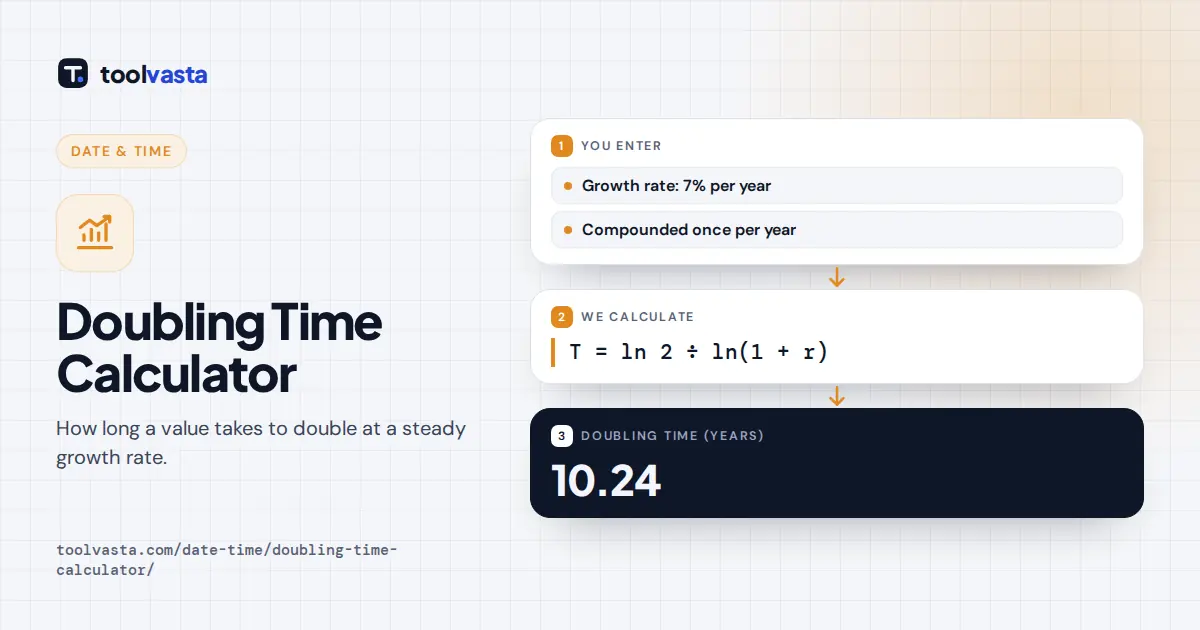
At 7% growth per year compounded annually, T = 0.693147 ÷ ln 1.07 = 0.693147 ÷ 0.067659 = 10.24 years, about 10 years and 3 months. The Rule of 72 gives 72 ÷ 7 = 10.29 years and the Rule of 70 gives 10.00 years. Tripling takes 16.24 years and tenfold growth 34.03 years.
From two values: 1,000 growing to 2,500 in 6 years is a factor of 2.5. The doubling time is 6 × 0.693147 ÷ ln 2.5 = 4.54 years, and the compound growth rate is 2.51/6 − 1 = 16.50% per year. For a shrinking value, 800 falling to 500 in 3 hours halves every 4.42 hours. We verified each figure with an independent script.
Doubling Times at Common Rates
| Rate per period | Exact (compound) | Continuous | Rule of 72 |
|---|---|---|---|
| 1% | 69.66 | 69.31 | 72.00 |
| 2% | 35.00 | 34.66 | 36.00 |
| 5% | 14.21 | 13.86 | 14.40 |
| 7% | 10.24 | 9.90 | 10.29 |
| 10% | 7.27 | 6.93 | 7.20 |
| 25% | 3.11 | 2.77 | 2.88 |
Rule of 72 vs Rule of 70
Both are mental shortcuts. The exact continuous result is 69.3 divided by the rate, so the Rule of 70 is closest for continuous growth and small rates, which is why demographers and economists use it for population and GDP. For compound growth at typical interest rates of 6% to 10%, the Rule of 72 is closer, and 72 also divides neatly by 2, 3, 4, 6, 8, 9 and 12. Above about 20% both rules drift, so use the exact answer.
Where Doubling Time Is Used
- Finance: how long an investment or a debt takes to double at a fixed rate.
- Population and economics: how quickly a city, country or economy doubles at its current growth rate.
- Biology: the generation time of bacteria or cells growing exponentially.
- Business: how long until users, revenue or traffic double at the current monthly growth.
- Decay: the halving time of a shrinking quantity, which for radioactive material is its half-life.
Limits
Doubling time assumes the growth rate stays constant. Real growth usually slows as limits are reached: populations run short of resources, markets saturate and investment returns vary from year to year. Treat the result as what happens if today’s rate continues, not as a forecast. For investments, fees and taxes also reduce the rate you actually earn, so enter the net rate after costs to get a realistic doubling time.
Frequently asked questions
How do you calculate doubling time?
Divide the natural log of 2 by the natural log of 1 plus the growth rate. At 7% per year that is 0.6931 divided by 0.0677, or 10.24 years. For continuous growth divide 0.6931 by the rate.
What is the Rule of 72?
A shortcut that estimates doubling time by dividing 72 by the percentage growth rate. At 8% a year, 72 divided by 8 gives 9 years. It is most accurate for compound rates between about 6% and 10%.
Is the Rule of 70 or the Rule of 72 more accurate?
For continuous growth and low rates, the Rule of 70 is closer because the exact constant is 69.3. For annual compounding at typical investment rates, the Rule of 72 is usually closer.
How do I find the doubling time from two data points?
Divide the starting value into the ending value, take the natural log, then divide the time between the points times ln 2 by that number. From 1,000 to 2,500 in 6 years gives 4.54 years.
What is the doubling time of a population growing 2% per year?
About 35 years with annual compounding, or 34.7 years for continuous growth. The Rule of 70 estimate of 35 years is a good approximation for population growth.
Can the calculator work out halving time?
Yes. Enter a negative growth rate, or an ending value lower than the starting value, and the result switches to halving time, which is the half-life of a decaying quantity.