How to Use the Julian Date Converter
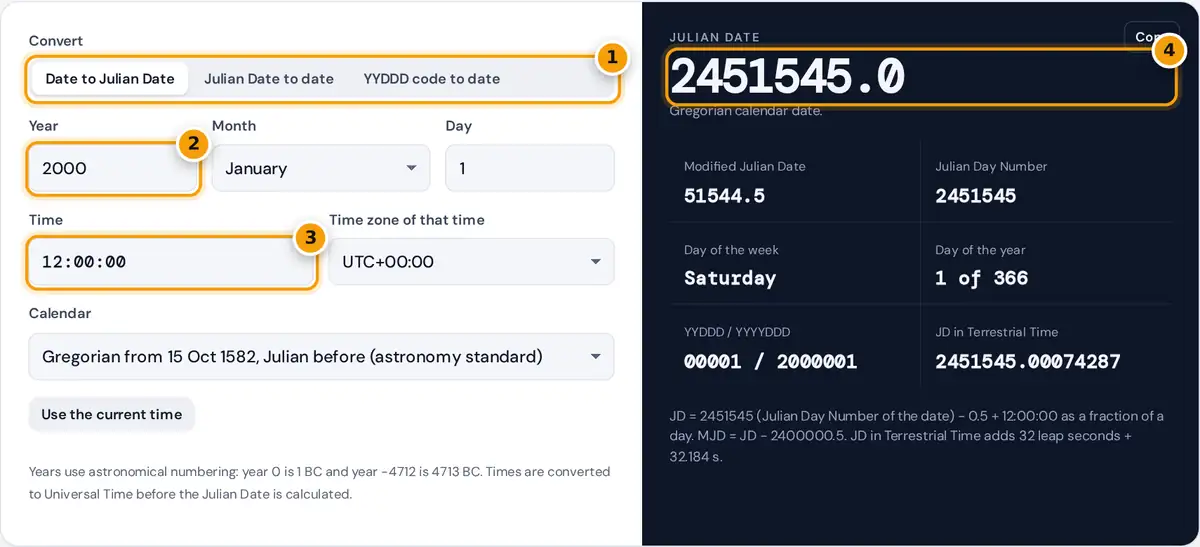
- Choose date to JD, JD to date, or a YYDDD day code.
- Enter the year, month and day.
- Enter the time and choose its time zone.
- Read the Julian Date with MJD, day number, weekday and YYDDD code.
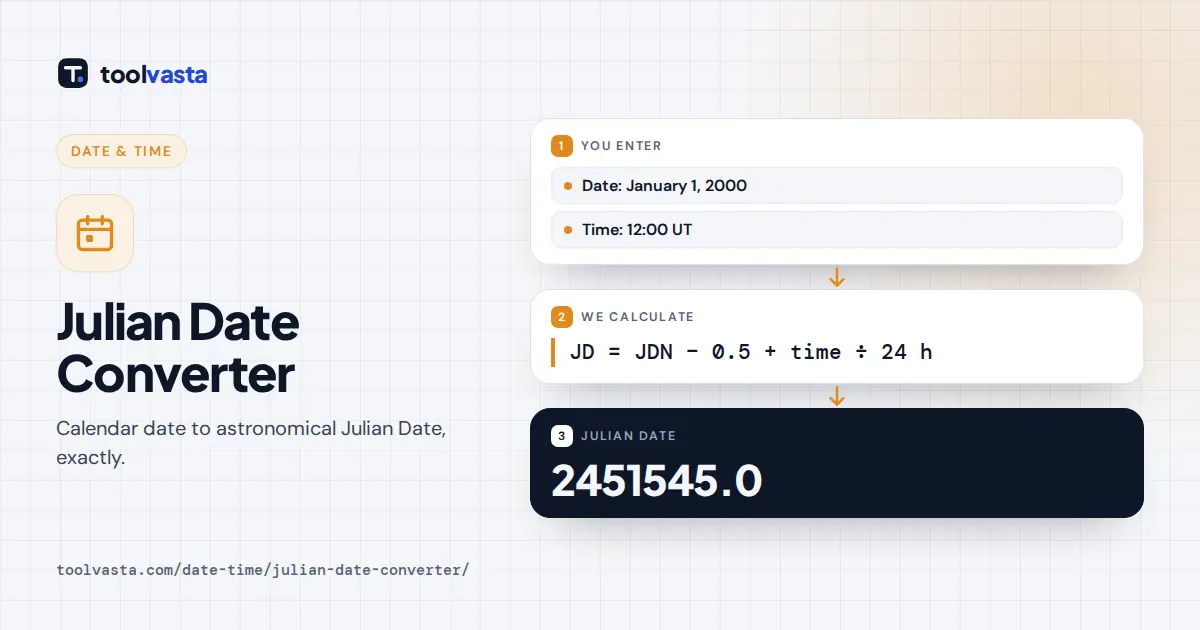
Choose Date to Julian Date, enter the year, month, day and time, and pick the time zone the time was recorded in. The calculator converts it to Universal Time and shows the Julian Date (JD), the Modified Julian Date (MJD), the Julian Day Number, the weekday, the day of the year and the YYDDD code. For dates from 1972 it also gives the JD in Terrestrial Time, the uniform time scale used in astronomical tables. The page opens on the standard epoch J2000.0, which is JD 2451545.0.
Choose Julian Date to date to turn a JD from an ephemeris, a satellite data file or a variable star log back into a calendar date and time. Choose YYDDD code to date to decode day-of-year codes such as 26274, which many people also call Julian dates.
Julian Date Formula
The Julian Date counts days, and fractions of a day, from noon Universal Time on January 1, 4713 BC in the Julian calendar. Astronomers start the day at noon so a night of observing has one date. The calculator first finds the Julian Day Number of the calendar date with whole-number arithmetic, then adds the time:
JDN = day + floor((153m + 2) ÷ 5) + 365y + floor(y/4) − floor(y/100) + floor(y/400) − 32045
JD = JDN − 0.5 + (hours ÷ 24) MJD = JD − 2400000.5
For Julian calendar dates the century terms are dropped and the constant becomes 32083. The time is carried in whole milliseconds, so there is no rounding drift, and the result is shown to 8 decimal places, enough to distinguish every millisecond.
Worked Examples and Checks
| Date and time | Julian Date |
|---|---|
| Jan 1, 2000, 12:00 (J2000.0) | 2451545.0 |
| Oct 4, 1957, 19:26:24 UT (Sputnik 1 launch, Meeus example 7.a) | 2436116.31 |
| Jan 27, 333, 12:00, Julian calendar (Meeus example 7.b) | 1842713.0 |
| Oct 15, 1582, 00:00, first Gregorian day | 2299160.5 |
| Nov 17, 1858, 00:00 (MJD 0) | 2400000.5 |
| Jan 1, 4713 BC, 12:00, Julian calendar | 0.0 |
For January 1, 2000: a = 1, y = 6799, m = 10, so JDN = 1 + 306 + 2,481,635 + 1,699 − 67 + 16 − 32,045 = 2,451,545. At 12:00 the fraction cancels the −0.5, giving JD 2451545.0 exactly, and MJD 51544.5. We verified every row against the Swiss Ephemeris and against Jean Meeus, Astronomical Algorithms, chapter 7.
UT, UTC and Terrestrial Time
A Julian Date is just a count of days, so it can be expressed in any time scale. Most everyday conversions use Universal Time, which is what this tool produces from your clock time. Planetary ephemerides use Terrestrial Time (TT), which runs ahead of UTC by the accumulated leap seconds plus 32.184 seconds, currently 69.184 seconds. J2000.0 is formally January 1, 2000 at 12:00 TT. The leap second table here runs to the last leap second, added at the end of 2016.
YYDDD Codes Are Not Julian Dates
Food manufacturers, the US military and IBM mainframes often print dates as YYDDD or YYYYDDD, for example 26274 for the 274th day of 2026, which is October 1. People call these Julian dates, but they are ordinal dates under ISO 8601 and have nothing to do with the astronomical count. The third mode decodes them and the first mode shows the code for any date.
Tips and Limits
- Year 0 exists in astronomical numbering and equals 1 BC. Enter -4712 for 4713 BC.
- October 5 to 14, 1582 do not exist in the standard calendar. Choose the proleptic Gregorian or Julian calendar to enter them anyway.
- Many countries switched calendars later than 1582, Britain and its colonies in 1752, so check which calendar a historical document uses.
- Supported range: JD 0 to the end of year 9999.
Frequently asked questions
What is today's Julian Date?
Press Use the current time and the calculator fills in the current UTC date and time and shows its Julian Date. In 2026 the Julian Date is a little over 2,461,000, increasing by exactly 1 every day at noon UTC.
What is the Julian Date of January 1, 2000?
At 12:00 it is exactly 2451545.0, the standard astronomical epoch J2000.0. At midnight at the start of that day it is 2451544.5, because Julian Dates begin at noon.
What is the difference between JD and MJD?
The Modified Julian Date equals the Julian Date minus 2,400,000.5. It starts at midnight instead of noon and uses smaller numbers. MJD 0 is November 17, 1858 at 00:00 UT.
How do I convert a Julian date like 26274 to a normal date?
That is a YYDDD day-of-year code. Choose the YYDDD mode and enter it: 26 is the year 2026 and 274 is the day of the year, which is October 1, 2026.
Is the Julian Date related to the Julian calendar?
Only by name. Joseph Scaliger defined the Julian Period in 1583, and astronomers later counted Julian Days from its start. The Julian calendar is the older calendar introduced by Julius Caesar, which the tool can also use.
Why does the Julian Date change at noon?
Astronomers in the nineteenth century wanted a whole night of telescope observations to share one date, so the Julian Day starts at noon Universal Time rather than at midnight.