How to Use the Minutes Calculator
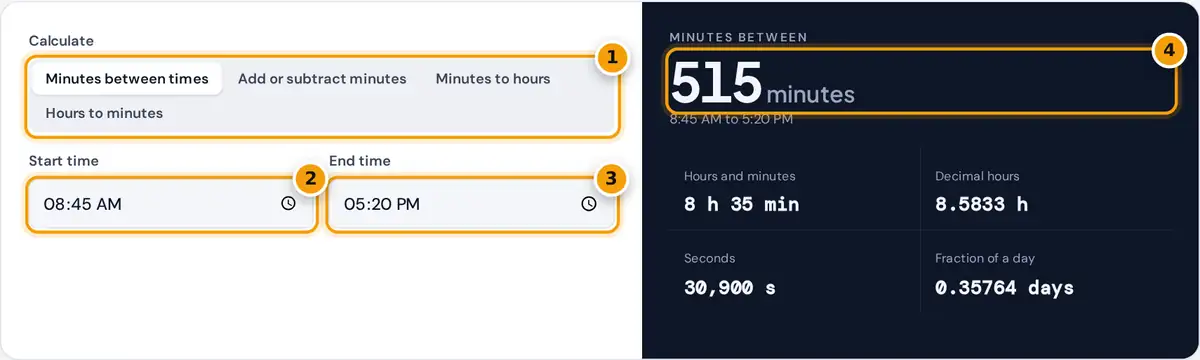
- Choose a mode: minutes between times, add or subtract, or convert minutes and hours.
- Enter the start time.
- Enter the end time. An earlier end time counts across midnight.
- Read the minutes between, then hours and minutes, decimal hours and seconds.
Choose one of four modes. Minutes between times counts the minutes from a start time to an end time, including any overnight spans. The result also appears in hours and minutes, decimal hours and seconds.
Add or subtract minutes tells you what time it will be, or was, a number of minutes from a given time. Press Use current time to start from now instead of typing the clock time.
Minutes to hours and Hours to minutes convert durations in either direction. Each mode also shows the fraction of a day, which is handy for spreadsheets that store time as part of one full day.
How to Count Minutes Between Two Times
Turn each time into minutes after midnight by multiplying the hour by 60 and adding the minutes. Subtract the start from the end, and the answer is the elapsed time between the two clock readings.
minutes between = end − start (add 1,440 if negative)
hours = minutes ÷ 60
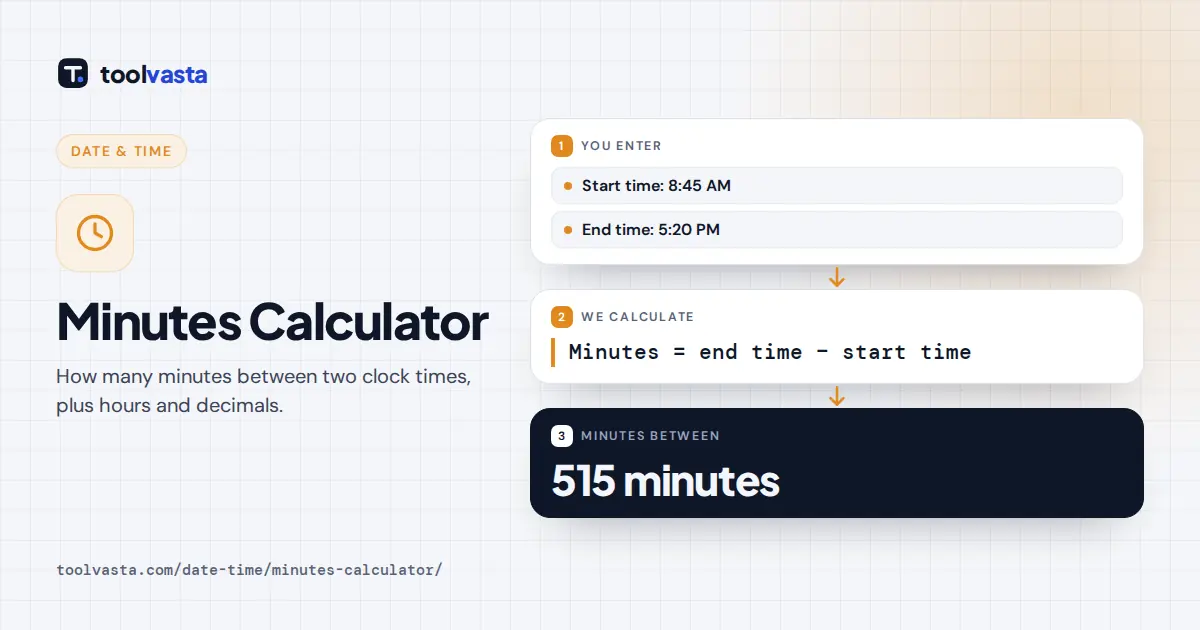
For example, from 8:45 AM to 5:20 PM, 8:45 is 525 minutes after midnight and 17:20 is 1,040. The time difference is 515 minutes, which is exactly 8 hours 35 minutes or 8.5833 decimal hours.
The same duration equals 30,900 seconds or about 0.358 of a full day. Working in minutes after midnight avoids the usual mistakes people make when borrowing hours by hand when the minutes column is smaller.
Times That Cross Midnight
If the subtraction ever gives a negative number, the end time falls on the next day. Add 1,440, the number of minutes in a day, and the calculator does this automatically for any overnight shift.
From 11:30 PM to 1:00 AM, the raw difference is 60 − 1,410 = −1,350. Adding 1,440 gives exactly 90 minutes, or 1 hour 30 minutes, which matches what you would count on any analog clock face.
On the 12-hour clock, 12:00 AM is midnight and 12:00 PM is noon, by long convention. Using the 24-hour clock, where midnight is 00:00 and noon is 12:00, removes that common source of confusion completely.
Adding or Subtracting Minutes
Convert the start time to minutes after midnight, add the minutes, then convert the total back into clock time. 9:40 AM plus 135 minutes is 580 + 135 = 715 minutes after midnight, which is 11:55 AM.
11:30 PM plus 90 minutes is 1,500 minutes, which passes midnight and lands on 1:00 AM on the next day. The result shows both 12-hour and 24-hour clock time and how many days were crossed.
Choose Subtract to find an earlier time, such as when to leave for an appointment. Choose Add to find a later time, such as when an oven timer or a paid parking session will end.
Minutes to Hours Conversion
Divide minutes by 60 for decimal hours. The whole number is the hours, and the remainder is the leftover minutes, so 135 minutes is 2.25 hours, which is the same as 2 hours 15 minutes.
| Minutes | Hours and minutes | Decimal hours |
|---|---|---|
| 45 | 45 min | 0.75 |
| 90 | 1 h 30 min | 1.5 |
| 100 | 1 h 40 min | 1.6667 |
| 150 | 2 h 30 min | 2.5 |
| 200 | 3 h 20 min | 3.3333 |
| 480 | 8 h | 8 |
| 1,440 | 24 h | 24 |
To go the other way, multiply hours by 60 and add the extra minutes: 3 hours 20 minutes is 200 minutes. Multiply minutes by 60 again when you need the total expressed in seconds instead.
Larger units of time follow exactly the same simple pattern. A day holds 1,440 minutes and a week holds 10,080 minutes, so seven 8-hour workdays add up to 3,360 minutes, or 56 hours of work.
Everyday Uses
Counting minutes worked on a shift is the most common use. Enter the start and end times, then copy the decimal hours into a timesheet so payroll software can multiply them by an hourly rate.
- Converting meeting lengths, video runtimes or call minutes into hours.
- Finding how many minutes remain until a flight, class or appointment.
- Timing cooking, workouts or study sessions.
Decimal hours matter a great deal for pay. Eight hours 35 minutes is 8.5833 hours, not 8.35, and confusing the two on a timesheet underpays about 14 minutes of work for every such shift recorded.
For parking meter checks, add the paid minutes to the current time. For a meeting, subtract minutes to find when to start preparing, or count the minutes between two times to confirm the total length.
Notes on Clocks and Daylight Saving
All times are treated as clock time on a normal 24-hour day. The calculator does not know your date, so it cannot adjust for days when clocks change or for travel across different time zones.
On the night daylight saving time starts or ends, real elapsed time differs from the clock difference by exactly 60 minutes. NIST daylight saving rules list the change dates for the United States each year.
In Canada, the National Research Council official time service explains time zones and clock changes. For flights, convert both departure and arrival times to one zone first, then count the minutes between them as usual.
Frequently asked questions
How many minutes are between two times?
Convert each time to minutes after midnight and subtract the start from the end. From 8:45 AM to 5:20 PM is 1,040 minus 525, which equals 515 minutes, or 8 hours 35 minutes.
How do I convert minutes to hours?
Divide by 60. For example, 135 minutes divided by 60 equals 2.25 hours, which is 2 hours and 15 minutes. The calculator shows both the decimal and the hours and minutes form.
How many minutes are in a day?
There are 1,440 minutes in a day, because 24 hours times 60 minutes equals 1,440. A week holds 10,080 minutes, and a 365-day year holds 525,600 minutes.
What time is it 90 minutes after 11:30 PM?
It is 1:00 AM the next day. Adding 90 minutes to 1,410 minutes after midnight gives 1,500, which passes midnight, and the calculator shows that one day was crossed.
How do I convert hours to minutes?
Multiply the hours by 60 and add any extra minutes. For example, 3 hours 20 minutes is 3 times 60 plus 20, which equals 200 minutes in total.
How do I calculate minutes worked for a timesheet?
Enter your start and end times in Minutes between times mode. Use the decimal hours result for pay, since 8 hours 35 minutes is 8.5833 hours, not 8.35 hours.