How to Use the Chinese Calendar Calculator
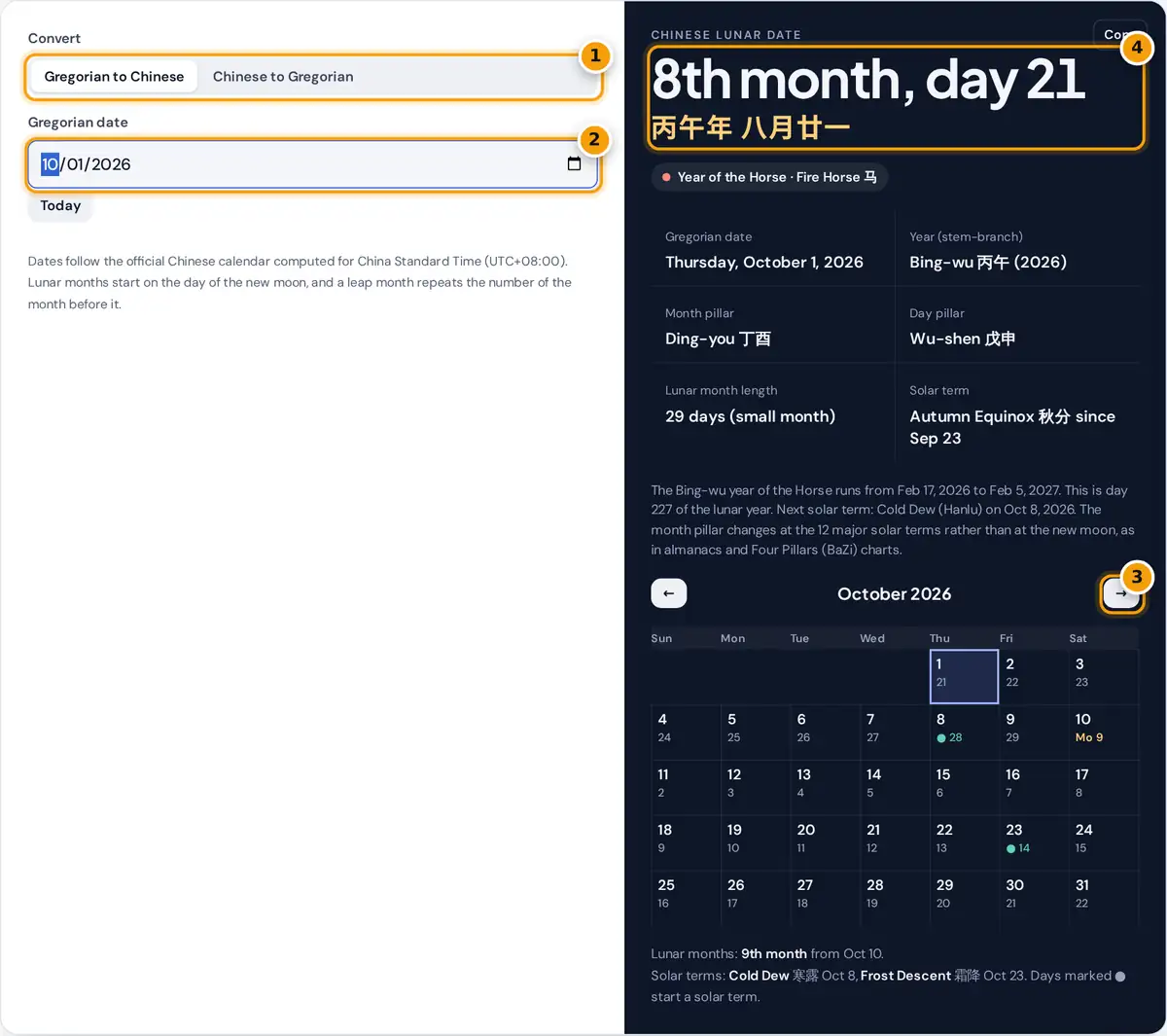
- Choose Gregorian to Chinese, or Chinese to Gregorian to find the date of a lunar birthday.
- Enter the Gregorian date, or press Today.
- Use the arrows to browse the month view with every lunar day and solar term.
- Read the lunar month and day, zodiac animal and stem-branch pillars.
Choose the direction first. Gregorian to Chinese takes an ordinary date, such as a birthday or a wedding day, and shows it in the Chinese lunar calendar. Chinese to Gregorian does the reverse: enter the Chinese year, the lunar month and day, tick Leap month if the date falls in an inserted month, and the calculator finds the matching Gregorian date. The page opens on today's date.
The result panel shows the lunar month and day in English and in Chinese characters, the zodiac animal with its element, and the stem-branch (ganzhi) names of the year, month and day. You also see whether the lunar month has 29 or 30 days and which of the 24 solar terms is in effect. Below it, a month view marks every lunar day, the first day of each lunar month and the days that start a new solar term. Use the arrows to move through the months.
How the Chinese Lunar Calendar Works
The Chinese calendar (nongli) is lunisolar. Each month begins on the day of the new moon, so months have 29 or 30 days and a lunar year of 12 months has about 354 days. To stay in step with the seasons, a leap month is added about seven times every 19 years. The rules, fixed in the calendar reform of 1645, are:
- The month that contains the winter solstice is always the 11th month.
- When there are 13 new moons between two winter solstices, the first month without a principal solar term (zhongqi) becomes a leap month and takes the number of the month before it.
- All calculations use the time in Beijing, China Standard Time (UTC+08:00) since 1929.
This calculator uses a table of every lunar month from 1900 to 2100, generated from astronomical new moons and solar terms, so it follows the same rules as the official calendar.
Stems, Branches and the 60-Day Cycle
Alongside the numbered months, Chinese almanacs name years, months and days with a pair of characters: one of the 10 heavenly stems and one of the 12 earthly branches. Together they form a cycle of 60 combinations. The branches are matched to the 12 zodiac animals and the stems to the five elements, which is why 2026 is a Fire Horse year (bing-wu).
day index = (Julian Day Number + 49) mod 60
month branch: Yin month begins at Lichun (sun at 315°)
stem of the Yin month = (2 × (year stem mod 5) + 2) mod 10
The year pillar here changes at Lunar New Year, as on printed calendars. The month pillar changes at the 12 major solar terms (Lichun, Jingzhe and so on), as in almanacs and Four Pillars (BaZi) charts. The day cycle has run without a break for many centuries, unaffected by months or leap years.
Worked Example
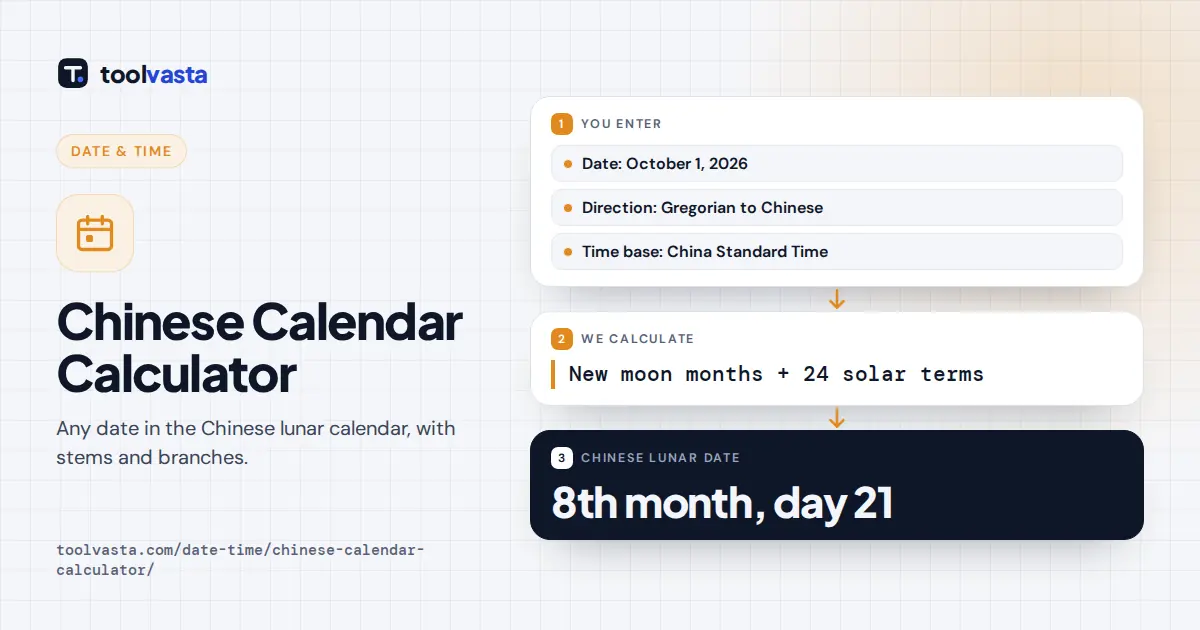
Take October 1, 2026. The new moon of September 11, 2026 began the 8th month of the Chinese year that started on February 17, 2026, so October 1 is the 21st day of the 8th month, written 丙午年 八月廿一. The month has 29 days, since the next new moon is on October 10.
The year is bing-wu (Fire Horse). October 1 lies between White Dew (September 8) and Cold Dew (October 8), the You month, and in a Bing year the Yin month stem is Geng, so seven months later the month pillar is Ding-you. For the day, January 1, 2000 is the well-known Wu-wu day (index 54). October 1, 2026 is 9,770 days later, and (54 + 9,770) mod 60 = 44, which is Wu-shen. We checked these values against an independent script.
| Gregorian date | Chinese date | Note |
|---|---|---|
| Jan 29, 2025 | 1st month, day 1 | Lunar New Year, Wood Snake |
| Jul 25, 2025 | Leap 6th month, day 1 | 2025 has 13 months |
| Feb 17, 2026 | 1st month, day 1 | Lunar New Year, Fire Horse |
| Sep 25, 2026 | 8th month, day 15 | Mid-Autumn Festival |
| Feb 6, 2027 | 1st month, day 1 | Lunar New Year, Fire Goat |
The 24 Solar Terms
The solar terms (jieqi) divide the sun's yearly path into 24 steps of 15°. They track the seasons exactly, unlike the lunar months, and farmers used them to plan the year. Spring Equinox is at 0°, Start of Spring (Lichun) at 315° and Winter Solstice at 270°. The calculator finds the sun's position for each day in China time, so a term listed on a day began at some moment during that day in Beijing.
Tips and Limits
- The range is Lunar New Year 1900 to the end of 2100. Older Chinese dates used different rules and are not covered.
- Calendars made for other time zones, such as the Vietnamese calendar (UTC+07:00), occasionally start a month one day earlier.
- Solar term dates come from a solar model accurate to about a minute of arc, so a term that begins within a few minutes of midnight may show one day off.
- For traditional birthdays, convert the birth date once and celebrate on the same lunar month and day each year. If you were born in a leap month, most families celebrate in the regular month of the same number.
Frequently asked questions
How do I convert a Gregorian date to the Chinese lunar calendar?
Choose Gregorian to Chinese and enter the date. The calculator finds the lunar month that began on or before that day and counts the days since its new moon, then adds the year's zodiac animal and stem-branch names.
How do I find the Gregorian date of a lunar birthday?
Choose Chinese to Gregorian, enter the Chinese year, the lunar month and the lunar day, and tick Leap month only if the date is in an inserted month. The matching Gregorian date appears at once.
What is a leap month in the Chinese calendar?
It is an extra month added in some years so the calendar keeps pace with the seasons. It repeats the number of the previous month, so 2025 had a 6th month followed by a leap 6th month.
What does ganzhi mean?
Ganzhi is the stem-branch system that names years, months and days with one of 10 heavenly stems and one of 12 earthly branches. The pairs repeat every 60 steps, giving names such as Jia-zi or Bing-wu.
Why does the Chinese zodiac year not start on January 1?
The zodiac year follows the lunar calendar, so it begins at Lunar New Year, between January 21 and February 20. Four Pillars astrology instead starts the year at Lichun, around February 4.
Are the solar terms the same every year?
Almost. Each term marks a fixed position of the sun, so it falls on nearly the same Gregorian date each year, varying by about a day. Start of Spring is usually February 3, 4 or 5.