How to Use the Calendar Generator
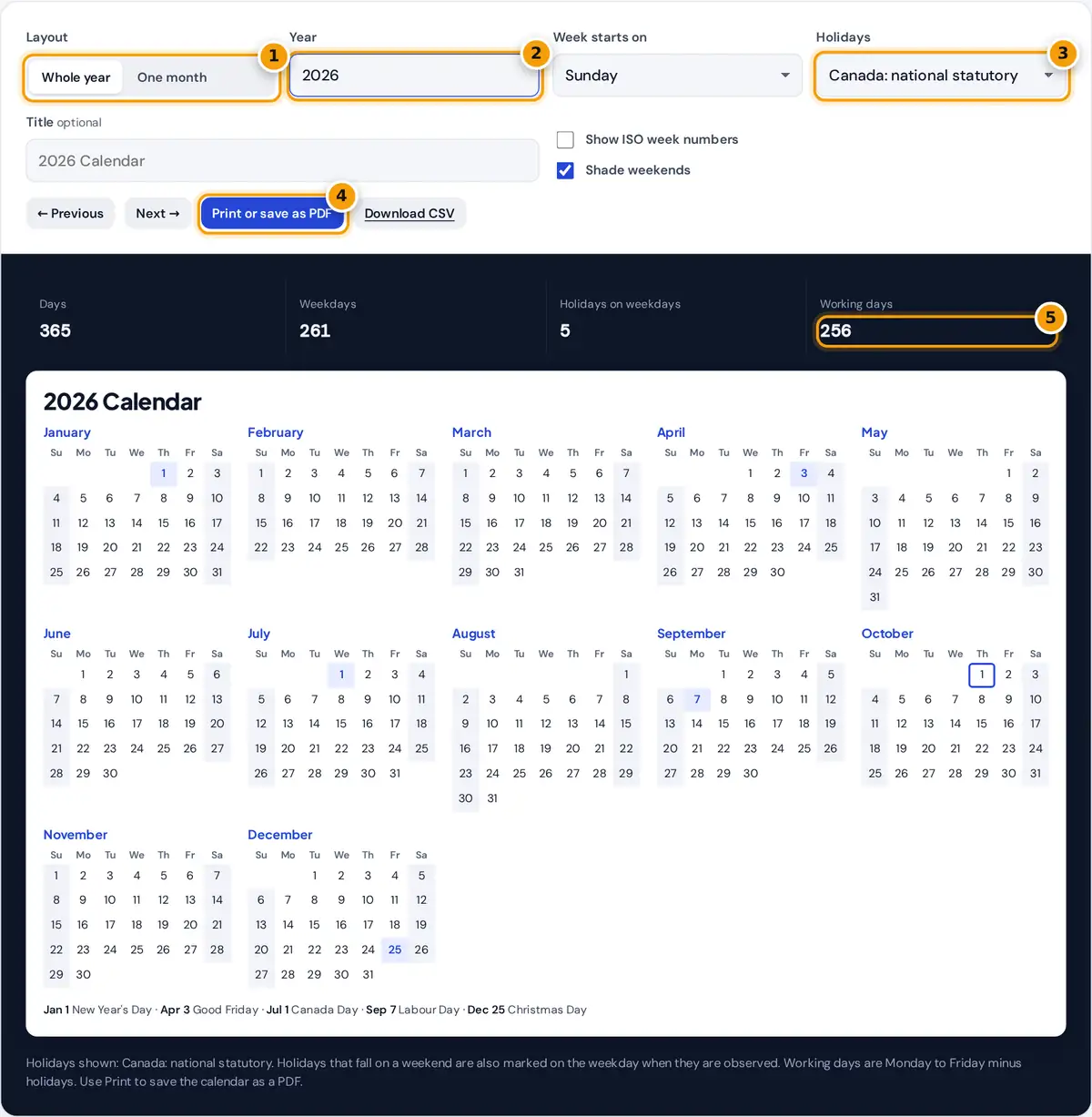
- Choose a whole year or a single month.
- Type the year you want.
- Pick a holiday set to mark Canadian statutory holidays.
- Print the calendar or save it as a PDF.
- Check the days, weekdays and working days for the period.
Choose Whole year for a twelve month overview or One month for a large grid with room for notes. Type the year, pick the month if needed, and choose whether weeks start on Sunday, the usual layout in Canada and the United States, or Monday, the international standard used in Europe and in ISO 8601. The calendar updates as you change each option, and the arrows step to the previous or next year or month.
Pick a holiday set to mark Canadian statutory holidays, tick ISO week numbers if you plan by week, and add your own title, for example a team name or “Family Calendar 2027”. Press Print or save as PDF to print only the calendar sheet. In the print dialog, choose Save as PDF to keep a file, and landscape orientation usually suits the year view best. Download CSV saves every date with its weekday, ISO week number and holiday name for a spreadsheet.
How the Calendar Is Built
Each month starts on the correct weekday from the Gregorian calendar, and February has 29 days in leap years. The weekday of the first of the month decides how many blank cells come before day 1 in the first row.
blank cells before day 1 = (weekday of the 1st − first day of week + 7) mod 7
ISO week = week containing the Thursday, weeks start on Monday
ISO week numbers follow ISO 8601: week 1 is the week with the year’s first Thursday, so it always contains January 4. A year has 52 or 53 ISO weeks, and the first days of January can belong to the last week of the previous year. In the year view, each row shows the ISO week of its Thursday.
Worked Example: 2026
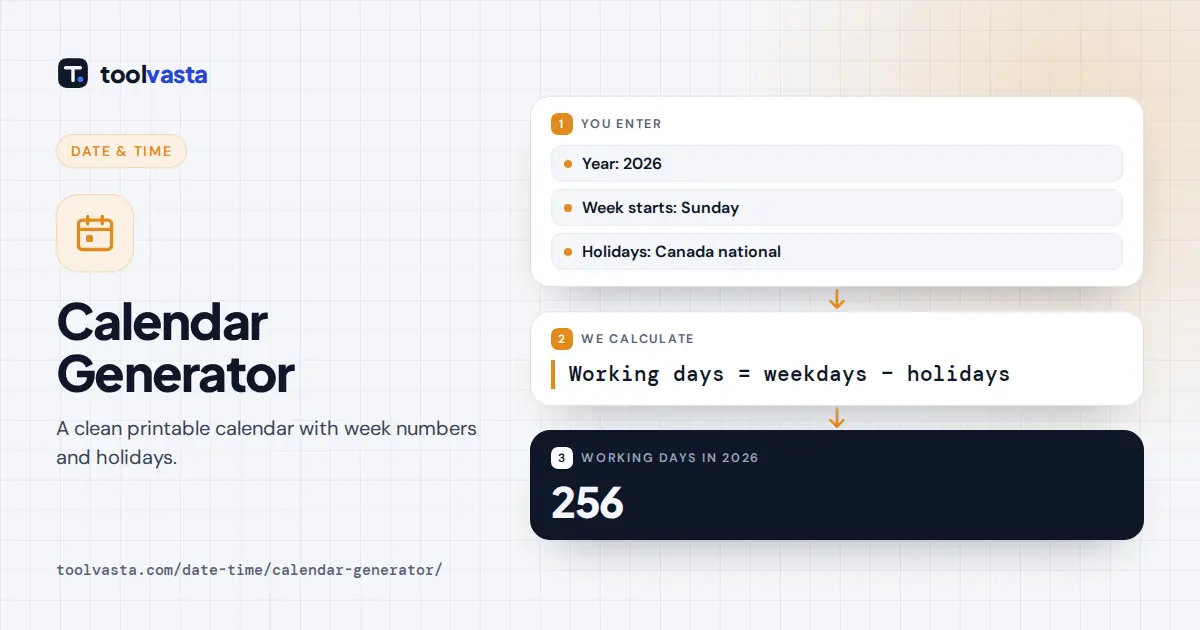
2026 starts on a Thursday and is not a leap year, so it has 365 days, 52 full weeks plus one extra Thursday. That gives 261 weekdays. With the national statutory holidays selected, all five fall on weekdays in 2026: New Year’s Day (Thursday, January 1), Good Friday (April 3), Canada Day (Wednesday, July 1), Labour Day (Monday, September 7) and Christmas Day (Friday, December 25). The calendar therefore shows 256 working days. Choose Ontario and you also see Family Day, Victoria Day, Thanksgiving and Boxing Day. Boxing Day falls on Saturday, December 26, so it is observed on Monday, December 28, leaving 252 working days. We checked these counts with a separate script.
Holiday Sets
| Set | Holidays included |
|---|---|
| Canada: national statutory | New Year’s Day, Good Friday, Canada Day, Labour Day, Christmas Day |
| Canada: federal employers | The above plus Easter Monday, Victoria Day, Civic Holiday, National Day for Truth and Reconciliation, Thanksgiving, Remembrance Day, Boxing Day |
| Ontario | New Year’s Day, Family Day, Good Friday, Victoria Day, Canada Day, Labour Day, Thanksgiving, Christmas Day, Boxing Day |
Easter-based holidays use the Gregorian computus, and holidays such as Labour Day and Thanksgiving use their rule (first Monday of September, second Monday of October). When a fixed-date holiday falls on a weekend, the following weekday is also marked as the observed day, as most employers do.
Tips for Printing
- For a wall calendar, print the month view twelve times, once for each month, using the arrows between prints.
- Turn on background graphics in the print settings if weekend shading or holiday colors do not appear.
- Use the year view on one page for planning school terms, vacations or project timelines.
- The CSV file opens in Excel, Google Sheets or Numbers and is a quick way to build a shift rota or content calendar.
Limits
Holiday sets cover Canada and Ontario only. Other provinces have their own statutory holidays, such as Saint-Jean-Baptiste Day in Quebec or Heritage Day in some provinces, so choose None and add your own notes if you are elsewhere. Years from 1900 to 2200 are supported, all on the Gregorian calendar.
Frequently asked questions
How do I print a calendar for 2026?
Type 2026 in the year box, choose the whole year or one month, then press Print or save as PDF. Only the calendar sheet prints. Landscape orientation fits the year view best.
Can I start the week on Monday?
Yes. Change Week starts on to Monday. Monday is the ISO 8601 standard used in Europe and for week numbers, while Sunday is the common layout in Canada and the United States.
What are ISO week numbers?
They number the weeks of the year from 1 to 52 or 53. Week 1 is the week containing the first Thursday of January, and weeks run Monday to Sunday under the ISO 8601 standard.
Which holidays can the calendar show?
National statutory holidays observed across Canada, the full set for federally regulated employers, or Ontario's public holidays. Observed days are marked when a holiday falls on a weekend.
How many working days are in 2026?
2026 has 261 weekdays. Subtracting the five national statutory holidays leaves 256 working days. With Ontario's holidays it is 252, because nine holidays fall on weekdays once observed days are counted.
Can I save the calendar as a PDF?
Yes. Press Print or save as PDF, then choose Save as PDF or Microsoft Print to PDF as the printer in your browser's print dialog. The file contains only the calendar sheet.