How to Use the SLA Uptime Calculator
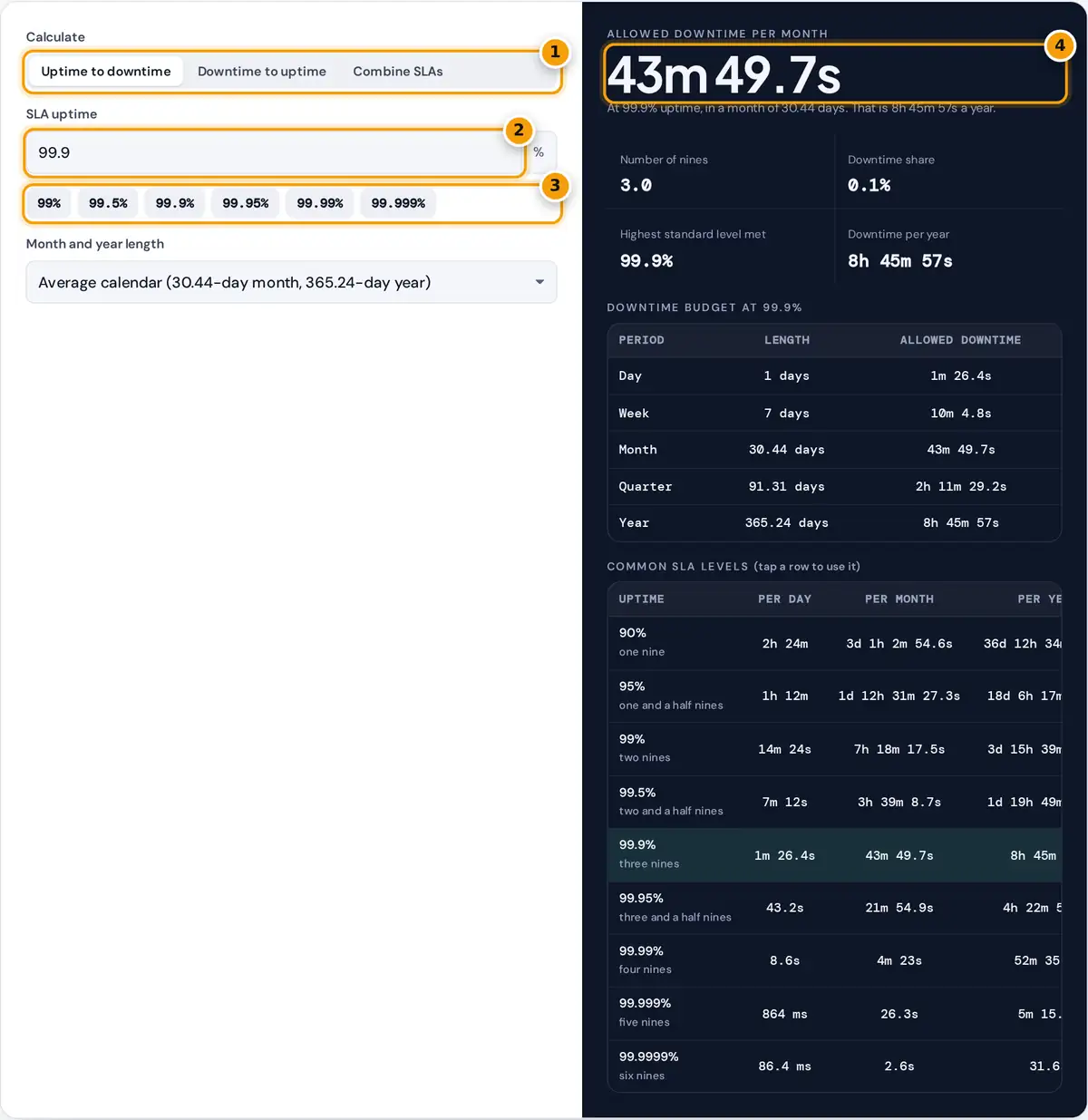
- Choose a mode: uptime to downtime, downtime to uptime, or combine several SLAs.
- Enter the SLA uptime percentage, for example 99.9.
- Or tap a common level from 99% to 99.999%.
- Read the allowed downtime per month, with the day, week, quarter and year budgets and a nines table below.
In Uptime to downtime mode, type the availability your service level agreement promises, or tap a common level such as 99.9% or 99.99%. The panel shows the downtime budget per month in large type, then per day, week, quarter and year. In Downtime to uptime mode, enter the downtime you measured and the period it happened in to get the uptime percentage you actually delivered, and the highest standard SLA level it still meets.
Combine SLAs estimates the availability of a system built from several services. List each one with its SLA and choose whether they work in series, where every service must be up, or as redundant copies, where any one is enough. The month and year length setting matters because contracts define a month differently, so match it to yours.
The Uptime and Downtime Formulas
uptime% = (1 − downtime ÷ period length) × 100
series: A = A₁ × A₂ × … redundant: A = 1 − (1 − A₁) × (1 − A₂) × …
The average calendar setting uses the Gregorian year of 365.2425 days, so an average month is 30.44 days or 2,629,746 seconds. A year at 99.9% therefore allows 0.001 × 31,556,952 = 31,557 seconds of downtime, which is 8 hours 45 minutes 57 seconds.
Worked Example
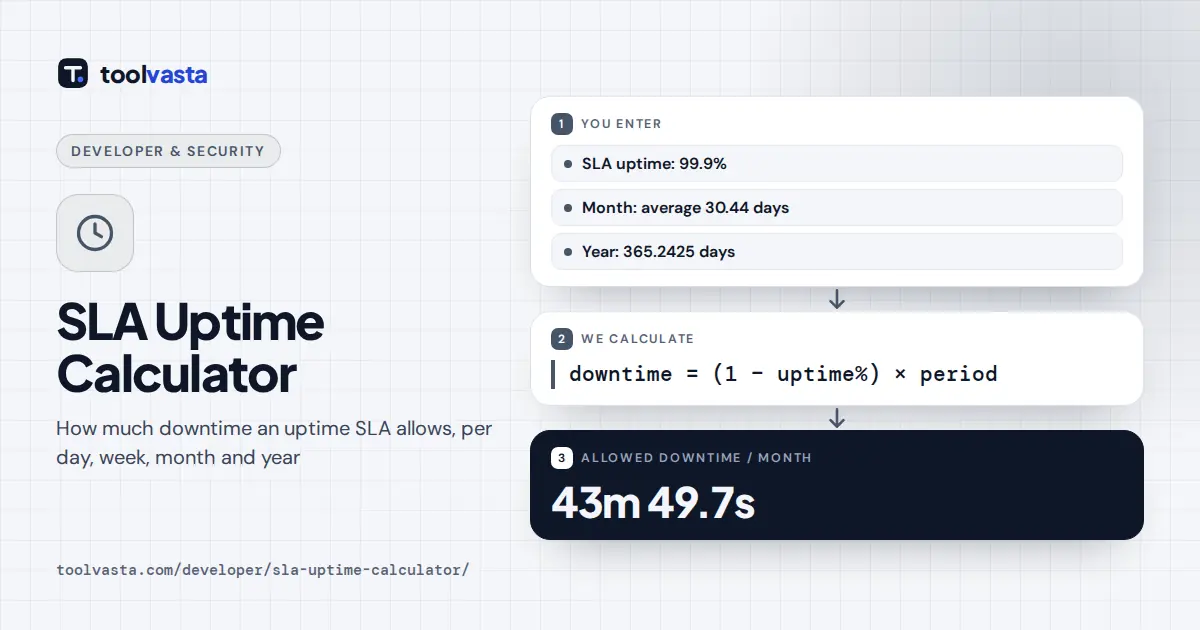
A provider promises 99.9% monthly uptime. The unavailable share is 0.1%, so the budget is 0.001 × 2,629,746 seconds = 2,629.7 seconds, or 43 minutes 49.7 seconds per average month. With a 30-day month it is 0.001 × 2,592,000 = 2,592 seconds, or 43 minutes 12 seconds. Going the other way, 30 minutes of downtime in an average month is 1,800 ÷ 2,629,746 = 0.068% unavailable, which is 99.9316% uptime: it meets 99.9% but not 99.95%.
For a chain of a load balancer at 99.99%, app servers at 99.95% and a database at 99.9%, every part must work, so the combined availability is 0.9999 × 0.9995 × 0.999 = 99.8401%, worse than any single part. That is about 1 hour 10 minutes of downtime a month.
The Nines Table
Downtime budgets for an average calendar month and a 365.2425-day year:
| Uptime | Name | Per day | Per month | Per year |
|---|---|---|---|---|
| 99% | Two nines | 14m 24s | 7h 18m 17.5s | 3d 15h 39m 29.5s |
| 99.5% | Two and a half nines | 7m 12s | 3h 39m 8.7s | 1d 19h 49m 44.8s |
| 99.9% | Three nines | 1m 26.4s | 43m 49.7s | 8h 45m 57s |
| 99.95% | Three and a half nines | 43.2s | 21m 54.9s | 4h 22m 58.5s |
| 99.99% | Four nines | 8.6s | 4m 23s | 52m 35.7s |
| 99.999% | Five nines | 864 ms | 26.3s | 5m 15.6s |
Each extra nine divides the downtime budget by ten. Moving from three to four nines cuts the yearly allowance from almost 9 hours to under an hour, which usually calls for automatic failover rather than faster manual fixes.
Using the Budget as an Error Budget
Site reliability teams treat the allowed downtime as an error budget to spend on purpose. If a team targets 99.95% internally to protect a 99.9% contract, it has about 21 minutes 55 seconds a month to cover failed deployments, migrations and incidents. When an outage uses most of that budget early in the month, the usual response is to slow down risky releases until the window resets, rather than to promise faster fixes.
Reading an SLA Carefully
- Measurement window. Most cloud SLAs are measured per calendar month, so a long outage early in the month cannot be offset later.
- Exclusions. Scheduled maintenance, customer-caused problems and events outside the provider’s control are often excluded from downtime.
- What counts as down. Some contracts count only full outages, others count error rates above a threshold or count in 1 or 5-minute intervals.
- Credits, not guarantees. Missing an SLA usually earns a service credit, not compensation for your losses.
- The combined figures assume failures are independent. Shared power, networks or software bugs make real redundancy weaker than the formula suggests.
Frequently asked questions
How much downtime does 99.9% uptime allow?
99.9% uptime allows 0.1% downtime: about 1 minute 26 seconds a day, 10 minutes 5 seconds a week, 43 minutes 50 seconds an average month and 8 hours 46 minutes a year.
What does five nines availability mean?
Five nines is 99.999% uptime. It allows only about 26 seconds of downtime a month or 5 minutes 16 seconds a year, a level usually reached only with redundant systems and automatic failover.
How do I calculate uptime percentage from downtime?
Divide the downtime by the length of the period, subtract the result from 1 and multiply by 100. For example, 30 minutes down in a 30-day month is 1 minus 30 divided by 43,200, which is 99.93%.
How do you calculate a composite SLA?
For services that all must work, multiply their availabilities: 99.95% times 99.9% is about 99.85%. For redundant copies, multiply their failure rates and subtract from 1: two 99.9% copies give 99.9999%.
Which month length should I use for SLA calculations?
Use the definition in your contract. Many cloud providers measure per calendar month, which varies from 28 to 31 days. The average month of 30.44 days is a good neutral choice for comparing levels.
What is the difference between SLA, SLO and SLI?
An SLI is a measured indicator, such as the share of successful requests. An SLO is your internal target for it. An SLA is the contract with customers, usually set looser than the SLO and backed by service credits.