How to Use the Atbash Cipher
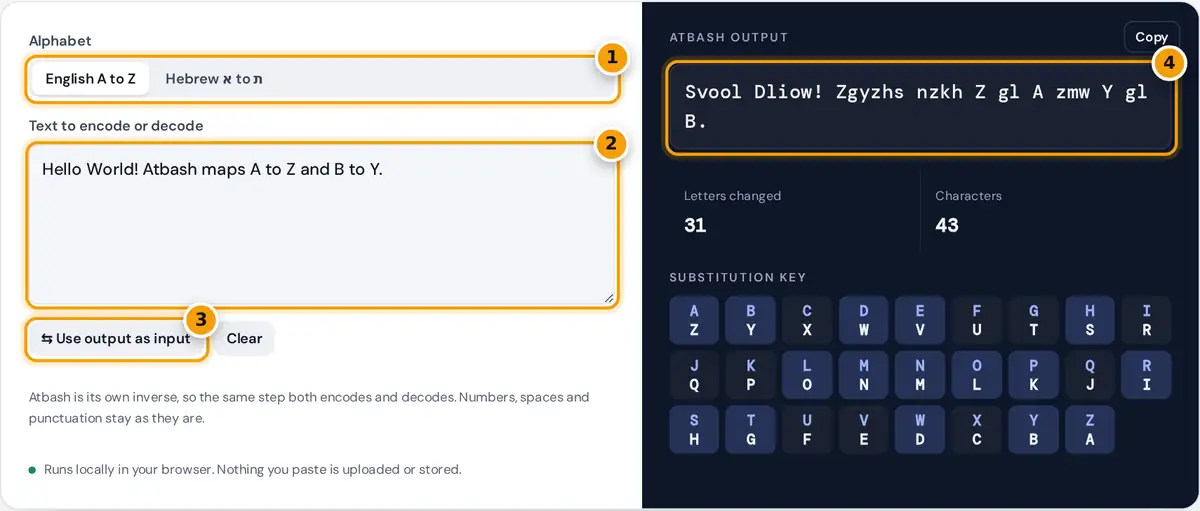
- Choose the English or Hebrew alphabet.
- Type or paste the text to encode or decode.
- Feed the output back in to see that Atbash reverses itself.
- Read the Atbash text and copy it, with the substitution key below.
Type or paste your text in the box and the Atbash version appears instantly in the result panel. There is no separate encode or decode button because Atbash is its own inverse: running it on ciphertext returns the original message. Press Use output as input to see this for yourself, and Copy to take the result elsewhere.
Choose English A to Z for the Latin alphabet or Hebrew for the original 22-letter Hebrew alphabet. Uppercase and lowercase are kept, and anything that is not a letter, such as digits, spaces, punctuation and emoji, passes through unchanged. The substitution key at the bottom highlights the letters that appear in your text.
How the Atbash Cipher Works
Atbash is a monoalphabetic substitution cipher. Write the alphabet forward, write it again backward underneath, and swap each letter for the one below it. The name comes from Hebrew: aleph (א) becomes tav (ת) and bet (ב) becomes shin (ש), giving “at-bash”.
Cipher: Z Y X W V U T S R Q P O N M L K J I H G F E D C B A
cipher letter = (25 − position) where A = 0, B = 1 … Z = 25
In numbers, a letter at position p maps to position 25 − p. Applying the rule twice gives 25 − (25 − p) = p, which is why the same step decodes.
Worked Example
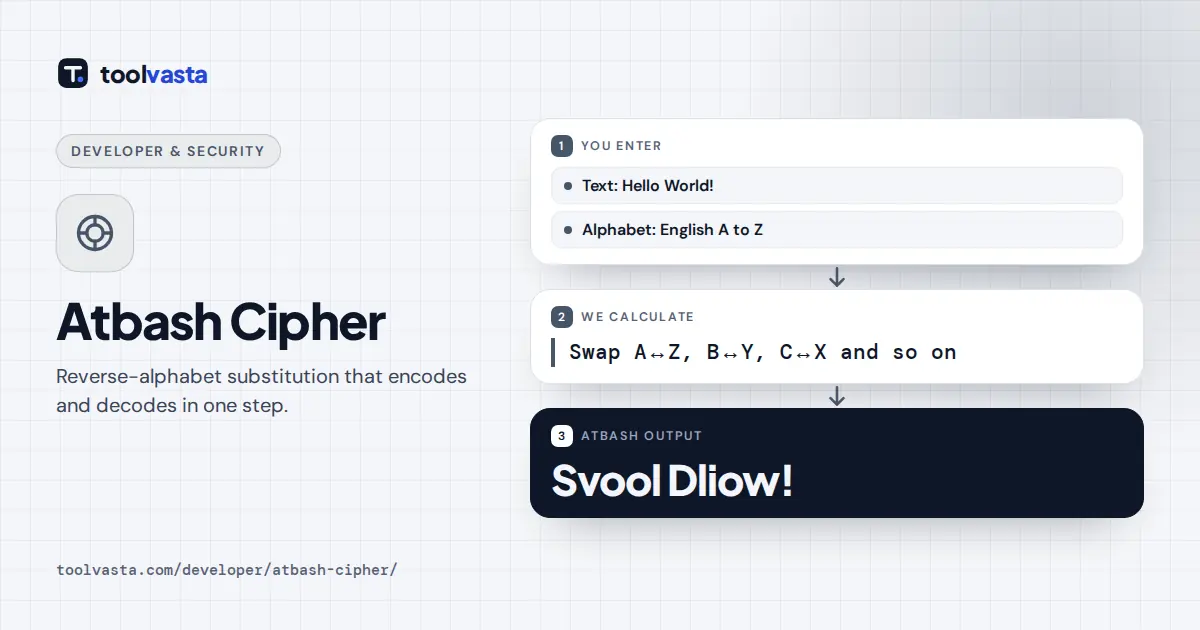
Encode HELLO. H is the 8th letter (position 7), so it becomes position 18, which is S. E (4) becomes V (21). L (11) becomes O (14), twice. O (14) becomes L (11). The result is SVOOL. The sample sentence “Hello World!” becomes “Svool Dliow!”, and running Svool Dliow! through the tool again returns Hello World!
Atbash in Hebrew
The cipher dates back to Hebrew scribes. Scholars point to the Book of Jeremiah, where the name Sheshach (ששכ) is read as an Atbash form of Babel (בבל). In Hebrew mode the tool pairs the 22 letters from both ends of the alphabet. Final letter forms are converted using their regular letter, so ם (final mem) becomes י, the partner of מ. Because final forms do not come back as finals, decoding Hebrew may return regular letters at the end of words.
| Letter | Atbash | Letter | Atbash |
|---|---|---|---|
| A | Z | N | M |
| B | Y | O | L |
| C | X | P | K |
| D | W | Q | J |
| E | V | R | I |
| F | U | S | H |
| G | T | T | G |
Is Atbash Secure?
No. Atbash has no key at all, so anyone who recognizes it can read the message. Like every simple substitution cipher it also keeps letter frequencies, so the most common ciphertext letter is likely V, the Atbash form of E. Use it for puzzles, escape rooms, geocaching, classroom activities and fun, never to protect real information. For that, use modern encryption such as AES.
Related Ciphers
- Caesar cipher: shifts every letter by a fixed amount instead of reflecting the alphabet. Try our Caesar Cipher Decoder.
- ROT13: a Caesar shift of 13. Like Atbash it is its own inverse, but it maps A to N rather than Z.
- Affine cipher: a general form where Atbash is the special case with multiplier 25 and shift 25.
Spotting Atbash in Puzzles
Atbash text is easy to recognize once you know the signs. Short words are a giveaway: the word “the” becomes “gsv”, “and” becomes “zmw” and “a” becomes “z”. If a puzzle mentions mirrors, reversals or opposites, try Atbash before a Caesar shift. Paste the text here and read the output at once.
Because the key never changes, Atbash also works well for teaching how substitution ciphers and frequency analysis work.
Frequently asked questions
How do I decode an Atbash cipher?
Paste the ciphertext into the tool and read the output. Atbash is its own inverse, so the same substitution that encodes also decodes. Each letter is replaced by the letter at the opposite end of the alphabet.
What is the Atbash cipher key?
The key is the reversed alphabet: A and Z swap, B and Y swap, C and X swap, down to M and N. There is no secret key to choose, which is why Atbash offers no real security.
What does Hello World become in Atbash?
Hello World becomes Svool Dliow. H maps to S, E to V, L to O, O to L, W to D, R to I and D to W. Case and the exclamation mark are kept as they are.
Where does the name Atbash come from?
It comes from the first and last letters of the Hebrew alphabet. Aleph swaps with tav and bet swaps with shin, which spells at-bash. The cipher appears in ancient Hebrew texts, including the Book of Jeremiah.
Does the Atbash cipher change numbers?
Not in the standard version. Atbash only substitutes letters, so digits, spaces and punctuation stay the same. Some puzzle makers also reverse digits, mapping 0 to 9, but that is a variation, not classic Atbash.
Is Atbash the same as ROT13?
No. Both are their own inverse, but ROT13 shifts each letter 13 places, so A becomes N. Atbash reflects the alphabet, so A becomes Z. They give different output for the same text.