How to Use the Morse Code Decoder
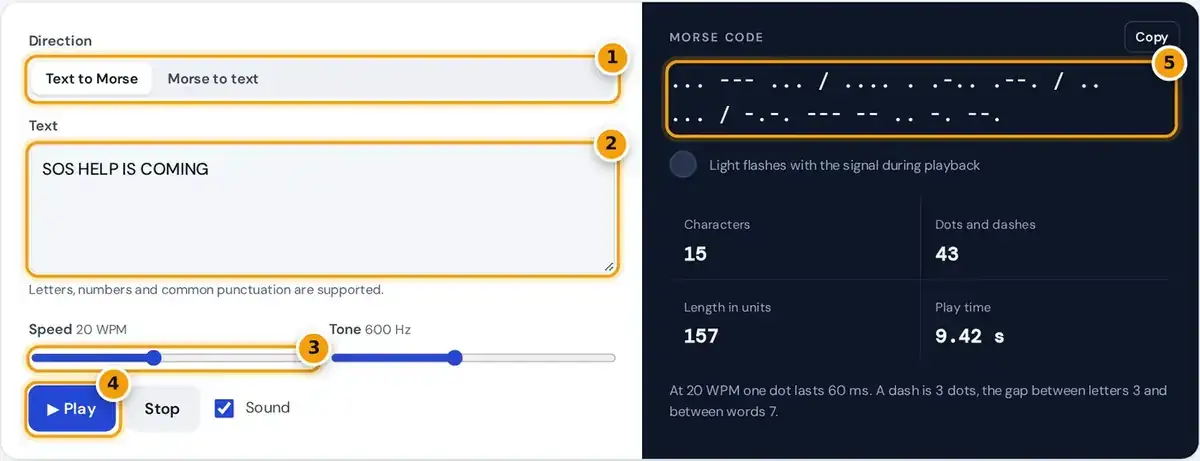
- Choose Text to Morse to encode, or Morse to text to decode dots and dashes.
- Type or paste your text or Morse code. Use / or a wide gap between words.
- Drag the speed slider to set the playback rate in words per minute.
- Press Play to hear the signal and watch the light flash in time.
- Read and copy the translated Morse code or text.
Choose Morse to text when you have a message in dots and dashes, or Text to Morse when you want to encode one. Output updates as you type, and the Copy button copies the result.
Switching direction carries your current result across, so you can decode a message, then flip it back to check the translation both ways. Unknown codes never stop the decoder; they simply show up as a #.
Press Play to hear the signal, or untick Sound to watch the light only. The circle in the result panel flashes in time with each dot and dash, which helps you practice reading light flashes.
Input Format for Decoding
Type a dot as a period and a dash as a hyphen. Leave exactly one space between letters and use a forward slash or two spaces between words. Line breaks also mark new word boundaries.
The decoder also accepts a middle dot or bullet in place of a period, and an underscore or a minus sign in place of a hyphen, so code copied from charts usually works without cleanup.
Spaces matter. Without a space between letters, a run such as three dots followed by a dash could mean V, or S then T, so run-together code cannot be decoded. Punctuation such as ? is supported.
Morse Code Timing Rules
| Element | Length |
|---|---|
| Dot (dit) | 1 unit |
| Dash (dah) | 3 units |
| Gap inside a letter | 1 unit |
| Gap between letters | 3 units |
| Gap between words | 7 units |
International Morse code measures everything in one unit, the length of a dot. Operators call the dot a dit and the dash a dah, and a dash lasts three times as long as a dot.
Inside a letter, symbols are separated by a short 1 unit gap. The gap between letters is 3 units and the gap between words is 7 units, which is what lets a listener hear structure.
These timing ratios come from the ITU-R M.1677 recommendation, the current international standard for Morse code timing. The player on this page follows them exactly, so the rhythm you hear matches real amateur radio practice.
Speed and the PARIS Standard
at 20 WPM: 1.2 ÷ 20 = 0.06 s = 60 ms
Speed is given in words per minute, or WPM, measured with the standard word PARIS. PARIS is exactly 50 units long including the space after it, so 20 WPM means sending 1,000 units every minute.
That makes the dot length 1.2 divided by the WPM, in seconds. At 20 WPM a dot lasts 60 milliseconds and a dash 180 milliseconds. The speed slider runs from 5 up to 40 WPM.
The tone slider sets the pitch from 300 to 1,000 Hz, with 600 Hz as the default. Some trainers use Farnsworth spacing, which stretches the gaps while keeping letters fast; this player uses standard spacing.
Worked Example
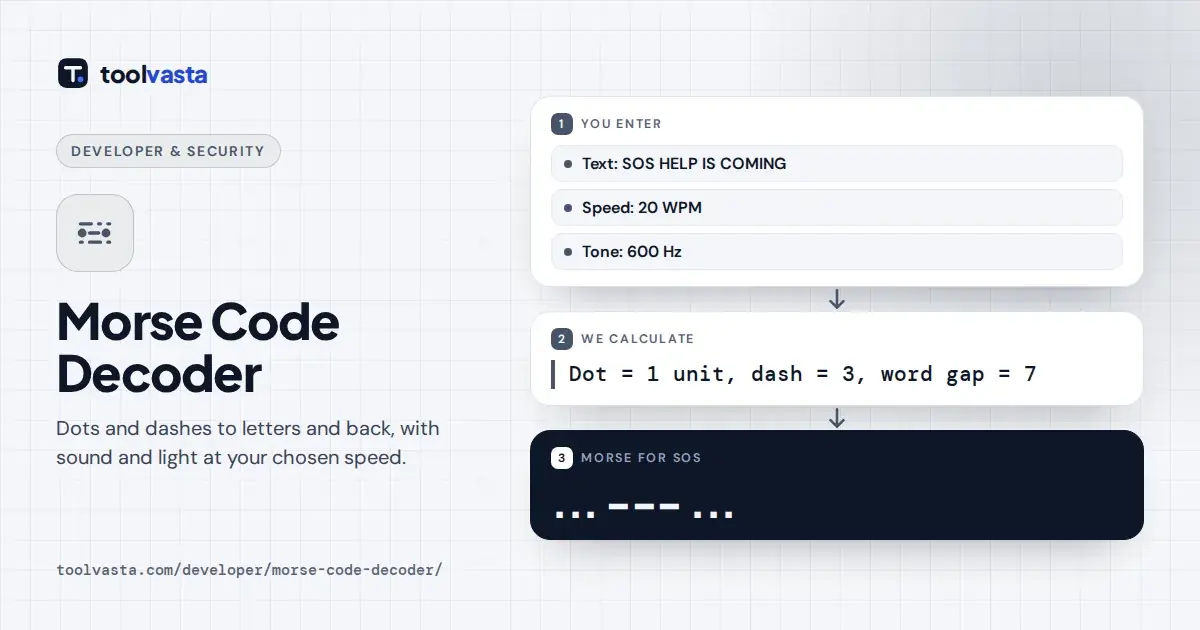
SOS is three dots, three dashes, then three dots. Each S has three dots plus two inner gaps, which is 5 units, and the O has three dashes plus two gaps, which is 11 units.
Add two letter gaps of 3 units and the total is 5 plus 11 plus 5 plus 6, or 27 units. At 20 WPM each unit is 0.06 seconds, so sending SOS takes 1.62 seconds.
The prefilled message, SOS HELP IS COMING, is 157 units long and plays in 9.42 seconds at 20 WPM. Drop the speed slider one step to 19 WPM and SOS alone stretches to 1.71 seconds.
Morse Code Alphabet
| Letter | Code | Letter | Code | Letter | Code |
|---|---|---|---|---|---|
| A | .- | J | .--- | S | ... |
| B | -... | K | -.- | T | - |
| C | -.-. | L | .-.. | U | ..- |
| D | -.. | M | -- | V | ...- |
| E | . | N | -. | W | .-- |
| F | ..-. | O | --- | X | -..- |
| G | --. | P | .--. | Y | -.-- |
| H | .... | Q | --.- | Z | --.. |
| I | .. | R | .-. | 0 | ----- |
The alphabet gives the most common English letters the shortest codes: E is a single dot and T is a single dash. Rarer letters such as Q, Y and Z use four symbols each instead.
All numbers use exactly five symbols. The digit 1 is a dot and four dashes, 2 is two dots and three dashes, and so on, with 5 as five dots and 0 as five dashes.
This tool uses International Morse code, not the older American Morse once used on United States railroad telegraphs. It also covers common punctuation such as the period, comma, question mark, slash, the @ sign and parentheses.
History and Modern Use
Samuel Morse and Alfred Vail developed the code for the electric telegraph in the United States during the 1830s. The Library of Congress Samuel Morse papers hold many of the original notebooks, documents and letters.
SOS became the international distress signal at an international radio conference in 1906. It was chosen because the pattern is easy to send and very hard to mistake, not because the letters stand for words.
Morse code is still used in amateur radio, where operators trade prosigns and abbreviations, and in navigation beacons that identify themselves in code. It also serves as an input method for people with limited mobility.
Tips for Learning Morse Code
Learn each character by its sound, not by counting dots and dashes. Counting works at slow speeds but breaks down quickly, while recognizing the rhythm of a whole letter keeps working as you speed up.
Many learners use the Koch method: start at full speed with two letters, then add one new letter each time you reach about 90 percent accuracy. Short, daily practice sessions usually beat long weekly ones.
Use the light to practice visual signals, or try a real flashlight. In real distress use SOS is sent as one continuous character with no letter gaps, although this translator shows it as three letters.
Frequently asked questions
How do I decode Morse code?
Switch to Morse to text, then type dots and dashes with a space between letters and a slash between words. The letters appear instantly, and any code the decoder does not recognize is shown as #.
What is SOS in Morse code?
SOS is three dots, three dashes, three dots: ... --- ... It was chosen because it is easy to send and recognize, not because it stands for a phrase such as save our ship.
How fast is 20 WPM in Morse code?
At 20 words per minute a dot lasts 60 milliseconds and a dash 180 milliseconds. That is a comfortable speed for experienced operators, while beginners often start slower and build up with practice.
How do I write a space between words?
Use a forward slash (/) or two spaces between words. A single space separates letters within a word, and a line break is also treated as the start of a new word.
Can this decoder translate Morse code from audio?
No. This tool decodes typed or pasted dots and dashes and plays code as sound, but it does not listen through a microphone. Write down what you hear, then paste it in.
Why is there no sound on my phone?
Some phones mute web audio when the ringer switch is set to silent. Turn the ringer on, press Play again, or uncheck Sound to use the flashing light only.