How to Use the ASCII Converter
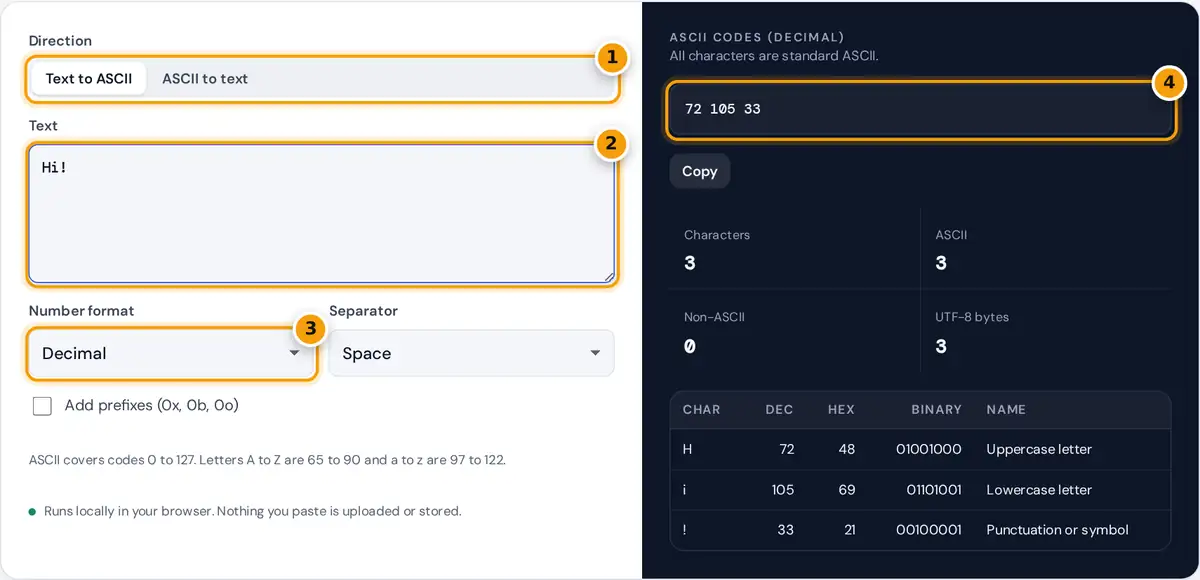
- Choose text to ASCII or ASCII to text.
- Type text, or paste codes separated by spaces or commas.
- Pick decimal, hexadecimal, binary or octal.
- Read the codes or text, with a per-character table below.
Type or paste text in Text to ASCII mode and the codes appear instantly. Pick the number format: decimal, hexadecimal, binary (8 bits per character) or octal. Choose a separator, and tick Add prefixes if you want codes such as 0x48 for use in source code. The table under the output lists every character with its decimal, hex and binary codes and a name, so control characters such as tabs and line feeds are easy to spot.
Switch to ASCII to text to decode. Paste codes separated by spaces, commas or new lines. The converter also understands prefixed values such as 0x41, 0b01000001 and U+00E9, and splits an unbroken hex or binary string into 2 or 8 digit chunks automatically. Everything runs locally in your browser.
What ASCII Is
ASCII, the American Standard Code for Information Interchange, assigns numbers 0 to 127 to 128 characters: 33 control codes (0 to 31 and 127), the space, digits, upper and lowercase English letters and common punctuation. Because it uses 7 bits, every ASCII character fits in one byte. Unicode and UTF-8 keep the same numbers for these 128 characters, so ASCII text is also valid UTF-8.
‘A’ = 65 = 0x41 = 01000001
lowercase = uppercase + 32 (‘a’ = 97)
digit value = code − 48 (‘7’ = 55)
Worked Example
Convert Hello, World!. H is 72, e is 101, l is 108 twice, o is 111, the comma is 44, the space is 32, W is 87, o is 111, r is 114, l is 108, d is 100 and the exclamation mark is 33. In hex the same text is 48 65 6C 6C 6F 2C 20 57 6F 72 6C 64 21, and the first character in binary is 01001000. Decoding 84 101 115 116 gives Test.
ASCII Table of Printable Characters
| Dec | Hex | Char | Dec | Hex | Char | Dec | Hex | Char |
|---|---|---|---|---|---|---|---|---|
| 32 | 20 | space | 64 | 40 | @ | 96 | 60 | ` |
| 33 | 21 | ! | 65 | 41 | A | 97 | 61 | a |
| 34 | 22 | " | 66 | 42 | B | 98 | 62 | b |
| 35 | 23 | # | 67 | 43 | C | 99 | 63 | c |
| 36 | 24 | $ | 68 | 44 | D | 100 | 64 | d |
| 38 | 26 | & | 69 | 45 | E | 101 | 65 | e |
| 40 | 28 | ( | 72 | 48 | H | 104 | 68 | h |
| 44 | 2C | , | 76 | 4C | L | 108 | 6C | l |
| 46 | 2E | . | 79 | 4F | O | 111 | 6F | o |
| 48 | 30 | 0 | 87 | 57 | W | 114 | 72 | r |
| 57 | 39 | 9 | 90 | 5A | Z | 122 | 7A | z |
| 63 | 3F | ? | 95 | 5F | _ | 126 | 7E | ~ |
Control Characters
Codes 0 to 31 and 127 do not print a symbol. The ones you meet most are 9 (tab), 10 (line feed, the Unix new line), 13 (carriage return, used with 10 for Windows new lines as CR LF), 27 (escape, which starts terminal color codes) and 0 (null, which ends strings in C). The converter names each one in the table so hidden characters in copied text become visible.
Beyond ASCII
Characters such as é, € or emoji are not ASCII. The converter shows their Unicode code point instead, for example é is 233 (U+00E9) and € is 8364 (U+20AC), and highlights them in the table. In UTF-8 these take two to four bytes, which is why the stats show both a character count and a byte count. For details see the Unicode C0 Controls and Basic Latin chart, which matches ASCII exactly. To work with binary text specifically, try our Binary Translator.
ASCII in Programming
ASCII codes appear constantly in code. Escape sequences such as A in C, Python and JavaScript, or A in HTML, all mean the letter A. Converting a character to its code and back is how simple ciphers, checksums and case conversions work.
Sorting also follows ASCII order in many systems, which is why uppercase words often sort before lowercase ones.
Frequently asked questions
How do I convert text to ASCII?
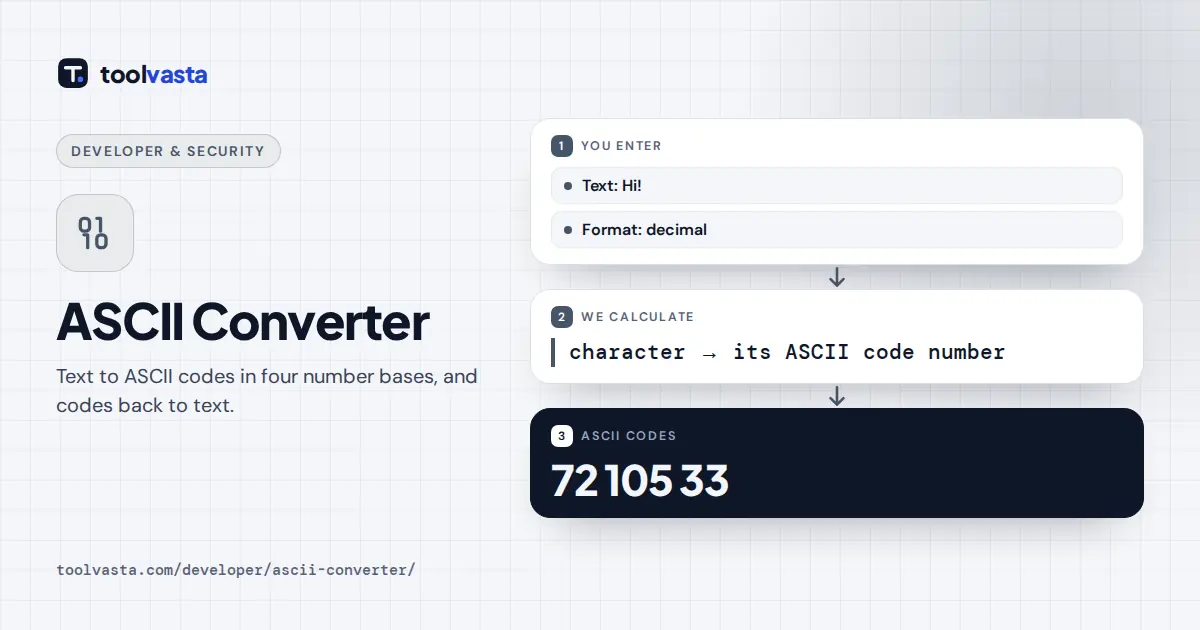
Type the text in Text to ASCII mode and choose a format. Each character is replaced by its number in the ASCII table, so Hi becomes 72 105 in decimal, 48 69 in hex or 01001000 01101001 in binary.
What is the ASCII code for A?
Uppercase A is 65 in decimal, 41 in hexadecimal and 01000001 in binary. Lowercase a is 97, exactly 32 higher, and the rest of the alphabet follows in order up to Z at 90 and z at 122.
How do I convert ASCII codes back to text?
Switch to ASCII to text, choose the number format and paste the codes separated by spaces, commas or new lines. For example, 84 101 115 116 in decimal decodes to the word Test.
What is the difference between ASCII and Unicode?
ASCII defines 128 characters, numbered 0 to 127, mainly English letters, digits and symbols. Unicode defines over 150,000 characters for all writing systems and keeps the same numbers for the ASCII range.
Why are some characters marked as not ASCII?
Accented letters, currency signs like the euro, and emoji have codes above 127, so they are outside ASCII. The converter shows their Unicode code point and highlights them, so you can spot them in data that must be pure ASCII.
What is ASCII code 10?
Code 10 is the line feed, the character that starts a new line on Linux and macOS. Windows uses carriage return 13 followed by line feed 10. Neither prints a visible symbol.