How to Use the Life Path Number Calculator
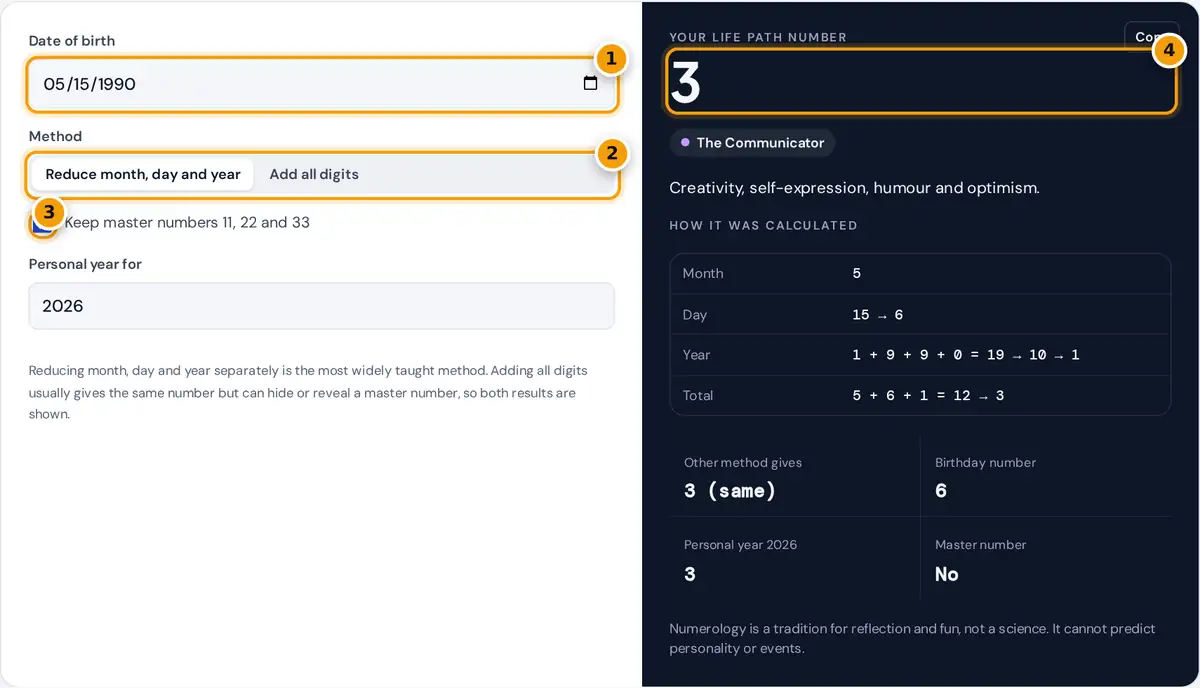
- Enter your date of birth.
- Choose the reduction method.
- Keep or reduce master numbers 11, 22 and 33.
- Read your life path number, its meaning and every calculation step.
Enter your date of birth. The calculator reduces the month, day and year to single digits, adds them and reduces the total, then shows your life path number with its traditional meaning. Every step of the arithmetic is listed so you can check it by hand. Leave the master number box ticked to keep 11, 22 and 33 instead of reducing them, which is the usual practice. The second method, adding all digits at once, is shown alongside, and the personal year box gives the numerology theme for any year you choose.
How the Life Path Number Is Calculated
Numerology reduces numbers by adding their digits until one digit remains, a process sometimes called the digital root. The standard life path method reduces each part of the birth date first:
day → single digit (or 11, 22)
year → add its digits, then reduce
life path = reduce(month + day + year), keeping 11, 22 and 33
Some numerologists add all eight digits of the date in one go instead. Both methods give the same single digit, because digit sums keep the same remainder when divided by 9. They can differ on master numbers, which is why the calculator shows both.
Worked Examples
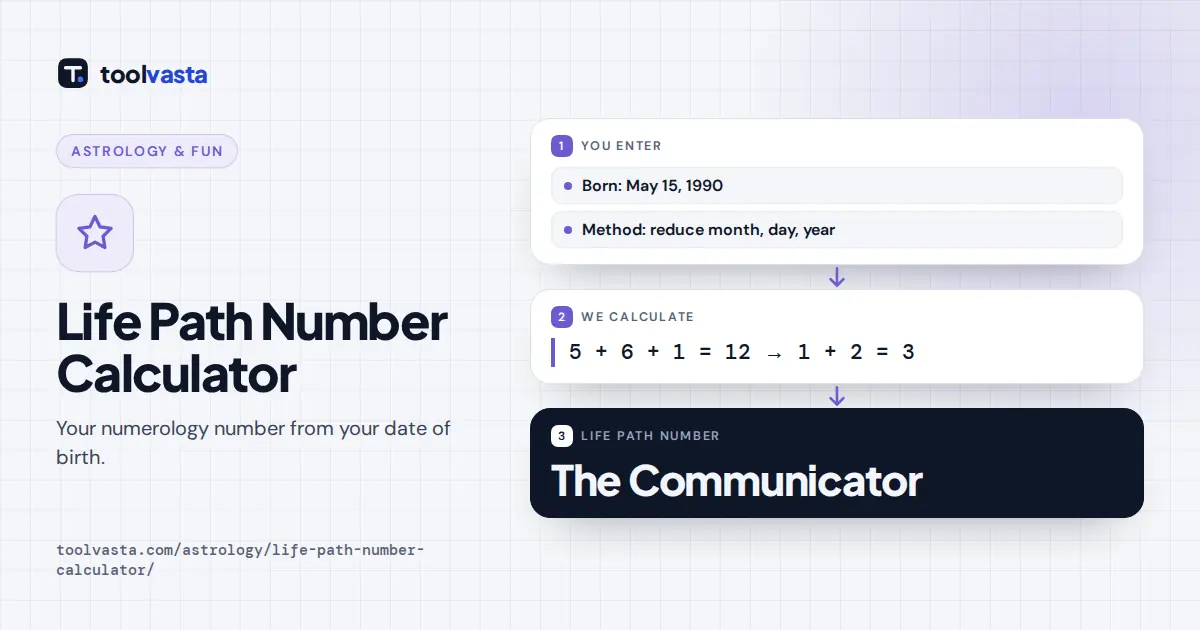
May 15, 1990. Month 5. Day 15 becomes 1 + 5 = 6. Year 1990 becomes 1 + 9 + 9 + 0 = 19, then 1 + 9 = 10, then 1. The total is 5 + 6 + 1 = 12, which reduces to 3. Adding all digits, 0 + 5 + 1 + 5 + 1 + 9 + 9 + 0 = 30, also gives 3.
December 25, 1990. Month 12 becomes 3, day 25 becomes 7 and the year becomes 1. The total is 11, a master number. With master numbers switched off it would reduce to 2.
January 3, 1980. The parts give 1 + 3 + 9 = 13, which reduces to 4. Adding every digit gives 0 + 1 + 0 + 3 + 1 + 9 + 8 + 0 = 22, a master number. This is a case where the two methods disagree, so the result depends on the tradition you follow. We checked these examples with a separate script.
Life Path Number Meanings
| Number | Traditional name | Themes |
|---|---|---|
| 1 | The Leader | Independence, initiative and the drive to go first. |
| 2 | The Peacemaker | Cooperation, diplomacy, patience and sensitivity to others. |
| 3 | The Communicator | Creativity, self-expression, humour and optimism. |
| 4 | The Builder | Stability, hard work, order and practical skill. |
| 5 | The Adventurer | Freedom, change, travel and curiosity. |
| 6 | The Nurturer | Responsibility, care, family and a sense of duty. |
| 7 | The Seeker | Analysis, study, introspection and spiritual questions. |
| 8 | The Achiever | Ambition, authority, business sense and material success. |
| 9 | The Humanitarian | Compassion, generosity, idealism and service. |
| 11 | The Intuitive (master number) | Inspiration, insight and heightened sensitivity, with the traits of 2. |
| 22 | The Master Builder (master number) | Large-scale vision turned into practical results, with the traits of 4. |
| 33 | The Master Teacher (master number) | Compassion and guidance on a wide scale, with the traits of 6. |
These descriptions summarise how numerology books traditionally describe each number. They are meant as prompts for reflection, not as facts about you.
Master Numbers 11, 22 and 33
Numerologists treat 11, 22 and 33 as master numbers with a stronger version of the traits of 2, 4 and 6. They are kept when they appear as the final total, and in most modern practice also when the month or day reduces to them. Not every tradition includes 33. If you see a different number on another website, the most likely reason is a different rule for master numbers or a different reduction method.
Personal Year Number
Your personal year number is calculated the same way, but with the current year in place of your birth year. For a May 15 birthday in 2026: 5 + 6 + (2 + 0 + 2 + 6 = 10, then 1) = 12, which reduces to 3. In numerology, personal years run in nine-year cycles, from new beginnings in year 1 to completion in year 9.
A Note on Accuracy
The arithmetic here is exact, but numerology itself is a cultural and spiritual tradition rather than a science. Controlled studies have not found that numbers derived from birth dates predict personality, careers or relationships. Enjoy it as a game or a prompt for self-reflection.
Frequently asked questions
How do I calculate my life path number?
Reduce your birth month, day and year to single digits by adding their digits, add the three results together, then reduce the total to one digit. Keep 11, 22 or 33 if they appear, because they are master numbers.
What is my life path number if I was born on May 15, 1990?
It is 3. The month is 5, the day 15 reduces to 6, and the year 1990 reduces to 1. Adding 5, 6 and 1 gives 12, which reduces to 3.
What are master numbers in numerology?
They are 11, 22 and 33, which numerologists do not reduce to a single digit. They are said to carry a stronger form of the traits of 2, 4 and 6.
Why do some calculators give a different life path number?
They may add all digits at once instead of reducing the month, day and year first, or treat master numbers differently. This calculator shows both methods so you can compare.
Which life path number is the rarest?
33 is the rarest. Using the standard method for every birth date from 1940 to 2010, about 0.9% give 33 and 3% give 22. Numbers 2 and 4 are also less common, because many of their totals become 11 or 22.
Is numerology scientifically proven?
No. Numerology is a traditional practice with roots in ancient number mysticism. Scientific studies have not found that life path numbers predict personality or life events, so treat the results as entertainment.