How to read your birth chart
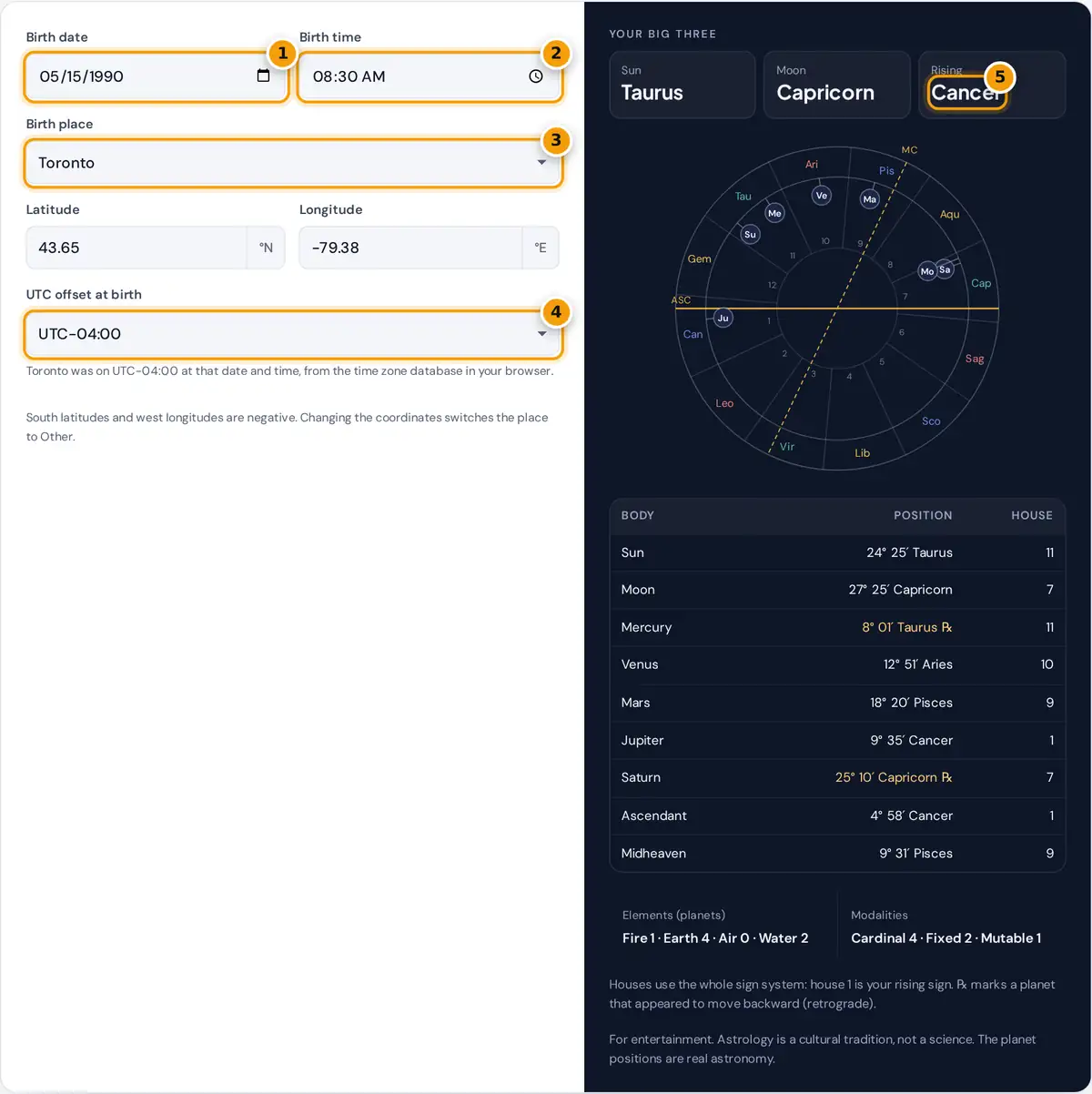
- Enter your date of birth.
- Enter your birth time as exactly as you can. It sets your rising sign and houses.
- Pick your birth city, or choose Other place and enter latitude and longitude.
- Check the UTC offset at birth. It fills in from the time zone database for your city.
- Read your big three, then each planet's sign, degree and house on the chart wheel.
- Enter your birth date and the exact time from your birth certificate.
- Pick your birth city. The coordinates and the UTC offset fill in automatically, including daylight saving time. If your city is missing, choose the nearest large city in the same time zone or pick Other place and type the coordinates.
- Read your big three at the top, then the chart wheel and the table of positions.
The wheel is drawn the traditional way, with your ascendant on the left at the nine o’clock position and the zodiac running counterclockwise. The gold line marks the horizon, the dashed line points to the midheaven, and the small numbers inside the ring are the houses.
What a birth chart shows
A birth chart, or natal chart, is a map of where the Sun, Moon and planets were along the zodiac at the moment and place you were born. Each body sits in a sign and a house. In astrological tradition the planets stand for parts of life, the signs describe style, and the houses describe areas such as home, work and relationships. These meanings are a cultural practice for reflection and entertainment and have no scientific support. The positions themselves are real astronomy.
| Body | Traditional theme | Time in each sign |
|---|---|---|
| Sun | Identity, vitality | About 1 month |
| Moon | Emotions, instincts | About 2.5 days |
| Mercury | Thinking, communication | 2 to 9 weeks |
| Venus | Love, values, pleasure | About 4 weeks, longer when retrograde |
| Mars | Drive, energy, conflict | About 6 weeks to 7 months |
| Jupiter | Growth, luck, belief | About 1 year |
| Saturn | Discipline, limits, time | About 2.5 years |
How the positions are calculated
The Sun uses the solar theory in chapter 25 of Jean Meeus, Astronomical Algorithms, and the Moon uses his full lunar theory from chapter 47. Mercury to Saturn use the approximate orbital elements published by E. M. Standish of NASA’s Jet Propulsion Laboratory (Keplerian Elements for Approximate Positions of the Major Planets, table 1 for 1800 to 2050). For each planet and for the Earth, the calculator solves Kepler’s equation, converts the orbit to ecliptic coordinates, subtracts the Earth’s position and corrects for light travel time, precession and nutation.
x′ = a(cos E − e), y′ = a√(1 − e2) sin E
geocentric λ = atan2(yplanet − yEarth, xplanet − xEarth) + 1.39697° × T + Δψ
We compared 300 random dates from 1800 to 2100 with the Swiss Ephemeris. The largest differences were 0.02° for Mercury and Venus, 0.07° for Mars, 0.14° for Jupiter and 0.36° for Saturn, far smaller than a sign. The ascendant and midheaven use the same sidereal time formulas as our rising sign calculator.
Worked example
For the pre-filled birth, May 15, 1990 at 08:30 in Toronto (UTC−04:00), the Sun is at 24°25′ Taurus, the Moon at 27°25′ Capricorn and the ascendant at 4°58′ Cancer. Mercury is at 8°01′ Taurus and retrograde, Venus at 12°51′ Aries, Mars at 18°20′ Pisces, Jupiter at 9°35′ Cancer and Saturn at 25°10′ Capricorn, also retrograde. The Swiss Ephemeris gives the same degrees and minutes to within 4 arcminutes. With Cancer rising, Jupiter falls in the first house, the Moon and Saturn in the seventh, Mars in the ninth, Venus in the tenth and the Sun and Mercury in the eleventh.
About houses
This chart uses whole sign houses, the oldest house system: the whole rising sign is the first house, the next sign the second, and so on. Many modern websites use Placidus houses, which divide the sky by time and can put a planet in a different house. Signs and degrees do not change between house systems.
Accuracy and limits
- Your birth time matters most. The rising sign moves about one degree every four minutes, and the Moon about half a degree an hour.
- Time zone history comes from your browser. For older births, confirm the UTC offset.
- Uranus, Neptune, Pluto, the lunar nodes and aspects are not shown.
- Above 66 degrees latitude houses become unreliable, so the tool does not calculate them there.
Frequently asked questions
How do I read my birth chart?
Start with your big three: the Sun, Moon and rising signs. Then look at which sign and house each planet occupies. The table lists every position with its degree.
Do I need my birth time for a birth chart?
For the rising sign and houses, yes. Without a time, the Sun and slow planets are still correct, but the Moon may be off by several degrees and the rising sign is unknown.
What house system does this birth chart use?
Whole sign houses, where each house is one full zodiac sign starting with your rising sign. Other sites often use Placidus, which can place planets in different houses.
What does the retrograde symbol mean?
It marks a planet that appeared to move backward through the zodiac at your birth, as seen from Earth. This is an optical effect of the planets' relative motion.
How accurate is this free birth chart?
Planet positions are within about 0.4 degrees of professional ephemerides for 1800 to 2100, and the Sun, Moon and ascendant are much closer than that. Birth time errors matter far more.