How to Use the Moon Sign Calculator
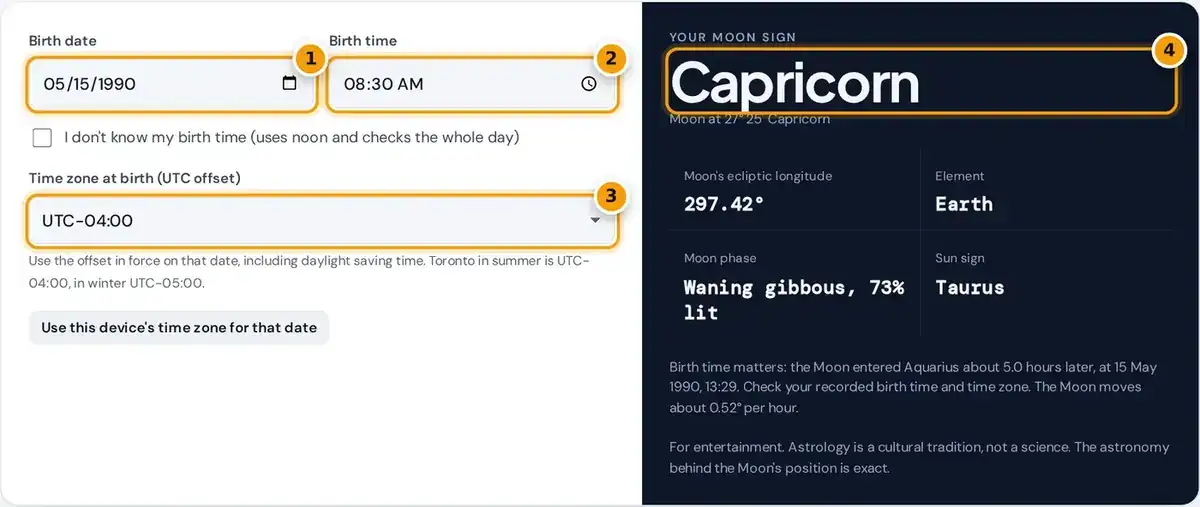
- Enter your birth date.
- Enter your birth time, or tick the box below if you do not know it.
- Choose the UTC offset in force where you were born, including daylight saving time.
- Read your Moon sign with its exact degree, element, Moon phase and any sign change that day.
Enter your birth date and the birth time printed on your birth certificate. The result then updates instantly and shows your Moon sign, the exact degree, the element, the Moon phase and your Sun sign.
Next, pick the UTC offset that applied where you were born on that date. Daylight saving time matters here: for example, a July birth in Toronto used UTC-04:00, while a January birth there used UTC-05:00.
The button under the time zone menu fills in your device's offset for that date. With an unknown birth time, simply tick the box and the calculator checks the whole day for a sign change.
What Is a Moon Sign?
In Western astrology, your Moon sign is the zodiac sign the Moon occupied at the moment you were born. It is one placement in your natal chart, alongside the Sun sign and the rising sign.
Astrologers traditionally link the Moon with emotional nature, instincts and what makes a person feel secure, while the Sun sign is usually tied to identity. Together with the rising sign, these form the Big Three.
These ideas belong to a long cultural tradition and are offered for reflection and entertainment. Astrology has no scientific support as a predictor of personality or events, even though the astronomy used here is precise.
Why Birth Time Matters
The Moon circles the zodiac in about 27.3 days, so it changes signs roughly every 2.5 days. That means on roughly two days in every five, it crosses from one sign into the next one.
If you were born near that moment, your cusp birth time decides the answer. The calculator warns you when the Moon entered or left its sign within 12 hours of your time, and says when.
Without a time, it uses noon and scans the day. It then tells you either that the Moon stayed in one sign all day, or that both signs are possible and when the switch happened.
How the Moon's Position Is Calculated
The Moon moves about 13 degrees a day, and the Sun disturbs its orbit, so an average position can be wrong by more than 6 degrees. A full lunar theory is needed for reliable signs.
T = (JDE − 2,451,545.0) ÷ 36,525
λ = L′ + Σl ÷ 1,000,000 + Δψ
sign = floor(λ ÷ 30), degree in sign = λ mod 30
This calculator follows chapter 47 of Jean Meeus, Astronomical Algorithms, which sums 60 periodic terms plus corrections for Venus, Jupiter and the Earth's flattening. Adding nutation then gives the apparent position as seen from Earth.
Your local time is converted to a Julian Day, then Delta T is added using the NASA polynomial expressions for Delta T. Dividing the final ecliptic longitude by 30 degrees then gives the zodiac sign.
Worked Example
Meeus tests his method with 12 April 1992 at 0h. The code gives an apparent longitude of about 133.17 degrees for that moment, which is 13°10′ Leo and matches the published textbook value very closely.
For the pre-filled birth, 15 May 1990 at 08:30 in UTC-04:00, the Moon sat at 297.42 degrees, or 27°25′ Capricorn. At that moment the Sun was in Taurus and the phase was a waning gibbous.
That position is under 3 degrees from Aquarius, so the calculator warns that the Moon entered Aquarius at 13:30 local time. Every example on this page was checked against the Swiss Ephemeris within 0.002 degrees.
Moon Signs and Their Elements
The twelve signs fall into four elements of three signs each. The calculator shows the element with your result, because astrologers often read the element as a quick, simple summary of the Moon's traditional mood.
| Element | Signs | Traditional theme |
|---|---|---|
| Fire | Aries, Leo, Sagittarius | Spontaneous, warm, expressive |
| Earth | Taurus, Virgo, Capricorn | Steady, practical, grounded |
| Air | Gemini, Libra, Aquarius | Curious, talkative, detached |
| Water | Cancer, Scorpio, Pisces | Sensitive, intuitive, private |
Fire signs are described as spontaneous and warm, and earth signs as steady and practical. Air signs are linked with curiosity and conversation, while water signs such as Cancer and Pisces are usually called sensitive.
These themes are traditional descriptions, not measurements. Two people with the same Moon sign can be very different, so treat the table as a starting point for reflection rather than as a verdict on anyone.
Tropical and Sidereal Moon Signs
This calculator uses the tropical zodiac, which starts at the March equinox point and splits the Sun's apparent path into twelve equal signs of 30 degrees. Most Western astrology websites and books use this system.
Vedic astrology uses the sidereal zodiac, anchored to the stars. Its starting point currently sits about 24 degrees earlier, so a sidereal Moon sign, called the Rashi, is often one sign behind the tropical one.
Vedic astrologers also divide the Moon's path into 27 Nakshatra segments. This tool does not calculate the Rashi or Nakshatra, so a different answer on a Vedic site usually reflects the zodiac, not an error.
Accuracy and Limits
The Moon's position is accurate to roughly 0.01 degree for years 1800 to 2200, which is far finer than anyone needs to find a sign. The Moon itself moves about half a degree every hour.
The biggest source of error is usually your birth data. Historical time zones changed often, and some places used local mean time or unusual daylight saving rules, so check the offset for older births carefully.
The Moon phase is shown for interest and comes from the angle between the Sun and Moon. The same angle drives the monthly lunar cycle described by NASA, from one new Moon to the next.
Frequently asked questions
How do I find my Moon sign?
Enter your birth date, birth time and the UTC offset for where you were born. The calculator works out the Moon's ecliptic longitude at that moment and shows the zodiac sign, degree, element and phase.
Can I find my Moon sign without a birth time?
Often, yes. Tick the unknown time box. If the Moon stayed in one sign all day, you get a definite answer. If it changed signs, the tool shows both possibilities and the time of the change.
How often does the Moon change signs?
About every two and a half days. The Moon travels through all twelve signs in roughly 27.3 days, so each sign holds it for a little over two days before it moves on.
How is the Moon sign different from the Sun sign?
The Sun sign depends mainly on your birthday and stays the same for about a month. The Moon sign changes every few days, so it needs the birth date plus, near a change, the birth time.
Why is my Moon sign different on another website?
Usually the time zone or daylight saving setting differs, or the other site uses the sidereal zodiac of Vedic astrology, where the Rashi often falls one sign behind the tropical Moon sign shown here.
Is astrology scientific?
No. Astrology is a cultural tradition enjoyed for reflection and fun, and studies have not found that signs predict personality or events. The Moon's position itself, however, is precise astronomy calculated from published formulas.