How to Use the Bhagyank Calculator
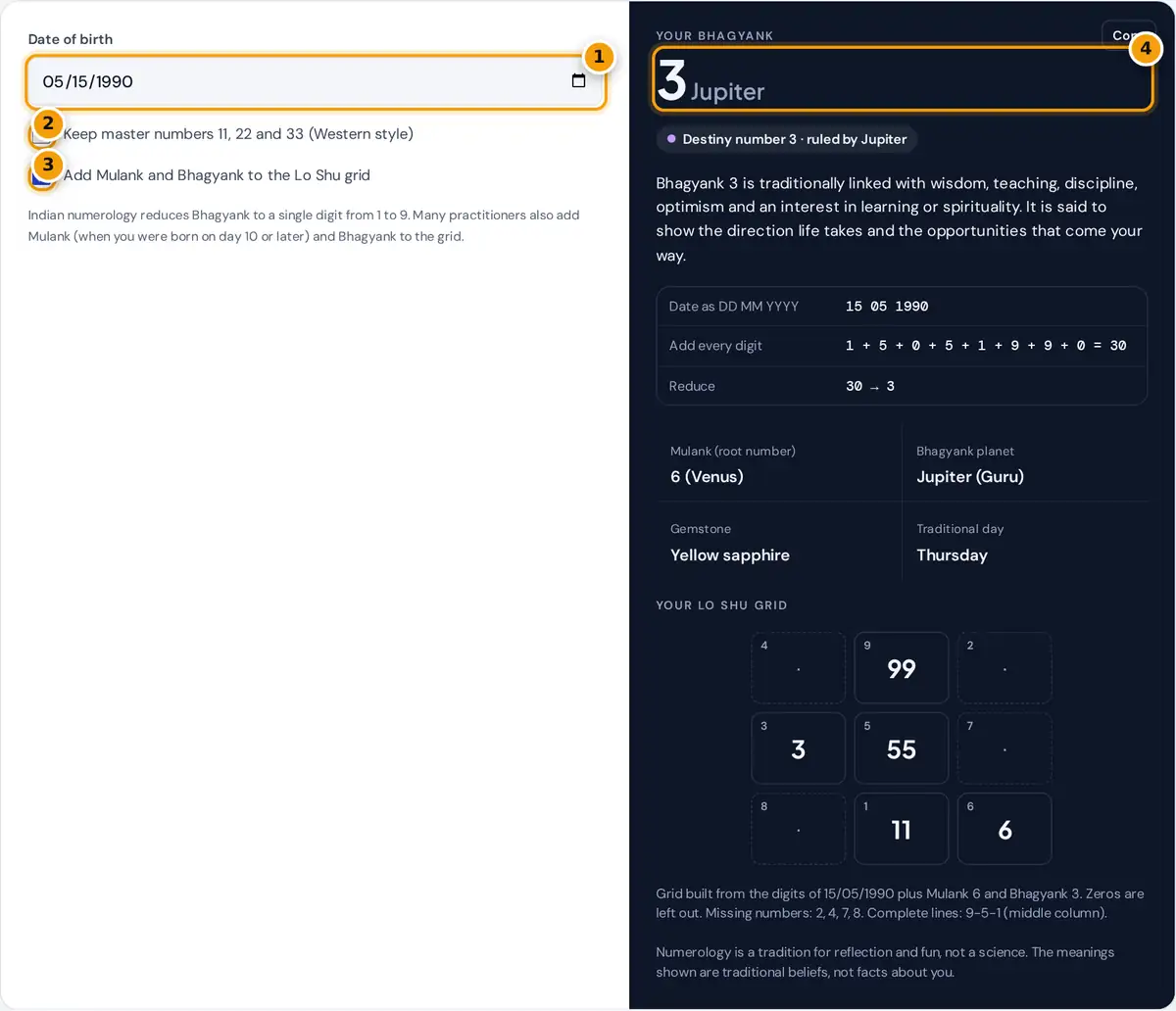
- Enter your date of birth.
- Tick to keep master numbers 11, 22 and 33 if you follow Western practice.
- Choose whether to add Mulank and Bhagyank to the Lo Shu grid.
- Read your Bhagyank, its planet and your Lo Shu grid.
Enter your date of birth. The calculator writes it as DD MM YYYY, adds every digit, reduces the total to a single digit and shows each step. You also get the planet that rules your Bhagyank, your Mulank (root number) and your Lo Shu grid, the 3 by 3 number square that Indian numerologists use alongside these numbers.
Two options change the method. Keep master numbers stops the reduction at 11, 22 or 33, as Western numerology does for the life path number. Indian numerology normally reduces to 1 to 9, so it is off by default. Add Mulank and Bhagyank to the Lo Shu grid follows the common practice of placing those numbers in the grid along with the birth date digits.
How Bhagyank Is Calculated
Bhagyank, also called the destiny number or conductor number, uses the whole date of birth. Every digit of the day, month and year is added, and the sum is reduced by adding its digits until one digit remains.
Mulank = reduce(DD)
reduce(n): add the digits of n until a single digit remains
Because digit sums keep the same remainder when divided by 9, you get the same Bhagyank whether you add all eight digits at once or reduce the day, month and year first. Only master numbers can differ between methods.
Worked Example
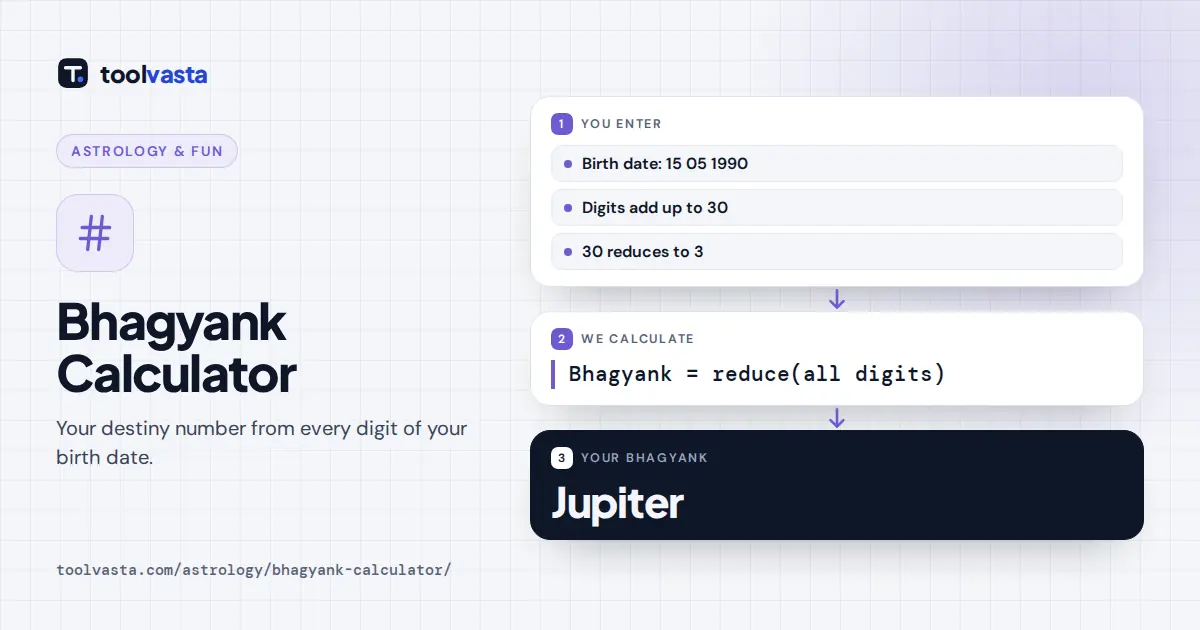
For May 15, 1990, written 15 05 1990, the digits add up to 1 + 5 + 0 + 5 + 1 + 9 + 9 + 0 = 30, and 3 + 0 = 3. The Bhagyank is 3, ruled by Jupiter. The Mulank is 1 + 5 = 6, ruled by Venus.
For the Lo Shu grid, the nonzero digits 1, 5, 5, 1, 9 and 9 go into their squares, then Mulank 6 and Bhagyank 3 are added. Numbers 2, 4, 7 and 8 are missing, and the middle column 9-5-1 is complete. For May 5, 1990 the digits add to 29, then 11, which is 2 in Indian numerology or the master number 11 if you keep master numbers. We checked these with a separate script.
The Lo Shu Grid
The Lo Shu square is an ancient Chinese magic square in which every row, column and diagonal adds up to 15. Indian numerologists place the digits of a birth date in it to see which numbers are strong, repeated or missing.
| Column 1 | Column 2 | Column 3 |
|---|---|---|
| 4 | 9 | 2 |
| 3 | 5 | 7 |
| 8 | 1 | 6 |
Zeros are left out because there is no square for them. A repeated digit is written once for each time it appears. Complete rows, columns and diagonals, called planes or arrows, are read as strengths, and missing numbers as qualities to develop. Interpretations of each plane vary between practitioners.
Bhagyank Meanings
| Bhagyank | Planet | Traditional themes |
|---|---|---|
| 1 | Sun | Leadership, independence, confidence and a wish to be in charge. |
| 2 | Moon | Sensitivity, imagination, cooperation and strong intuition. |
| 3 | Jupiter | Wisdom, teaching, discipline, optimism and an interest in learning or spirituality. |
| 4 | Rahu | Unconventional thinking, hard work, sudden turns and a streak of rebellion. |
| 5 | Mercury | Quick thinking, communication, business sense, travel and versatility. |
| 6 | Venus | Love, beauty, art, comfort and harmony at home. |
| 7 | Ketu | Introspection, research, intuition, spirituality and detachment. |
| 8 | Saturn | Discipline, patience, justice and results that come slowly but last. |
| 9 | Mars | Energy, courage, determination, protectiveness and a quick temper. |
A Note on Accuracy
The arithmetic is exact, but numerology is a cultural tradition, not a science, and the meanings are traditional beliefs rather than facts. Different schools treat master numbers, the Lo Shu grid and sunrise births differently, which is why other calculators may give slightly different results. Enjoy the reading as a prompt for reflection.
Frequently asked questions
How do I calculate my Bhagyank?
Add every digit of your date of birth and reduce the total to one digit. For 15 05 1990 the digits add to 30, and 3 + 0 = 3, so the Bhagyank is 3.
Is Bhagyank the same as the life path number?
They are closely related. Both reduce the full birth date. Western numerology keeps master numbers 11, 22 and 33 for the life path, while Indian numerology reduces Bhagyank to a single digit.
What is the Lo Shu grid?
It is a 3 by 3 magic square with the numbers 4 9 2, 3 5 7 and 8 1 6, where every line adds to 15. Numerologists place your birth date digits in it to find strong and missing numbers.
Why are Mulank and Bhagyank added to the Lo Shu grid?
Many Indian numerologists add them because they are considered key numbers of the chart. Mulank is usually added only for births on day 10 or later, since a single-digit day is already in the grid.
What does a missing number in the Lo Shu grid mean?
Numerologists read it as a quality you have less of naturally and may need to develop, for example patience or organization. These are traditional interpretations rather than proven facts.
Which planet rules my Bhagyank?
The same planets rule Bhagyank as Mulank: 1 Sun, 2 Moon, 3 Jupiter, 4 Rahu, 5 Mercury, 6 Venus, 7 Ketu, 8 Saturn and 9 Mars.